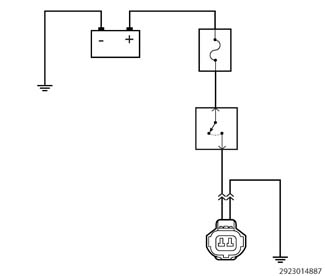
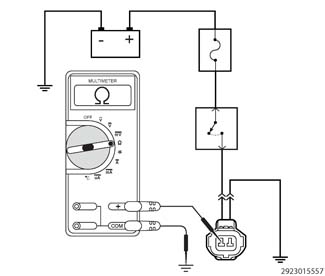
The purpose of the following procedure is to demonstrate how to
check a circuit for a Short to Ground.
NOTE:
The circuit shown
is an example, and is intended for demonstrational purpose only.
The following are circuit tests covered in this procedure:
Testing For A Short
To Ground Using An Ohmmeter
NOTE:
Perform the
following test using a known good multimeter.
Below is a list of possible causes that could be related to a Short
to Ground condition.
Possible Causes
SHORTED CIRCUIT (CHAFED, PIERCED OR PINCHED WIRES)
SHORTED IN-LINE CONNECTOR
(BENT, PUSHED OUT OR CORRODED TERMINALS)
TESTING FOR
A SHORT TO GROUND USING AN OHMMETER
NOTE:
Before measuring the
resistance of any circuit, first measure the resistance between the
two leads of the multimeter. Take this value and subtract it from
the value recorded when measuring the resistance of the circuit being
checked (The meter leads can add 0.5 ohm or more of total resistance).
1.
Turn the ignition
off.
2.
Disconnect the
wire harness connectors from the module and component for the suspected
circuit being shorted to ground.
NOTE:
Check connectors -
Clean/repair as necessary.
3.
With the component
wire harness connectors disconnected, use a meter set to measure Ohms
(Ω), and measure the resistance between the circuit and a known good
ground.
4.
Use the negative
lead of the meter and touch a known good ground.
5.
Use the positive
lead of the meter and carefully probe the circuit suspected of having
the short.
Is the
resistance to ground below 10k ohms ?
Yes
Repair the short to
ground. Use the wiring diagram as a guide to follow the path of the
circuit.
One method to help
isolate the short is to disconnect any in-line connectors that the
circuit being tested runs through and measure for the short again.
If the short goes away, the short is on the other side of the in-line
connector.
No
The circuit is not
shorted to ground or the condition that originally caused the short
may not be present at this time. Continue to measure the resistance,
wiggle the wire harness and connectors while checking for an intermittent
short.
Use the wiring diagram
as a guide to trace the circuits and look for any in-line connectors
where the short could occur intermittently.
Look for any chafed,
pierced, pinched, or partially broken wires.
Look for broken, bent,
pushed out or corroded terminals. Verify that there is good pin to
terminal contact in the related wire harness connectors.
Perform any Technical
Service Bulletins (TSBs) that may apply.