CHECK FOR EXCESSIVE CURRENT DRAW
Theory of Operation
What is current draw?
Current draw, or parasitic draw is an electrical load that draws current from the battery when the ignition is turned off. Some are considered normal, some above normal. Normal draw comes from various electronic devices connected to battery positive at all times. Many vehicle modules draw a few mA (milliamps) as a means to “Keep Alive Memory”. Whether it’s the clock in the radio or the last known position of the memory mirrors, these tiny amounts of current typically will only add up to 20 or 30 mA. The vehicle can sit parked for days, even a few weeks without any problems of excessive battery drain that might prevent starting. As long as the vehicle is driven periodically in order for the alternator to recharge the battery there is no problem. A problem may occur, in situations such as new vehicles in dealer stock or long term airport parking situations.
Below are some examples of modules and components that require keep alive memory:
What is excessive current draw?
Excessive current draw can be determined by an ammeter reading in excess of 50 mA. The typical “normal” current draw will not exceed 20 or 30 mA.
How to locate the problem?
Locating the problem involves a process of elimination. If the problem is not obvious, like the trunk light staying on, you will have to start troubleshooting:
- Start by removing one fuse at a time until you see the reading on the meter drop off (be careful to reinstall the fuses in their proper location).
- Once you’ve determined the high-draw circuit, there still may be a half-dozen loads, each individually drawing current from the battery.
- To zero in on that circuit or circuits, use the schematic diagram and disconnect each device on the circuit one-at-a-time and check the meter.
- When the milliamp reading drops off significantly, you’ve found the problem.
Perform the following test to determine where the cause of the draw is located.
Possible Causes |
|---|
| INSTALLED AFTERMARKET ACCESSORIES (AUDIO SYSTEMS, VEHICLE ALARMS, ETC.) |
| COURTESY LIGHTS REMAINING ON (INTERIOR, TRUNK, HOOD, ETC.) |
| BATTERY CHARGERS PLUGGED INTO THE CIGARETTE LIGHTER/POWER OUTLETS |
TESTING FOR PARASITIC DRAW
| NOTE: | For a more accurate current draw reading, wait 20 minutes to make sure all modules have powered down before continuing. Some modules may stay powered up longer than others. |
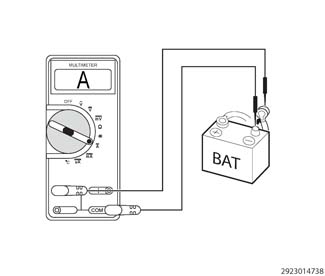 |
| 1. | Disconnect the Negative battery cable (ground). |
| 2. | Using a multimeter, set the multimeter leads up to properly measure Amperage. |
| 3. | Connect the ground lead that is plugged into the COM port of the multimeter to the Negative battery post/terminal. |
| 4. | Connect the other lead of the multimeter that is plugged into the Amp port of the multimeter to the Negative battery cable. |
Do not crank the engine or turn
on any accessories that may draw more than 10 Amps. You may open the
protective fuse in the multimeter.
CAUTION:
| 5. | While monitoring the amperage reading on the multimeter, begin to remove fuses (one at a time) from each fuse location on the vehicle and see if the amperage drops. |
| NOTE: |
| 6. | If the amperage does not drop, install the fuse you just removed and remove the next fuse. |
Does the amperage drop to between 0.02 to 0.04 of an Amp when removing any fuses?
Yes
- Use the wiring diagram as a guide to help indicate what components or modules are powered by the fuse.
-
At this point you can
install the fuse and begin disconnecting the components powered by
the fuse.
- When the amperage drops after disconnecting a component this will indicate which component is at fault.
- It is important to know how long some modules are designed to remain awake.
- You don't want to replace a component that is operating normally.
- The condition that originally caused the draw may not be present at this time.
No