SENSOR, Camshaft Position, 3.6L
DESCRIPTION
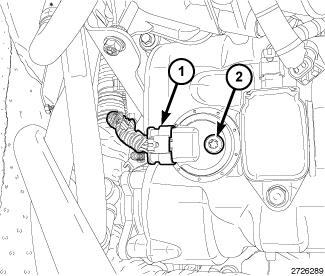 |
The two Camshaft Position (CMP) sensors are located at the rear of the cylinder head covers. The sensors are bolted to the cylinder head and utilize a radial lip seal where they protrude through the covers. The attaching bolt (2) has an O-ring seal and is captured in the sensor.
 |
The magnetic timing wheels must
not come in contact with magnets (pickup tools, trays, etc.) or any
other strong magnetic field. This will destroy the timing wheels ability
to correctly relay camshaft position to the camshaft position sensor.
CAUTION:
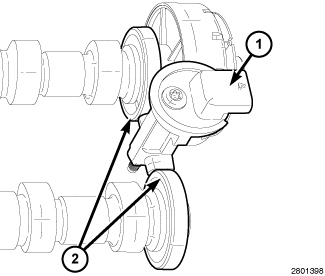
The Camshaft Position Sensors (CMP) sensors (1) are dual read, single element hall effect sensors mounted between the magnetic encoded timing wheels (2). The magnetic timing wheels are used because of their small diameter allowing for a compact cylinder head design.
OPERATION
 |
The magnetic timing wheels must
not come in contact with magnets (pickup tools, trays, etc.) or any
other strong magnetic field. This will destroy the timing wheels ability
to correctly relay camshaft position to the camshaft position sensor.
CAUTION:
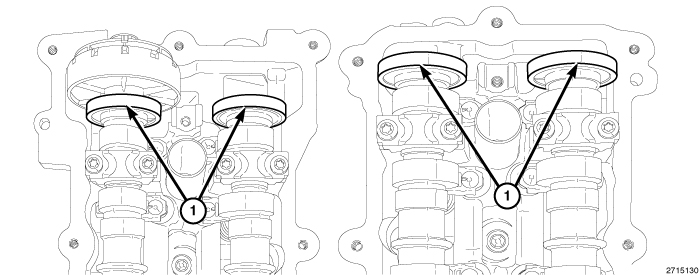
The 3.6 liter engine uses a Dual Over Head Camshaft (DOHC) configuration. The camshafts are a nodular cast iron design and have two pressed on magnetic timing wheels (1) that are magnetically encoded.
The Camshaft Position Sensors (CMP) are mounted between the timing wheels (1).
REMOVAL
|
The magnetic timing wheels (1)
must not come in contact with magnets (pickup tools, trays, etc.)
or any other strong magnetic field. This will destroy the timing wheels
ability to correctly relay camshaft position to the camshaft position
sensor.
CAUTION:
 |
The Camshaft Position (CMP) sensors are located at the rear of the cylinder head covers and are bolted to the cylinder head.
- Disconnect and isolate the negative battery cable.
-
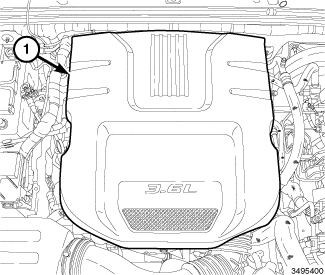
Remove the engine cover (1).
NOTE: The RH CMP sensor is shown, the LH CMP sensor is similar. If removing both RH and LH CMP sensors, mark the sensors so they can be installed in their original locations.
- Disconnect the electrical connector (1) from the CMP sensor.
-
Loosen the sensor mounting bolt (2).
- Pull the sensor and mounting bolt from the cylinder head cover.
-
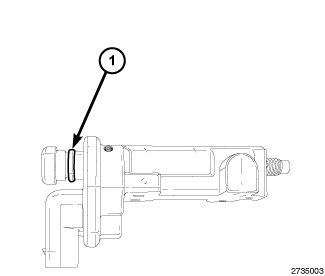
The O-ring seal (1) can be reused if not damaged.
INSTALLATION

|
The magnetic timing wheels (1)
must not come in contact with magnets (pickup tools, trays, etc.)
or any other strong magnetic field. This will destroy the timing wheels
ability to correctly relay camshaft position to the camshaft position
sensor.
CAUTION:
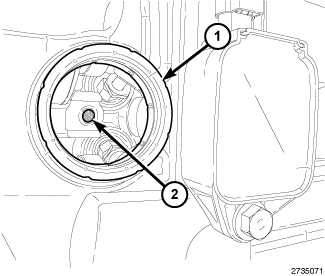 |
- Clean out the camshaft position (CMP) sensor mounting bolt hole (2) in cylinder head.
-
The CMP sensor seal (1) can be reused if not damaged.
-
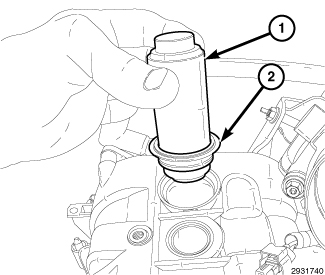
If required, install a new CMP sensor seal (2) in the cylinder head cover:
- Lubricate the CMP sensor seal inner and outer diameters with clean engine oil.
- Place the CMP sensor seal (2) on the Cam Sensor/Spark Plug Tube Seal Installer 10256 (1).
- Push the seal into the cylinder head cover until the base of the seal is seated.
-
Remove the tool.
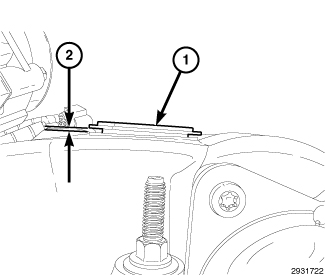
NOTE: A properly installed CMP sensor seal (1) will have a 1.5 - 2.0 mm (0.06 - 0.08 in.) gap (2) between the cylinder head cover and the seal upper flange.
- The sensor mounting bolt O-ring (1) can be reused if not damaged.
-
Apply a small amount of engine oil to the sensor mounting bolt O-ring (1).
NOTE: The RH CMP sensor is shown, the LH CMP sensor is similar. If both RH and LH CMP sensors where removed, install them into their original locations.
- Install the CMP sensor to the cylinder head. Tighten the mounting bolt (2) to 9 N·m (80 in. lbs.).
-
Connect the electrical connector (1) to the sensor.
- Connect the negative battery cable and tighten nut to 5 N·m (45 in. lbs.).
- Install the engine cover (1).
| NOTE: |
The Cam/Crank Variation Relearn procedure must be performed using the scan tool anytime there has been a repair/replacement made to a powertrain system, for example: flywheel, valvetrain, camshaft and/or crankshaft sensors or components. |