OUTLET, Power, 12 V
DESCRIPTION
INSTRUMENT PANEL MOUNTED
An instrument panel mounted cigar lighter/power outlet receptacle is optional equipment on this model. On models equipped with the optional Smoker's Package, the cigar lighter knob and heating element are included. On models without the Smoker's Package, the cigar lighter receptacle is equipped with a snap fit plastic cap and is treated as an auxiliary power outlet. The cigar lighter receptacle is installed in the instrument panel accessory switch bezel, which is located near the bottom of the instrument panel center stack area, below the radio. The cigar lighter base is secured by a snap fit within the center lower bezel. This power outlet is a ignition switched 12 volt battery feed.
The cigar lighter receptacle is serviced with the accessory switch bezel and if defective, the entire switch bezel must be replaced. The plastic cap and the knob and heating element unit are available for service replacement. These components cannot be repaired and, if faulty or damaged, they must be replaced.
FRONT CONSOLE AND REAR CARGO MOUNTED
A front console mounted power outlet is standard equipment and a rear cargo area power outlet is optional equipment on this model. The front console mounted power outlet is mounted inside the center console. This outlet can be used as a cigar lighter or power outlet, but only has 12 volt battery voltage when the ignition is in the ON or ACC positions. The rear power outlet is installed in the right rear quarter trim panel, near the spare tire jack. The power outlet base and mount are secured by a snap fit within the quarter trim panel. A plastic protective cap snaps into the power outlet base when the power outlet is not being used, and hangs from the power outlet base mount by an integral bail strap while the power outlet is in use. While the power outlet is very similar to a cigar lighter base unit, it does not include the two small spring-clip retainers inside the bottom of the receptacle shell that are used to secure the cigar lighter heating element to the insulated contact. It has 12 volt battery voltage when the ignition is in the ON or ACC positions.
OPERATION
CIGAR LIGHTER/POWER OUTLET
The cigar lighter consists of two major components: a knob and heating element unit, and the cigar lighter base or receptacle shell. The receptacle shell is connected to ground, and an insulated contact in the bottom of the shell is connected to battery current.
The cigar lighter knob and heating element are encased within a spring-loaded housing, which also features a sliding protective heat shield. When the knob and heating element are inserted in the receptacle shell, the heating element resistor coil is grounded through its housing to the receptacle shell. If the cigar lighter knob is pushed inward, the heat shield slides up toward the knob exposing the heating element, and the heating element extends from the housing toward the insulated contact in the bottom of the receptacle shell.
Two small spring-clip retainers are located on either side of the insulated contact inside the bottom of the receptacle shell. These clips engage and hold the heating element against the insulated contact long enough for the resistor coil to heat up. When the heating element is engaged with the contact, battery current can flow through the resistor coil to ground, causing the resistor coil to heat.
When the resistor coil becomes sufficiently heated, excess heat radiates from the heating element causing the spring-clips to expand. Once the spring-clips expand far enough to release the heating element, the spring-loaded housing forces the knob and heating element to pop back outward to their relaxed position. When the cigar lighter knob and element are pulled out of the receptacle shell, the protective heat shield slides downward on the housing so that the heating element is recessed and shielded around its circumference for safety.
POWER OUTLET
The power outlet base or receptacle shell is connected to ground, and an insulated contact in the bottom of the shell is connected to battery current. The power outlet receives battery voltage from a fuse in the Totally Integrated Power Module (TIPM) when the ignition is in the ON or ACC positions.
REMOVAL
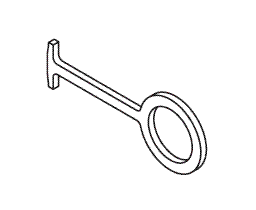
-
Disconnect and isolate the battery negative cable.
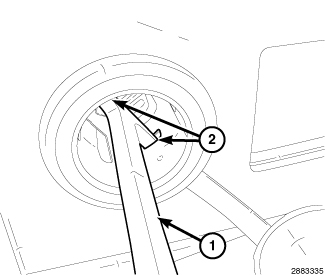
- Look inside and note position of the retaining bosses (2).
- Insert Remover, Power Outlet 10246 (1) into the retaining bosses (2) of the power outlet.
-
Pull out the base through the mounting ring by gently rocking the tool.
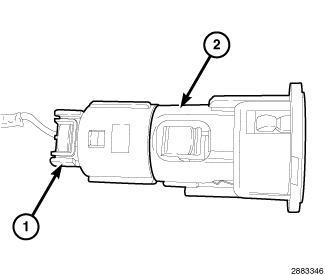
- Disconnect the harness (1) from the power outlet (2).
-
Set the base aside and remove the base mount ring.
INSTALLATION
|
- Connect the wire connector (1) to the power outlet receptacle (2).
- Install the power outlet mount into the panel.
- Align the splines on the outside of the power outlet receptacle base connector receptacle with the grooves on the inside of the mount.
- Press firmly on the power outlet receptacle base until the retaining bosses of the mount are fully engaged in their receptacles.
-
Connect the battery negative cable.