SENSOR, Evaporator Temperature
DESCRIPTION
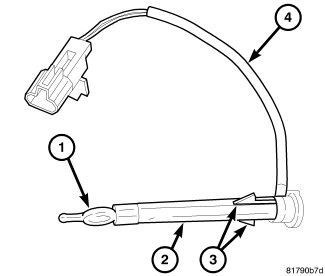 |
The evaporator temperature sensor measures the temperature of the conditioned air downstream of the A/C evaporator. The evaporator temperature sensor is an electrical thermistor (1) mounted on the end of a molded plastic housing (2) that is inserted into the driver side of the HVAC housing near the coldest point of the A/C evaporator. The evaporator temperature sensor is retained in the HVAC housing by two integral retaining tabs (3) and is connected to the vehicle electrical system by use of a wire lead and connector (4) with two terminals.
OPERATION
The evaporator temperature sensor monitors the temperature of the conditioned air downstream of the A/C evaporator and supplies an input signal to the A/C heater control. The A/C heater control uses the evaporator temperature sensor input signal to optimize A/C system performance and to protect the A/C system from evaporator freezing. The evaporator temperature sensor will change its internal resistance in response to the temperatures it monitors and is connected to the A/C heater control through sensor ground circuit and a 5 volt reference signal circuit. As the temperature of the A/C evaporator decreases, the internal resistance of the evaporator temperature sensor decreases.
The A/C heater control uses the monitored voltage reading as an indication of evaporator temperature. The A/C heater control is programmed to respond to this input by requesting the Powertrain Control Module (PCM) to cycle the A/C clutch as necessary to optimize A/C system performance and to protect the A/C system from evaporator freezing.
The evaporator temperature sensor is diagnosed using a scan tool (Refer to 28 - DTC-Based Diagnostics/HVAC - Diagnosis and Testing) .
The evaporator temperature sensor cannot be adjusted or repaired and must be replaced if inoperative or damaged.
REMOVAL
Disable the airbag system before
attempting any steering wheel, steering column or instrument panel
component diagnosis or service. Disconnect and isolate the negative
battery (ground) cable, then wait two minutes for the airbag system
capacitor to discharge before performing further diagnosis or service.
This is the only sure way to disable the airbag system. Failure to
follow these instructions may result in accidental airbag deployment
and possible serious or fatal injury.
WARNING:
 |
| NOTE: |
Illustration shown with air distribution housing removed for clarity. |
| NOTE: |
It is not necessary to remove and disassemble the HVAC housing to service the evaporator temperature sensor. The evaporator temperature sensor can be removed for service from underneath the instrument panel. |
- Disconnect and isolate the negative battery cable.
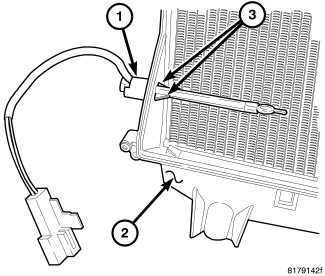
- Reach up under the driver side of the instrument panel and disconnect the electrical connector for the evaporator temperature sensor (1) from the instrument panel wire harness.
- Remove the evaporator temperature sensor electrical connector from the side of the HVAC housing (2).
- Using needle nose pliers, carefully pull the evaporator temperature sensor straight out of the side of the HVAC housing.
-
Route the electrical connector and wire lead of the evaporator temperature sensor out from under the heater core tubes and remove the sensor from the vehicle.
INSTALLATION
|
| NOTE: |
Illustration shown with air distribution housing removed for clarity. |
- Route the electrical connector and wire lead of the evaporator temperature sensor (1) under the heater core tubes located on the driver side of the HVAC housing (2).
- Install the evaporator temperature sensor into the driver side of the HVAC housing. Make sure the retaining tabs (3) are fully engaged to the housing.
- Connect the electrical connector for the evaporator temperature sensor to the instrument panel wire harness.
-
Reconnect the negative battery cable.