SENSOR, Crankshaft Position
DESCRIPTION
The Crankshaft Position (CKP) sensor is mounted into the right rear side of the cylinder block. It is positioned and bolted into a machined hole.
OPERATION
 |
| NOTE: |
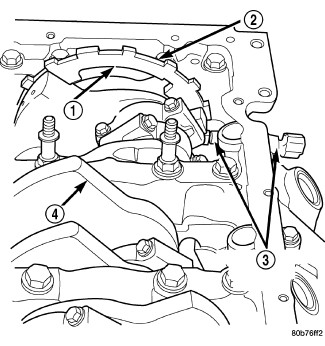
Typical tonewheel (1) and Crankshaft Position (CKP) sensor (3) shown. |
Engine speed and crankshaft position are provided through the Crankshaft Position (CKP) sensor. The sensor generates pulses that are the input sent to the Powertrain Control Module (PCM). The PCM interprets the sensor input to determine the crankshaft position. The PCM then uses this position, along with other inputs, to determine injector sequence and ignition timing.
The CKP sensor (3) is a hall effect device combined with an internal magnet. It is also sensitive to steel within a certain distance from it.
A tonewheel (targetwheel) (1) is bolted to the engine crankshaft. This tonewheel has sets of notches (2) at its outer edge.
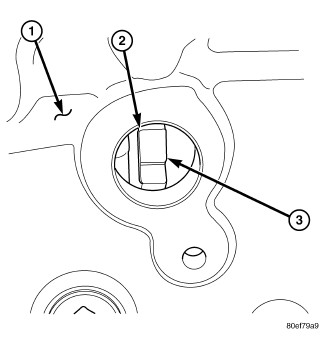 |
The notches (3) cause a pulse to be generated when they pass under the sensor. The pulses are the input to the PCM.
REMOVAL
 |
- Disconnect and isolate the negative battery cable.
- Raise and support the vehicle (Refer to 04 - Vehicle Quick Reference/Hoisting - Standard Procedure) .
-
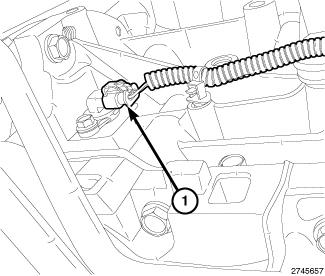
Disconnect the electrical connector (1) from the crankshaft position (CKP) sensor.
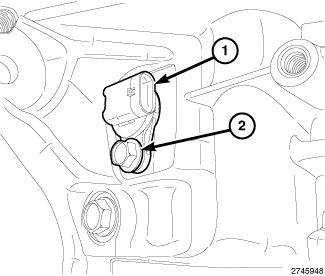
- Remove the sensor mounting bolt (2).
-
Carefully twist the sensor (1) from the cylinder block.
-
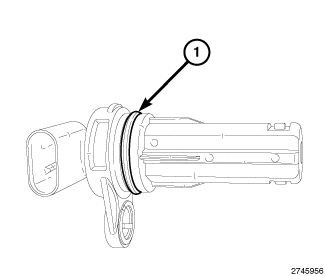
The CKP sensor O-ring (1) can be reused if not damaged.
INSTALLATION
|
- The crankshaft position (CKP) sensor O-ring (1) can be reused if not damaged.
-
Apply a small amount of engine oil to the sensor O-ring (1).
- Clean out the CKP sensor mounting bolt hole in the engine block.
-
Install the sensor (1) into the engine block with a slight rocking and twisting action.
CAUTION: Before tightening the CKP sensor mounting bolt, be sure the sensor is completely flush to the cylinder block. If the CKP sensor is not flush, damage to the sensor mounting tang may result.
-
Install the mounting bolt (2) and tighten to 12 N·m (106 in. lbs.).
- Connect the electrical connector (1) to the sensor.
- Lower the vehicle.
- Connect the negative battery cable and tighten nut to 5 N·m (45 in. lbs.).
| NOTE: |
The Cam/Crank Variation Relearn procedure must be performed using the scan tool anytime there has been a repair/replacement made to a powertrain system, for example: flywheel, valvetrain, camshaft and/or crankshaft sensors or components. |