PADS and/or SHOES, Brake
FRONT PADS
- Raise and support vehicle.
- Remove wheel and tire assembly.
-
Drain small amount of fluid from master cylinder brake reservoir with clean suction gun.
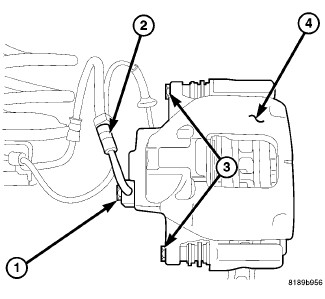
- Remove the 2 caliper mounting bolts (3).
- Compress the caliper (4) and remove from the adaptor.
-
Secure caliper (4) to nearby suspension part with wire. Do not allow brake hose to support caliper weight.
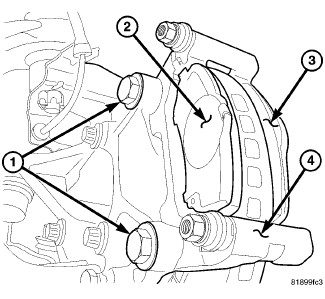
- Remove the inboard (2) and outboard brake pads (3) from the caliper adapter (4).
-
Remove the anti-rattle clips from the brake caliper adapter (4).
REAR DISC BRAKE PADS
 |
- Raise and support vehicle.
- Remove the wheel and tire assemblies.
- Compress the caliper.
-
Remove the caliper, (Refer to 05 - Brakes/Hydraulic/Mechanical/CALIPER, Disc Brake - Removal)
.
NOTE: Do not allow brake hose to support caliper assembly.
- Support and hang the caliper.
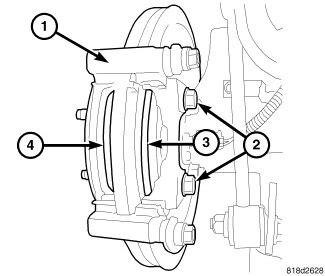
- Remove the inboard brake pad (3) from the caliper adapter (1).
-
Remove the outboard brake pad (4) from the caliper adapter (1).
INSPECTION
Visually inspect brake pads for uneven lining wear. Also inspect for excessive lining deterioration. Check the clearance between the tips of the wear indicators (if equipped) on the pads and the brake rotors.
If a visual inspection does not adequately determine the condition of the lining, a physical check will be necessary. To check the amount of lining wear, remove the disc brake pads from the vehicle.
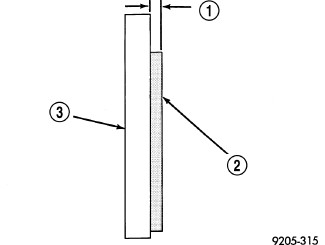 |
Measure brake pad minimum thickness (1). Brake pads must be replaced when usable material on a brake pad lining (2) measured at its thinnest point measures one millimeter (0.04 inches) or less.
If a brake pad fails inspection, replace both disc brake pads (inboard and outboard) at each caliper. It is also necessary to replace the pads on the opposite side of the vehicle as well as the pads failing inspection to maintain proper braking characteristics.
If the brake pad assemblies do not require replacement, be sure to reinstall the brake pads in the original position they were removed from.
| NOTE: |
It is important to inspect both front and rear brake pads during the same inspection. |
FRONT PADS
|
- Remove and clean all rust and debris from the anti-rattle clip mounting surfaces (3) on the brake caliper adapter (2).
- Install new anti-rattle clips into the caliper adapter (4).
-
Install the inboard (2) and outboard brake pads (3) onto the caliper adapter (4).
- Install caliper (4) on the caliper adapter.
- Install the caliper slide pin bolts (3) and tighten to 44 N·m (32 ft. lbs.).
- Install wheel and tire assembly.
- Remove support and lower vehicle.
- Pump brake pedal until caliper pistons and brake pads are seated and a firm brake pedal is obtained.
-
Fill brake fluid.
REAR DISC BRAKE PADS
|
- Bottom pistons in caliper bore with C-clamp. Place an old brake shoe between a C-clamp and caliper piston.
- Clean caliper mounting adapter and anti-rattle springs.
-
Install anti-rattle springs.
NOTE: Anti-rattle springs are not interchangeable.
- Install inboard brake pad (3) in adapter (1).
- Install outboard brake pad (4) in adapter (1).
- Install caliper, (Refer to 05 - Brakes/Hydraulic/Mechanical/CALIPER, Disc Brake - Installation) .
- Install wheel and tire assemblies and lower vehicle, (Refer to 22 - Tires and Wheels/Wheels - Standard Procedure) .
- Apply brakes several times to seat caliper pistons and brake pads to obtain firm pedal.
-
Top off master cylinder fluid level.