B1412/12
Diagnostic trouble codes
DESCRIPTION
The A/C ambient temperature sensor is installed in the front part of the condenser to detect the ambient temperature and control the heater and air conditioner "AUTO" function. The sensor connected to the hybrid vehicle control ECU detects fluctuation in the ambient temperature that is used for controlling the room temperature. The sensor sends a signal to the A/C amplifier assembly via the hybrid vehicle control ECU. The resistance of the A/C ambient temperature sensor changes in accordance with the ambient temperature. As the temperature decreases, the resistance increases. As the temperature increases, the resistance decreases.The hybrid vehicle control ECU applies voltage (5 V) to the A/C ambient temperature sensor and reads voltage changes as the resistance of the A/C ambient temperature sensor changes. The hybrid vehicle control ECU sends the read signal to the A/C amplifier via CAN and body multiplex communications.
| DTC No. |
DTC Detecting Condition |
Trouble Area |
| B1412/12 |
Open or short in ambient temperature sensor circuit |
|
WIRING DIAGRAM
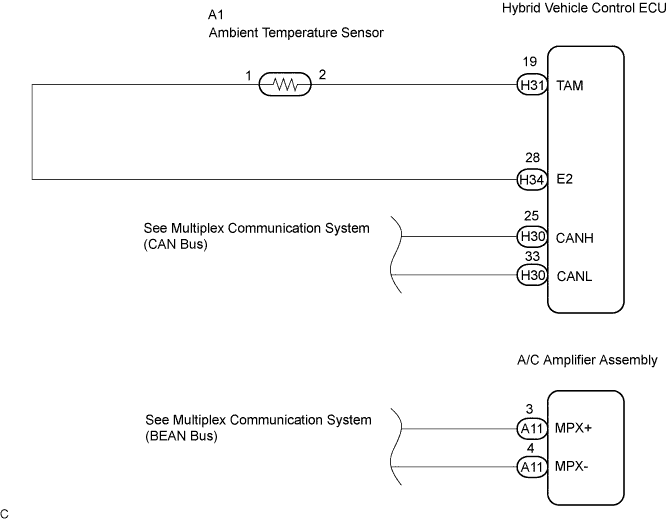

INSPECTION PROCEDURE
| 1. READ VALUE OF INTELLIGENT TESTER |

Connect the intelligent tester to the DLC3.
Turn the ignition switch ON and push the intelligent tester main switch on.
Select the item below in the DATA LIST, and read the display on the intelligent tester.
| Item |
Measurement Item/Display (Range) |
Normal Condition |
Diagnostic Note |
| AMBIENT TEMP SENS |
Ambient temperature sensor / min.: -23.3°C (-9.94°F) max.: 65.95°C (150.71°F) |
Actual ambient temperature is displayed |
Open in the circuit: -23.3°C (-9.94°F) Short in the circuit: 65.95°C (150.71°F) |
- OK:
- The display is as specified in the normal condition.
- Result:
Result
Proceed to
NG
A
OK (Checking from the PROBLEM SYMPTOMS TABLE)
B
OK (Checking from the DTC)
C
|
|
||||
|
|
||||

| A | |
 |
| 2. INSPECT HYBRID VEHICLE CONTROL ECU |
Remove the hybrid vehicle control ECU with the connectors still connected.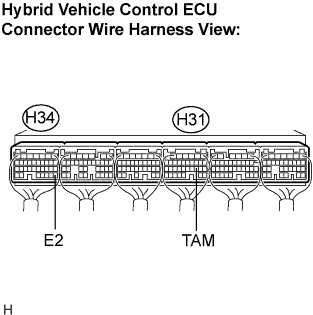
Measure the voltage according to the value(s) in the table below.
- Voltage:
Tester connection
(Symbols)
Condition
Specified condition
H31-19 (TAM) - H34-28 (E2)
Ignition switch ON
at 25°C (77°F)
1.7 to 2.1 V
H31-19 (TAM) - H34-28 (E2)
Ignition switch ON
at 40°C (104°F)
1.0 to 1.4 V
- HINT:
- As the temperature increases, the voltage decreases.
- Result:
Result
Proceed to
NG
A
OK (Checking from the PROBLEM SYMPTOMS TABLE)
B
OK (Checking from the DTC)
C
|
|
||||
|
|
||||
| A | |
|
| 3. INSPECT A/C AMBIENT TEMPERATURE SENSOR |
Remove the A/C ambient temperature sensor.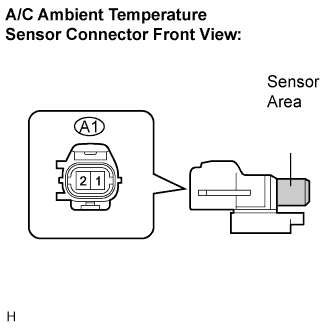
Disconnect the connector from the A/C ambient temperature sensor.
Measure the resistance according to the value(s) in the table below.
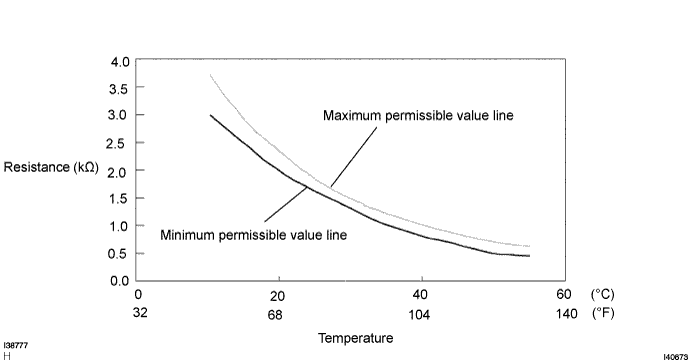
- Resistance:
Tester connection
Condition
Specified condition
A1-1 - A1-2
10°C (50°F)
3.00 to 3.73 kΩ
A1-1 - A1-2
15°C (59°F)
2.45 to 2.88 kΩ
A1-1 - A1-2
20°C (68°F)
1.95 to 2.30 kΩ
A1-1 - A1-2
25°C (77°F)
1.60 to 1.80 kΩ
A1-1 - A1-2
30°C (86°F)
1.28 to 1.47 kΩ
A1-1 - A1-2
35°C (95°F)
1.00 to 1.22 kΩ
A1-1 - A1-2
40°C (104°F)
0.80 to 1.00 kΩ
A1-1 - A1-2
45°C (113°F)
0.65 to 0.85 kΩ
A1-1 - A1-2
50°C (122°F)
0.50 to 0.70 kΩ
A1-1 - A1-2
55°C (131°F)
0.44 to 0.60 kΩ
A1-1 - A1-2
60°C (140°F)
0.36 to 0.50 kΩ
- NOTICE:
- Even slightly touching the sensor may change the resistance value. Be sure to hold the connector of the sensor.
- When measuring, the sensor temperature must be the same as the ambient temperature.
- Even slightly touching the sensor may change the resistance value. Be sure to hold the connector of the sensor.
- HINT:
- As the temperature increases, the resistance decreases (see the graph).
|
|
||||
| OK | |
|
| 4. CHECK HARNESS AND CONNECTOR (A/C AMBIENT TEMPERATURE SENSOR - HYBRID VEHICLE CONTROL ECU) |
Disconnect the connector from the hybrid vehicle control ECU.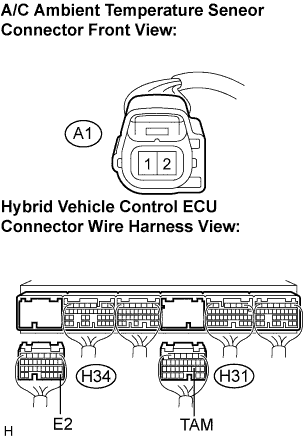
Measure the resistance according to the value(s) in the table below.
- Resistance:
Tester connection
Condition
Specified condition
H31-19 (TAM) - A1-2
Always
Below 1 Ω
H34-28 (E2) - A1-1
Always
Below 1 Ω
H31-19 (TAM) - Body ground
Always
10 kΩ or higher
H34-28 (E2) - Body ground
Always
10 kΩ or higher
|
|
||||
| OK | ||
 |
||
| ||