INSPECTION
Inspection
| INSPECT BACK DOOR LOCK ASSEMBLY (W/O POWER BACK DOOR SYSTEM) |

Check operation of the door lock.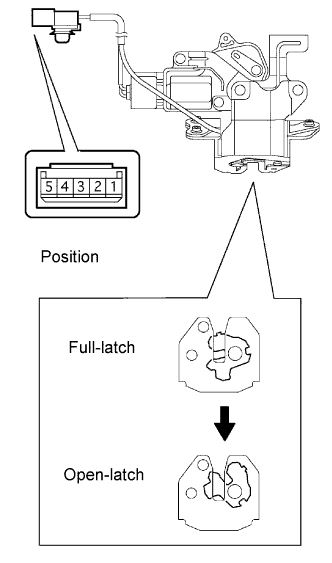

Using a screwdriver, push the latch in order to put the back door lock in the locked condition (full-latch position).
Apply battery voltage to the door lock and check operation of the latch.
- OK:
Measurement Condition
Specified Condition
Battery positive (+) → Terminal 5
Battery negative (-) → Terminal 3
Latch turns to open-latch position
- HINT:
- If the result is not as specified, replace the door lock assembly.
Measure the resistance of the back door courtesy switch.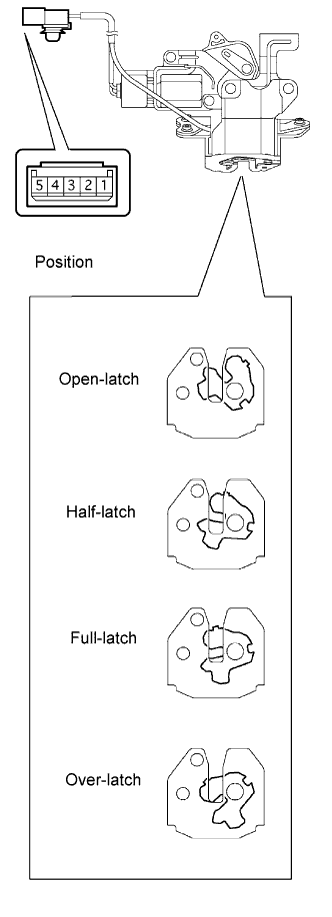
- Standard resistance (Courtesy switch):
Tester Connection
Door Lock Latch Position
Specified Condition
1 - 2
Open-latch
Below 1 Ω
1 - 2
Half-latch
Below 1 Ω
1 - 2
Full-latch
10 kΩ or higher
1 - 2
Over-latch
10 kΩ or higher
- HINT:
- If the result is not as specified, replace the door lock assembly.
| INSPECT BACK DOOR LOCK ASSEMBLY (W/ POWER BACK DOOR SYSTEM) |
Check operation of the door lock.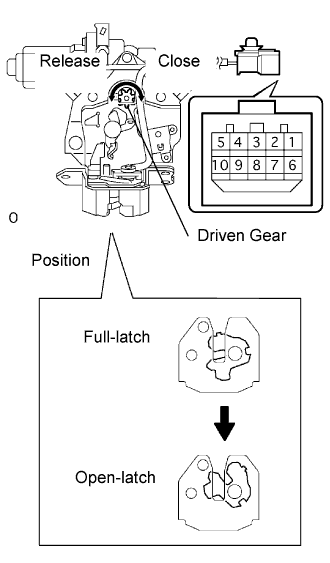
Using a screwdriver, push the latch in order to put the back door lock in the locked condition (full-latch position).
Apply battery voltage to the door lock and check operation of the latch.
- OK:
Measurement Condition
Specified Condition
Battery positive (+) → Terminal 5
Battery negative (-) → Terminal 7
Latch turns to open-latch position
- HINT:
- If the result is not as specified, replace the door lock assembly.
Apply battery voltage to the door lock motor and check operation of the motor.
- OK:
Measurement Condition
Specified Condition
Battery positive (+) → Terminal 5
Battery negative (-) → Terminal 7
Close operation (Full-latch)
Battery positive (+) → Terminal 7
Battery negative (-) → Terminal 5
Release operation (Open-latch)
- HINT:
- If the result is not as specified, replace the door lock assembly.
Measure the resistance of the back door courtesy switch.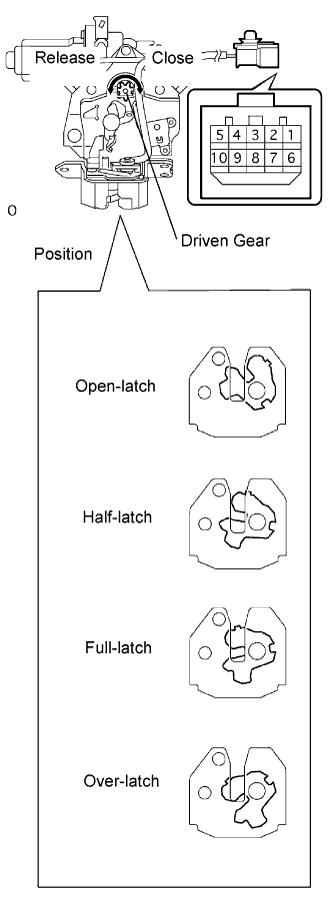
- Standard resistance (Courtesy switch):
Tester Connection
Door Lock Latch Position
Specified Condition
1 - 6
Open-latch
Below 1 Ω
1 - 6
Half-latch
Below 1 Ω
1 - 6
Full-latch
10 kΩ or higher
1 - 6
Over-latch
10 kΩ or higher
- HINT:
- If the result is not as specified, replace the door lock assembly.
Measure the resistance of the back door full-latch switch.
- Standard resistance (Full-latch switch):
Tester Connection
Door Lock Latch Position
Specified Condition
2 - 4
Open-latch
10 kΩ or higher
2 - 4
Half-latch
10 kΩ or higher
2 - 4
Full-latch
10 kΩ or higher
2 - 4
Over-latch
Below 1 Ω
- HINT:
- If the result is not as specified, replace the door lock assembly.
Measure the resistance of the back door half-latch switch.
- Standard resistance (Half-latch switch):
Tester Connection
Door Lock Latch Position
Specified Condition
3 - 4
Open-latch
Below 1 Ω
3 - 4
Half-latch
10 kΩ or higher
3 - 4
Full-latch
10 kΩ or higher
3 - 4
Over-latch
10 kΩ or higher
- HINT:
- If the result is not as specified, replace the door lock assembly.
Measure the resistance of the position switch.
Full-latch:
Connect the battery positive (+) lead to connector terminal 7 and the negative (-) lead to connector terminal 5.- Standard resistance:
Tester Connection
Driven Gear Position
Specified Condition
8 - 9
Release
Below 1 Ω
- HINT:
- If the result is not as specified, replace the door lock assembly.
Over-latch:
Connect the battery positive (+) lead to connector terminal 5 and the negative (-) lead to connector terminal 7.- Standard resistance:
Tester Connection
Driven Gear Position
Specified Condition
8 - 9
Close
10 kΩ or higher
- HINT:
- If the result is not as specified, replace the door lock assembly.