Previous Next

TESTING

1990–94 Vehicles
  1. Detach the camshaft position sensor connector.
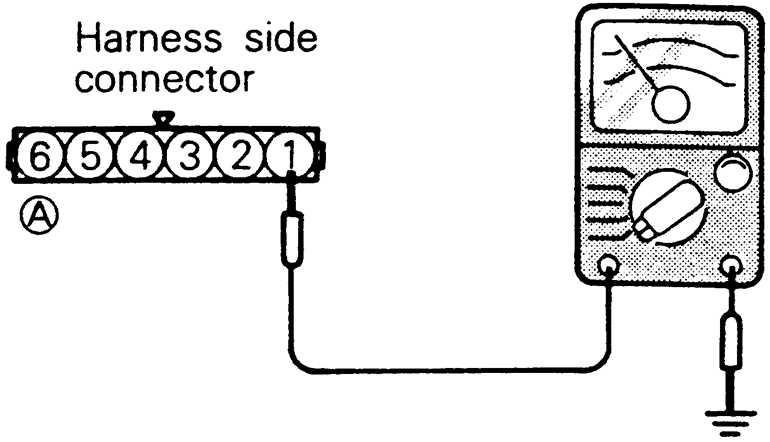
  2. Attach an ohmmeter to connector harness terminal No. 3 on the 1.8L engine or terminal 4 on the 2.0L engine and ground and check for continuity. If there is no continuity, replace the sensor.

    Fig. 1: Testing the camshaft position sensor harness for continuity — 1.8L engine

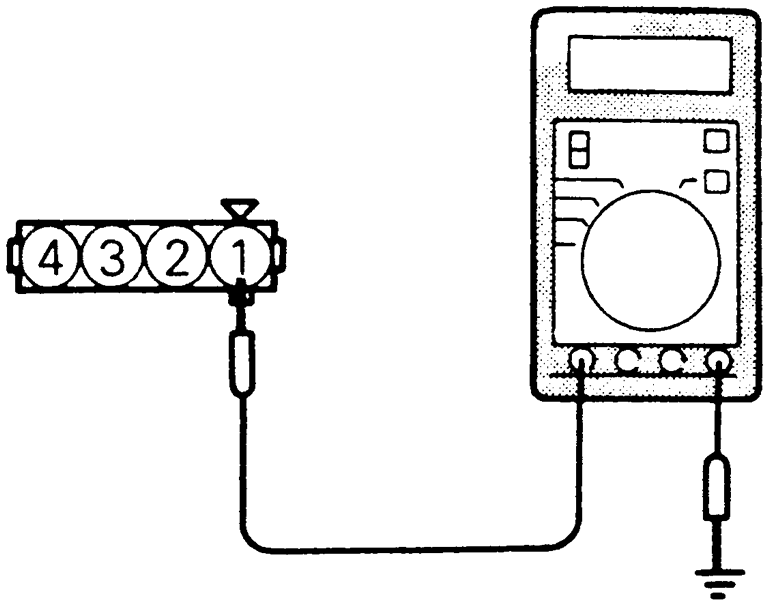
  3. Check the voltage at the harness with the connector detached, ignition ON and the ohmmeter connected to ground and the No. 4 harness terminal for the 1.8L engine or the No. 1 harness terminal for the 2.0L engine. The voltage reading should be 4.8–5.2 ohms. If not within specifications, replace the harness. If within specifications replace the sensor.

    Fig. 2: Check the camshaft position sensor harness for proper voltage — 2.0L engine

1995–98 Vehicles
2.0L NON-TURBO ENGINES
  1. Detach the sensor connector, then use an ohmmeter to measure at the harness side.
  2. With the ignition switch ON, measure the voltage between harness No. 1 and ground. It should be 8.5–9.5 volts.

    Fig. 3: Camshaft sensor terminal identification — 1995–98 2.0L non-turbo engine

  3. Check the voltage between terminal No. 3 and ground. It should be 4.8–5.2 volts.
  4. Check to see if there is continuity between the No. 2 terminal and ground. There should be continuity.
  5. If the voltage readings are correct, and there is continuity, replace the sensor. If not, repair or replace the harness, or the PCM may be faulty.
2.0L TURBO AND 2.4L ENGINES
  1. Attach the connector, use test harness MD998478 or equivalent.
  2. With the engine cranking, check the voltage between the No. 2 terminal and ground. It should be 0.4–3.0 volts.
  3. With the engine idling, check the voltage between the No 2 terminal and ground. It should be 0.5–2.0 volts.
  4. If these specifications are met, the PCM may be faulty.

    Fig. 4: Camshaft position sensor terminal identification — 2.0L turbo and 2.4L engines

  5. Detach the sensor connector and measure at the harness side. Attach an ohmmeter.
  6. With engine cranking, measure the voltage between terminal No. 2 and ground. It should be 0.4–3.0 volts.
  7. With the engine idling, measure the voltage between terminal No. 2 and ground. It should be 4.8–5.2 volts.
  8. Check to see if there is continuity between terminal No. 1 and ground, there should be continuity.
  9. If the voltage readings are correct, and there is continuity, replace the sensor. If not, repair or replace the harness, or the PCM may be faulty.

Previous Next