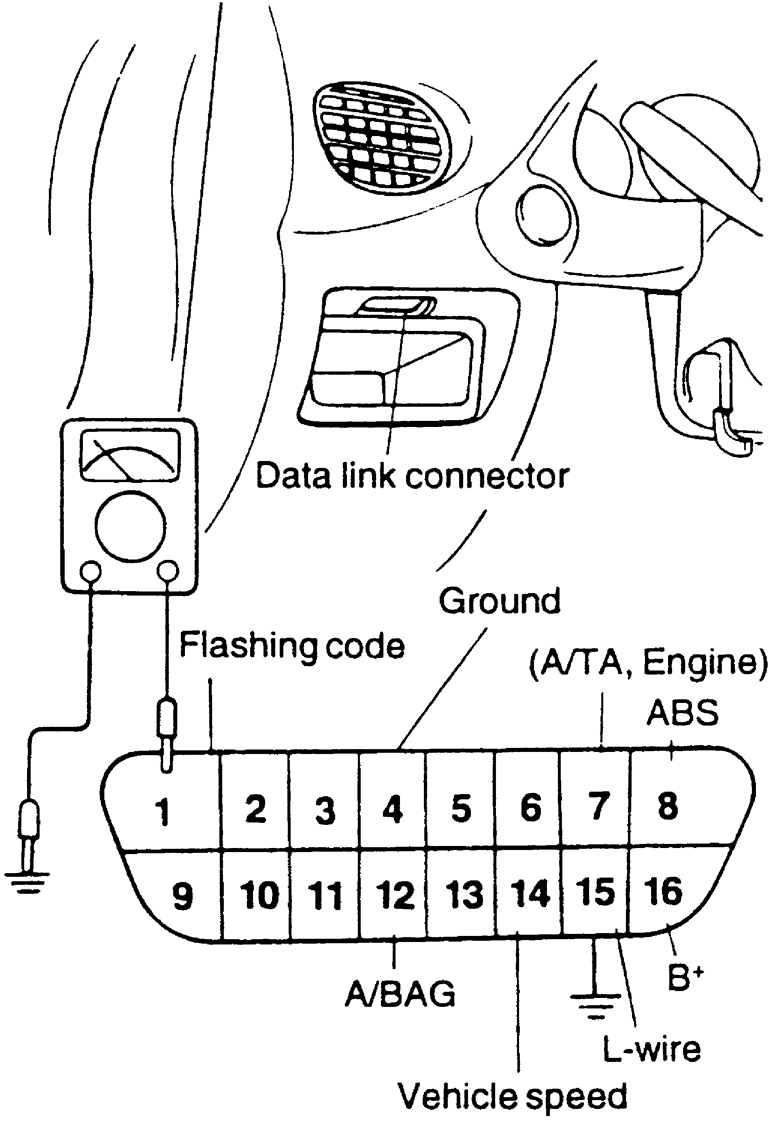
The Diagnostic Link Connector (DLC), under the left-hand side of the instrument panel, must be located to retrieve any DTC's.
In 1996, all Mitsubishi switched from an arbitrary code listing and format, to the federally regulated On Board Diagnostics 2nd Generation (OBD II) code system. Normally, OBD II equipped vehicles do not have the option of allowing the person servicing the vehicle to flash the codes out with a voltmeter; usually a scan tool is necessary to retrieve OBD II codes. Mitsubishi, however, does provide this option.
The Federal government decided that it was time to create a standard for vehicle diagnostic systems codes for ease of servicing and to insure that certain of the vehicle's systems were being monitored for emissions purposes. Since OBD II codes are standardized (they all contain one letter and four numbers), they are easy to decipher.
| Fig. 1: For OBD II code retrieval without using a scan
tool on Mitsubishi models, connect the DVOM and jumper wire as shown
|
The OBD II system in the Mitsubishi models is designed so that it will flash the DTC's out on a voltmeter (even though a scan tool is better). However, the first two characters of the code are not used. This is because the transaxle is a part of the powertrain, so all transaxle related codes will begin with a P. Also, since there are no overlapping numbers between SAE and Mitsubishi codes, the second digit is also not necessary.
The system flashes the codes out in a series of flashes in three groups, each group corresponding to one of the three last digits of the OBD II code. Therefore, Code P0753 would be flashed out in seven flashes, followed by five flashes, then by three flashes. Each group of flashes is separated by a brief pause. All of the flashes are of the same duration, with the only exception being zero. Zero is represented by a long flash. Therefore, seven flashes, one long flash, two flashes would indicate a P0702 code (shorted TP sensor circuit).
To retrieve the codes, perform the following: