Core plugs need replacement only if they are found to be leaking, are excessively
rusty, have popped due to freezing or, if the engine is being overhauled.
If the plugs are accessible with the engine in the truck, they can be removed
as-is. If not, the engine will have to be removed.
- If necessary, remove the engine and mount it on a work stand. If the engine
is being left in the truck, drain the engine coolant and engine oil
CAUTION
When draining the coolant, keep in mind that cats and dogs are attracted
by ethylene glycol antifreeze, and are quite likely to drink any that is
left in an uncovered container or in puddles on the ground. This will prove
fatal in sufficient quantity. Always drain the coolant into a sealable container.
Coolant should be reused unless it is contaminated or several years old.
- Remove anything blocking access to the plug or plugs to be replaced.
- Drill or center-punch a hole in the plug. For large plugs, drill a 1⁄2 in.
hole; for small plugs, drill a 1⁄4 in.
hole.
- For large plugs, using a slide-hammer, thread a machine screw adapter or
insert 2-jawed puller adapter into the hole in the plug. Pull the plug from
the block; for small plugs, pry the plug out with a pin punch.
- Thoroughly clean the opening in the block, using steel wool or emery paper
to polish the hole rim.
- Coat the outer diameter of the new plug with sealer and place it in the
hole.
| Fig. 1: Using a punch and hammer, the freeze plug
can be loosened in the block
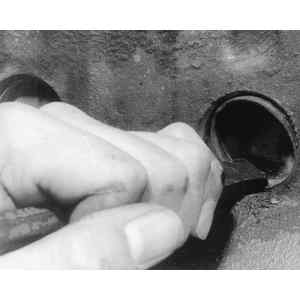
|
| Fig. 2: A freeze plug removed from the block
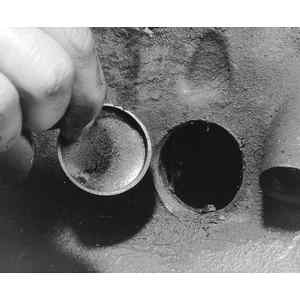
|
- For cup-type core plugs: these plugs are installed with the flanged end
outward. The maximum diameter of this type of plug is located at the outer
edge of the flange. Carefully and evenly, drive the new plug into place with
a large socket-shaped tool, which fits snugly into the freeze plug.
- For expansion-type plugs: these plugs are installed with the flanged end
inward. The maximum diameter of this type of plug is located at the base of
the flange. It is imperative that the correct type of installation tool is
used with this type of plug. Under no circumstances is this type of plug to
be driven in using a tool that contacts the crowned portion of the plug. Driving
in this plug incorrectly will cause the plug to expand prior to installation.
When installed, the trailing (maximum) diameter of the plug MUST be below
the chamfered edge of the bore to create an effective seal. If the core plug
replacing tool has a depth seating surface, do not seat the tool against a
non-machined (casting) surface.
- Install any removed parts and, if necessary, install the engine in the truck.
- Refill the cooling system and crankcase.
- Start the engine and check for leaks.

