If a clanging noise due to the lash adjuster produced immediately after the
engine has started or during operation persists, perform the following checks:
- Check the engine oil, and add or replace if necessary.
- If the engine oil is low, the air drawn in from the oil strainer will
be trapped in the oil passage.
- If the engine oil level is higher than the specified level, agitation
of oil by the crankshaft could cause a large amount of air to enter the
oil.
- A deteriorated oil contains a large amount of air, because the air,
once trapped, is not readily separated from the oil.
If the air trapped due to these causes enters the high pressure chamber
in the lash adjuster, the air in the high pressure chamber will be compressed
while the valve is in the opened position. The lash adjuster will be
drawn too far in, and will produce noise when the valve closes. This
is the same phenomenon that occurs when the valve clearance is adjusted
to an excessive dimension.
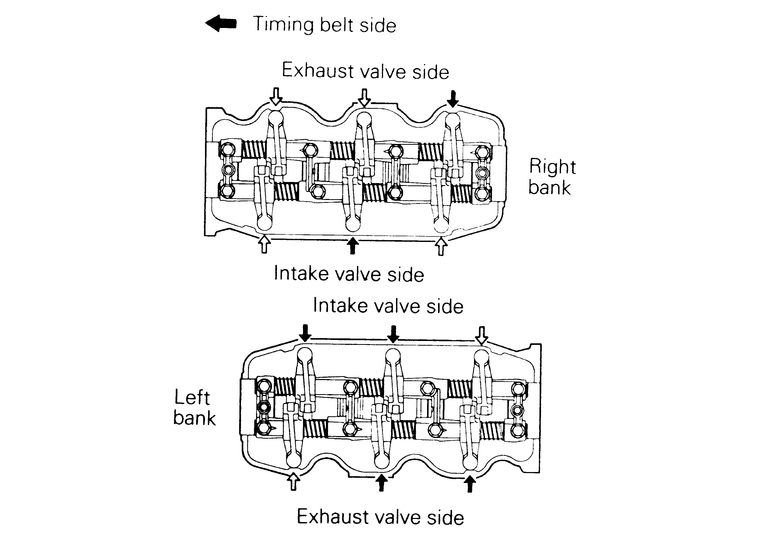
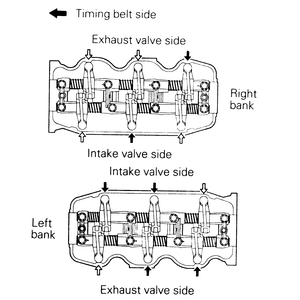
| Fig. 1: Check the valves with the white arrows,
rotate the crankshaft 360°, then check the valves with the
black arrows — 2.0L, 2.3L, 2.4L and 2.6L Engines
|
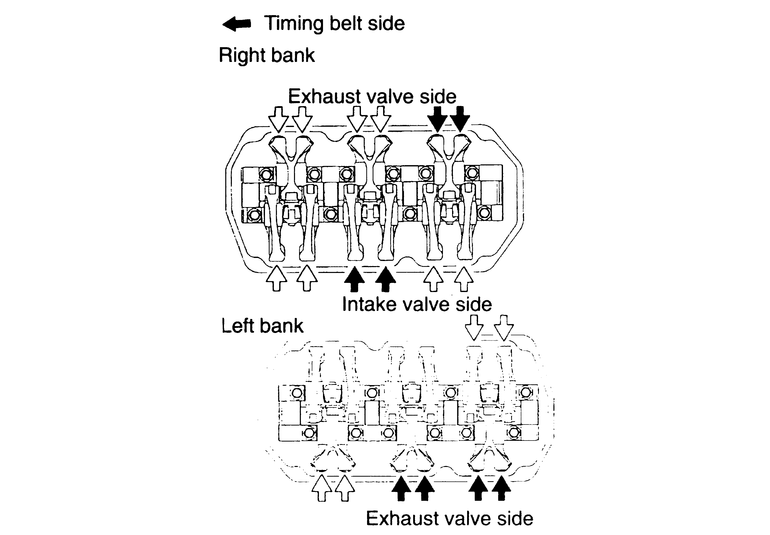
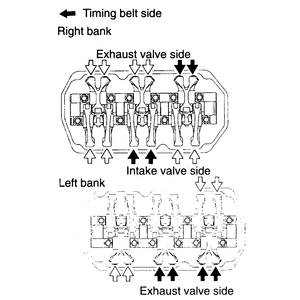
| Fig. 2: Check the valves with the white arrows,
rotate the crankshaft 360°, then check the valves with the
black arrows — 3.0L (12 Valve) Engines
|
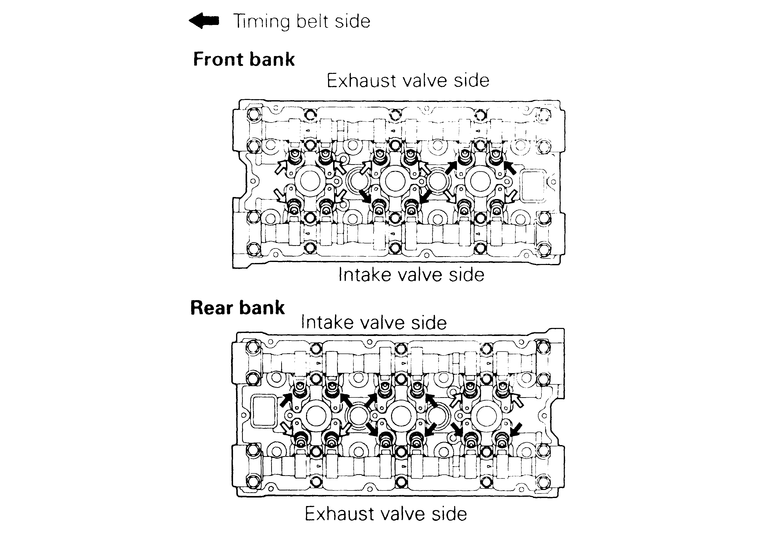
| Fig. 3: Check the valves with the white arrows,
rotate the crankshaft 360°, then check the valves with the
black arrows — 3.0L (24 Valve) Engines
|
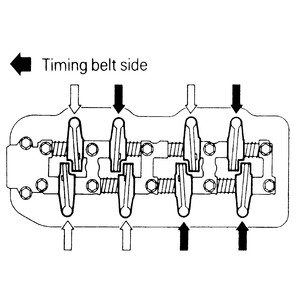
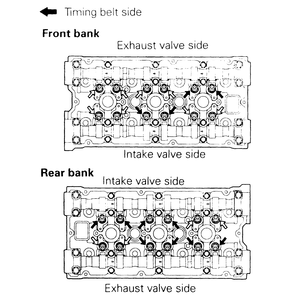
| Fig. 4: Check the valves with the white arrows,
rotate the crankshaft 360°, then check the valves with the
black arrows — 3.5L Engines
|
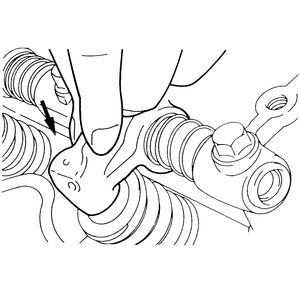
| Fig. 5: Push the rocker arm to check if the rocker
moves down or not — all engines except for the
3.5L Engines.
|
| Fig. 6: Push the rocker arm to check if the rocker
moves down or not — 3.5L Engines.
|
In this case, the normal condition will be restored if the air escapes
from the lash adjuster.
- Start the engine and slowly race (accelerate the engine from idling speed
to 3,000 rpm in 30 seconds and then decelerate it to the idling speed in 30
seconds) it several times (less than 10 times). If racing the engine causes
the noise to die away, it means that the air has escaped from the high pressure
chamber of the lash adjuster and that the lash adjuster has regained its normal
functions.
- When the vehicle is parked on a slope for a long period of time, the
oil in the lash adjuster will decrease. When the engine is started, the
air might enter the high pressure chamber.
- After a long period of parking during which the oil in the oil passage
goes away, it will take some time before the oil is re-supplied to the
lash adjuster. Therefore, the air could enter the high pressure chamber.
- If any abnormal noise is not eliminated by racing, check the lash adjuster.
- Stop the engine.
- Set the engine so that cylinder No. 1 is positioned at the top dead
center of the compression stroke.
- Press the rocker arm at the area indicated by the white arrow mark to
check whether the rocker arm is lowered or not.
- Slowly turn the crankshaft 360°clockwise.
- In the same procedure as step "c'', check the rocker arm at the area
indicated by the black arrow mark.
- Push down the rocker arm at a portion located right above the lash adjuster.
If the rocker arm goes down readily, the lash adjuster is defective. Replace
it with a new one in accordance with Step 4. In addition, when replacing
the lash adjuster, be sure to remove air positively from the lash adjuster
before installation. Then perform inspection in accordance with steps
"a'' through "e'' to make sure that there is no abnormality. In addition,
if the rocker arm is felt to be very stiff or cannot be pushed down when
it is pushed, the lash adjuster is in the normal condition. Therefore,
check for other causes of noise.
When cleaning or checking the lash adjusters, use only clean diesel fuel. To
test the lash adjusters, follow this procedure.
- Immerse the lash adjuster in clean diesel fuel.
- While lightly pushing down the inner steel ball using a small wire, move
the plunger up and down four or five times to bleed air. The use of the retainer
facilitates the air bleeding of the rocker arm mounted type lash adjuster.
- Remove the small wire and press the plunger in. If the plunger is hard to
be pushed in, the lash adjuster is normal. If the plunger can be pushed in
all the way readily, bleed the lash adjuster again and test again. If the
plunger is still loose, replace the lash adjuster.
NOTE: Upon completion of bleeding the air out of the lash
adjuster, hold the adjuster upright to avoid the diesel fuel from spilling.
- After air bleeding, set the lash adjuster on the special tool (leak down
tester MD998440).
- After the plunger has gone down somewhat 0.008–0.020 in. (0.2–0.5mm),
measure the time needed for it to go down an additional 0.04 in. (1mm). Replace
if the measured time is not between 4–20 seconds.