NOTE: The 1993–95, rear-wheel drive 2.4L (California)
Pick-ups have the same engine controls as the 3.0L engines. All other 2.4L engines
are listed as 2.4L engines.
- Unplug the TPS harness connector and link the two unplugged connector halves
using the test harness set (Mitsubishi special tool).
- Connect a voltmeter between terminal 2 and 4 of the TPS itself.
- Turn the ignition switch ON and wait for 15 seconds or
longer.
NOTE: When the ignition switch is turned ON,
the idle speed control plunger extends to the fast idle opening angle. After
15 seconds has passed, the plunger contracts and stops at the initial position,
which is the position corresponding to the idle position where the output
voltage of the idle speed control motor position sensor is 0.9 volts.
- Check that the output voltage of the TPS is 0.48–0.52 volts.
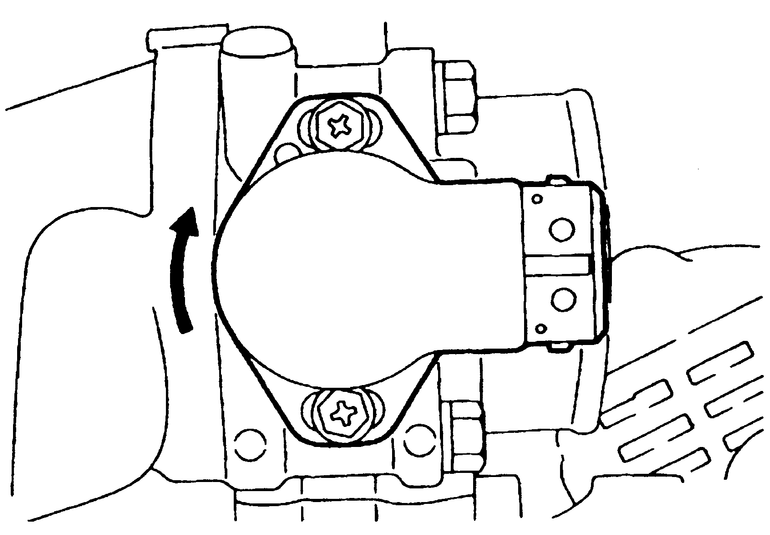
- If the voltage deviates from the standard value, loosen the TPS mounting
bolts and turn the TPS body to adjust. Tighten the bolts securely after the
adjustment.
NOTE: Turning the TPS body clockwise raises the output
voltage. When the TPS is adjusted, there may be an output of diagnostic
trouble code of idle speed control motor position sensor malfunction. This
occurs when the TPS output voltage is outside the range of normal voltage
at idling, and this is not a malfunction of the idle speed control motor
position sensor.
- Turn the ignition OFF.
- When the diagnostic trouble code is output during adjustment, erase the
diagnostic trouble code by using a scan tool or disconnect the negative cable
from the battery terminal for 10 seconds or more and then reconnect it. When
the negative battery cable has been removed and installed again, idle the
engine for approximately 15 minutes to warm it up. This will clear the memory
of all diagnostic trouble codes output during the TPS adjustment.
This procedure is also for the adjustment of the Closed Throttle Position (CTP)
switch.
- Unplug the connector.
- Use jumper wires to connect an ohmmeter between terminals 1 and 2 of the
sensor/switch itself (not the harness connector).
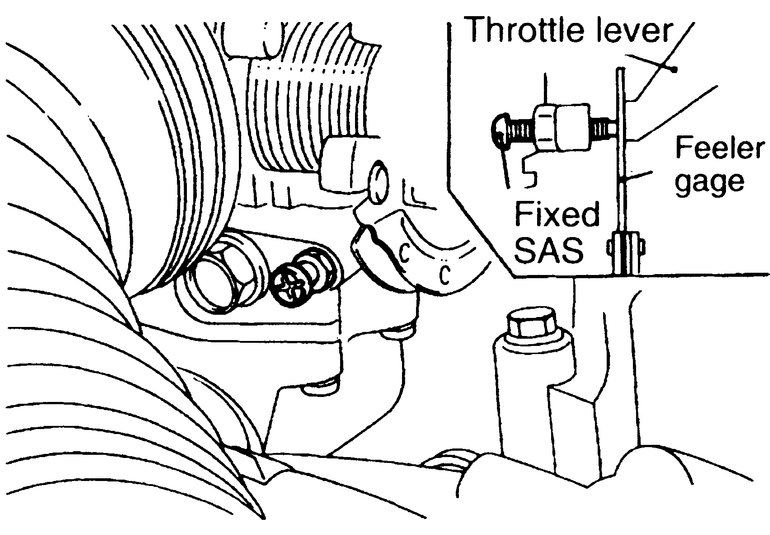
- Insert a feeler gauge with a thickness of 0.0256 in. (0.65mm) between the
fixed SAS and the throttle lever.
| Fig. 1: Insert a feeler gauge between the fixed SAS
and the throttle lever
|
| Fig. 2: After loosening the mounting bolts, the TPS
can be rotated until the correct resistance is reached
|
- Loosen the mounting bolts and turn the body fully clockwise.
- In this condition, check for continuity between terminals 1 and 2.
- Slowly turn the sensor/switch counter-clockwise until you find the point
where there is no continuity between terminals 1 and 2. Tighten the mounting
bolts to hold it in this position.
- Link the sensor/switch and the harness connector with the test harness set
(Mitsubishi tool MB991348).
- Connect a voltmeter between the sensor/switch terminal 3 and terminal 1.
- Turn the ignition ON, but do not start the engine.
- Check the TPS output voltage, which should be 400–1,000 mV.
- If the voltage is outside the standard value, check the TPS and associated
harness.
- Remove the feeler gauge.
- Turn the ignition switch to OFF.