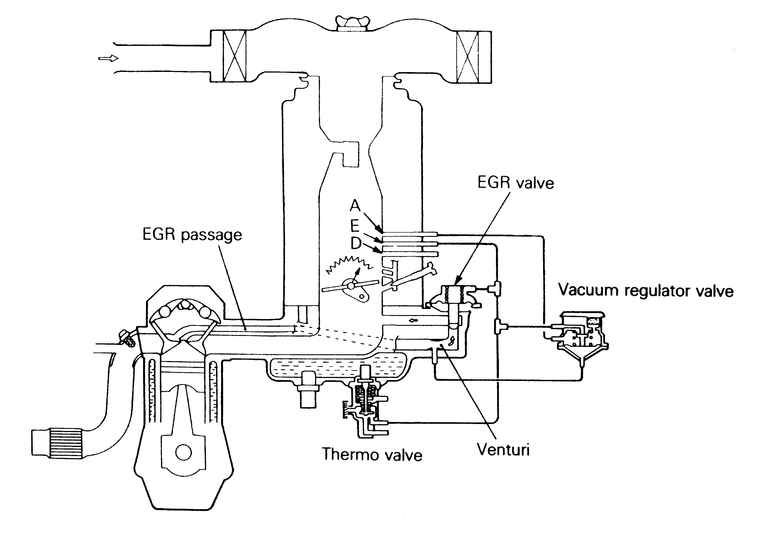
Exhaust Gas Recirculation (EGR) is used to reduce peak flame temperatures in the combustion chamber. A small amount of exhaust gas is diverted from the exhaust manifold and re–entered into the intake manifold, where it mixes with the air/fuel charge and enters the cylinder to be burned. Cooler combustion reduces the formation of Nitrogen Oxide (NO2) emissions.
The system consists of the EGR valve, controlling the flow of exhaust gas and various vacuum and/or electric controls to keep the EGR from working at the incorrect time.
No EGR is required when the engine is cold due to lower flame temperatures in the engine. EGR under these conditions would produce rough running so EGR function is cut off either by a thermo valve or by the ECM (which is monitoring coolant temperature.) Additionally, EGR flow is cut off at warm idle to eliminate any roughness or stumble on initial acceleration.
Cooler combustion temperatures also result in slightly reduced power output. This isn't felt during normal, part-throttle driving and the emission benefits outweigh the slight loss. However, in a wide-open throttle situation a power reduction is not desirable; full power could be the margin of success in a passing or accident avoidance situation. For this reason, EGR function is eliminated when the engine goes on wide–open throttle. Normally, the vacuum to the EGR valve can overcome the spring tension within the valve and hold it open. When the throttle opens fully, vacuum to the EGR is reduced and the spring closes the valve.
A common symptom of EGR malfunction is light engine ping at part throttle, particularly noticeable under load such as going uphill or carrying several passengers. An EGR valve which fails to close properly can also cause a rough or uneven idle. If the engine is correctly tuned and other common causes (vacuum leaks, bad plug wires, etc.) are eliminated, EGR function should be considered as a potential cause when troubleshooting a rough idle.
Since the majority of EGR components do not require routine maintenance and should not clog or corrode if unleaded gas is used, you should check all other reasonable causes of a problem before checking this system.
| Fig. 1: A diagram of a common EGR system — 2.0L
and 2.6L engines
|