NOTE: A vacuum pump capable of producing more than 10 in. Hg.
(33.8 kPa) of vacuum will be needed to perform this test.
- Allow the engine to cool overnight. Since the EGR system works differently
for warm and cold engines, a completely cold engine is required for testing.
- Disconnect the vacuum hose with the green stripe from either the throttle
body (fuel injected) or the base of the carburetor. Attach the end of the
hose to vacuum pump.
- Plug the port from which the hose was removed. Start the engine and attempt
to draw a vacuum with the hand pump. The system should NOT hold vacuum with
the engine cold and running at idle.
- Allow the engine to warm up to normal operating temperature. The coolant
must be 80–85°C (175–185°F) before testing. Using the
pump, draw a vacuum of 1.2–1.7 in. Hg (4–5.75 kPa). The carbureted
system will leak vacuum at warm idle.
- For carbureted engines, increase the engine speed to 3500 rpm. Slowly draw
vacuum with the hand pump and observe the vacuum gauge on the pump. The system
should leak vacuum until the pump reaches about 1.5 in. Hg, (5.75 kPa) at
which time the vacuum should be held.
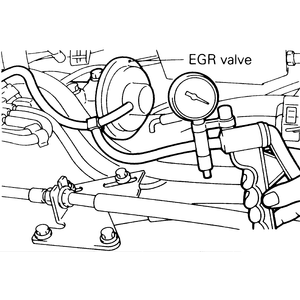
| Fig. 1: Check the EGR system vacuum by using a hand
vacuum pump and a "T'' connector
|
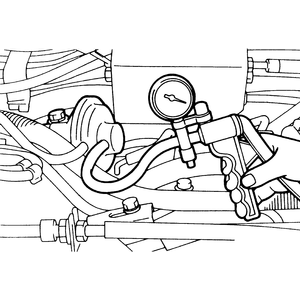
| Fig. 2: Disconnect the three-way terminal (the "T''),
and connect the hand vacuum pump to the EGR valve
|
- Allow the engine to cool overnight.
- Disconnect the vacuum hose with the green stripe from the EGR valve. Use
a "T'' connector to connect the hand vacuum pump into the system and connect
the hose back to the EGR.
- Start the engine and observe the vacuum gauge on the hand pump. Press the
accelerator suddenly to race the engine. On a cold engine, there should be
no change in the vacuum; normal (atmospheric) pressure is maintained.
- Allow the engine to warm up to normal operating temperature, generally 158–170°F
(68–77°C). Repeat the sudden rpm test while watching the gauge
on the pump. The vacuum should rise temporarily to about 3.9 in. Hg (13.2
kPa).
- Disconnect the "T'' from the system and connect the vacuum pump directly
to the EGR valve.
- Draw a vacuum of at least 9.4 in. Hg (31.75 kPa) for the 2.4L and the 3.0L
(12 valve) engines or 9.1 in. Hg (30.7 kPa) for the 3.0L (24 valve) and 3.5L
engines while the engine is at warm idle. The quality of the idle should change
noticeably, becoming rough or even stalling as the EGR valve opens. The exact
vacuum level at which this occurs varies by engine family.
Coolant temperature should be 185–203°F (85–95°C).
- Disconnect the vacuum hose from the throttle body EGR vacuum nipple and
connect a hand vacuum pump to the nipple.
- Start the engine and check to see that, after raising the engine speed by
racing the engine, vacuum raises proportionately with the rise in engine speed.
NOTE: If there is a problem with the change in vacuum,
it is possible that the throttle body port may be clogged and requires cleaning.
- Reconnect the vacuum hoses.
- Label and disconnect the hoses from the valve. Carefully loosen and remove
the retaining bolts, remembering that they are probably heat–seized
and rusty. Use penetrating oil freely.
- Remove the valve and clean the gasket remains from both mating surfaces.
- Inspect the valve for any sign of carbon deposits or other cause of binding
or sticking. The valve must close and seal properly; the pintle area may be
cleaned with solvent to remove soot and carbon.
- Attach the vacuum pump to the vacuum port on the EGR valve. If the valve
has two vacuum ports, pick one and plug the other.
- Perform the vacuum holding test. Refer to the following information and
draw the correct amount of vacuum, making sure it is held. If the correct
vacuum cannot be maintained, the valve is leaking internally.
- 2.0L and 2.6L engines: holds vacuum at 10 in. Hg (33.75 kPa), will not
pass air at 1.2 in. Hg (4 kPa), air passes through at 3.3 in. Hg (11.2
kPa).
- 3.0L 1989 engines: holds vacuum at 9.7 in. Hg (32.75 kPa), will not
pass air at 0.8 in. Hg (2.7 kPa), air passes through at 3.3 in. Hg (11.2
kPa).
- 2.4L, 3.0L and 3.5L post 1990–95 engines: will not pass air at
1.2 in. Hg (4 kPa) or less, air passes through at 9.1–9.4 in. Hg
(30.7–31.75 kPa) or more.
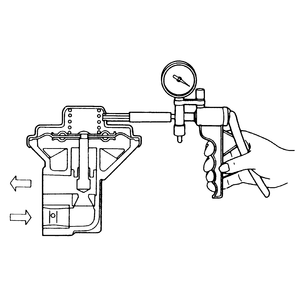
| Fig. 3: Use the hand vacuum pump to check the
functioning of the EGR valve
|
- Release the vacuum but keep the pump attached to the valve. Devise a way
to blow into the valve while drawing a vacuum and reading the gauge on the
pump. Draw a slight vacuum and make sure that the valve is closed (your breath
does not pass) at the specified vacuum.
- Now increase the vacuum and check that the valve passes air at the specified
vacuum. If the valve is sticky or worn, it may not open properly. A weakened
valve will open too soon. If either condition is encountered, replace the
valve.
- Install the valve with a new gasket. (Don't forget to remove the plug from
the second vacuum port). Tighten the bolts.
- Connect the hoses and lines to their proper ports.
- Label and disconnect the vacuum hoses, taking note of the position of each.
- Remove the wiring harness connector.
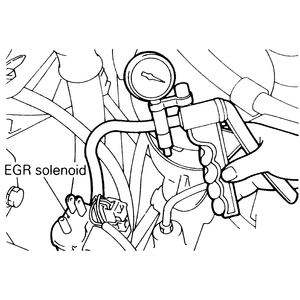
- Connect the hand vacuum pump to the port which contained the vacuum hose
with the red stripe (green stripe on 1990–95 2.4L, 3.0L and 1994–95
3.5L engines).
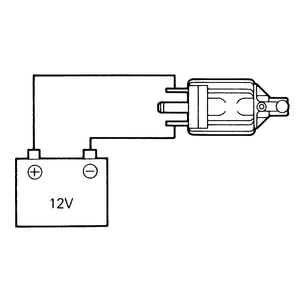
- Use jumper wires to bridge battery voltage to the terminals of the solenoid.Draw
a vacuum with the pump. When battery voltage is present, the solenoid should
hold vacuum. When the voltage is removed, it should not be possible to draw
and hold a vacuum. If either condition is not met, the unit must be replaced.
| Fig. 4: Connect the hand vacuum pump to the nipple
where the green-stripped vacuum hose was attached
|
| Fig. 5: Apply a vacuum and check to see if vacuum
is maintained when a 12 volt current is supplied — be
certain to connect the wires to the correct terminals
|
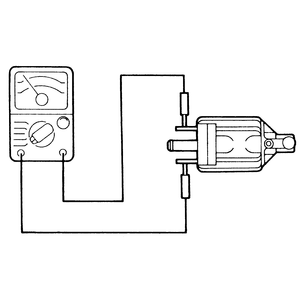
| Fig. 6: Measure the resistance between the terminals
of the solenoid valve — the resistance should be 36–44
ohms at 20°C (68°F)
|
NOTE: A vacuum pump capable of producing more than 10 in. Hg
(33.8 kPa) of vacuum will be needed to perform this test.
The engine families which contain the secondary air system use the purge control
temperature thermovalve to enable or trigger the EGR system. Later engines (G64B,
4G15, 4G61, 4G63 and 6G72) use a separate sensor devoted just to the EGR system.
1990–95 Pick-up trucks and Monteros use an additional sensor which measures
the temperature of the exhaust gas at the EGR. The electrical signal generated
by this EGR temperature sensor is used in conjunction with the signal from the
oxygen sensor to fine tune the air/fuel mixture very accurately under all driving
conditions.
The vacuum valve is checked by removing the hoses (label them!) and installing
the vacuum pump on one port. Draw a vacuum with the pump: if the coolant temperature
is below 122°F (50°C), vacuum should leak. Once the engine is warmed
up to its normal operating temperature 175–185°F (80–85°C)
the vacuum should be held. If it is necessary to remove the valve, partially
drain the coolant until it is below the level of the sensor. Perform this work
only on a cold engine. Carefully unscrew the unit, applying wrench force only
to the faceted part, never on the plastic. Before reinstalling, coat the threads
with sealant (3M® No. 4171 or equivalent); tighten the valve to 22
ft. lbs. (30 Nm) and refill the coolant.
The California electric EGR temperature sensor must be removed from the car
before testing. With the motor cold, carefully disconnect the wiring connector
and unscrew the sensor from the EGR valve.
Place the sensor in a pan of water. Use a thermometer to measure the water
temperature as you heat the pan. Use an ohmmeter to measure the resistance at
the terminals of the sensor as the temperature increases. At 50°C (122°F)
) the resistance should be 60,000–83,000 ohms. When the water reaches
212°F (100°C) , the resistance should be 11,000–14,000 ohms.
The sensor should be replaced if there is significant deviation in the resistance.
When reinstalling the sensor, tighten it to 8 ft. lbs. (11 Nm).

