- Allow the engine to reach normal operating temperature.
- Connect a tachometer to the engine.
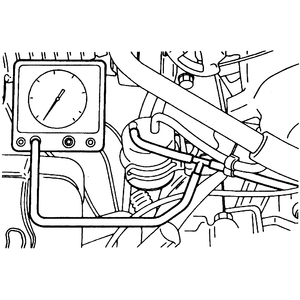
- Connect a vacuum gauge, by using a T-joint, between the variable induction
control solenoid and the variable induction control vacuum actuator.
- Start the engine and check to be sure that the negative pressure is applied
to the vacuum gauge according to the following items:
- At the engine rpm of 3,200 or less, negative pressure should be maintained
and the control valve should be closed.
- When the engine is raced from 3,200 rpm or less, the negative pressure
should not change and the control valve should be closed.
- With the engine rpm at or above 3,400, the negative pressure should
leak and the control valve should be open.
- Check to be sure that the rod of the variable induction control vacuum actuator
moves during inspection.
| Fig. 1: Attach a vacuum gauge, using a T-joint, to
the hose running between the vacuum tank and the variable induction
control solenoid
|
NOTE: A vacuum pump capable of producing more than 10 in. Hg
(33.8 kPa) of vacuum will be needed to perform this test.
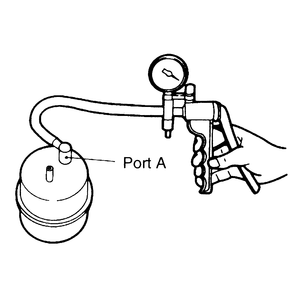
- Install a hand vacuum pump to port A and check to be sure that air-tightness
is maintained when 19.7 in. Hg (66.5 kPa) of vacuum is applied. After checking,
remove the hand vacuum pump.
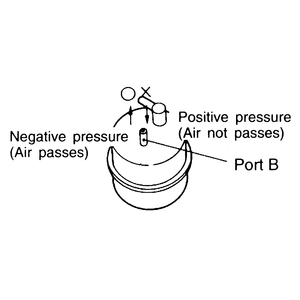
- Check to be sure that air passes through when negative pressure is applied
to port B, and that air does not pass through when positive pressure is applied
to port B.
For electrical testing of the VIC solenoid and harness, refer to the procedures
presented later in the electrical engine controls portion of this section.
| Fig. 2: Attach a hand vacuum pump to port A
|
| Fig. 3: Test the vacuum cannister by using ports A and
B
|

