Mechanical fuel pumps are found on all non-diesel Pick-up trucks through 1989
and all 4-cylinder Monteros. The mechanical fuel pump is mounted on the side
of the head, centered between the runners of the intake manifold. The intake
manifold does not require removal to remove the pump, but access can be tricky.
A selection of socket extensions, swivels and open end wrenches can be helpful.
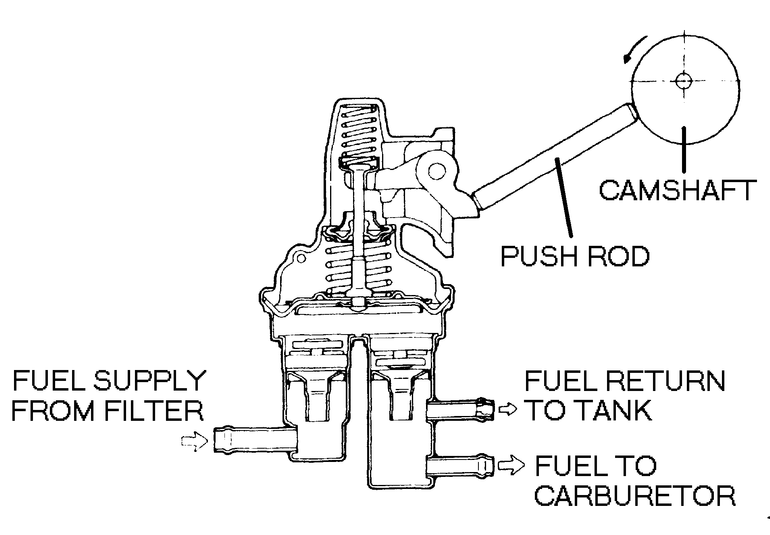
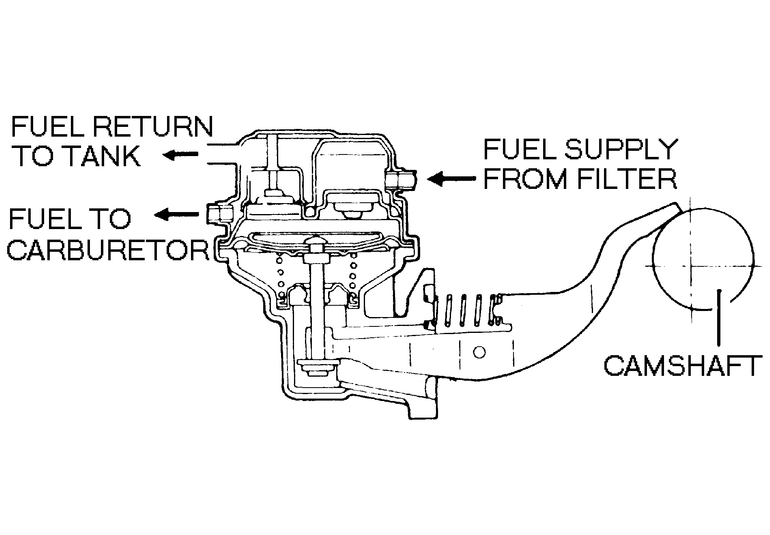
A pushrod or lever arm runs from a special camshaft lobe to the pump rocker
arm, transferring the motion to the pump diaphragm. As the diaphragm moves,
fuel is alternately drawn into the pump and then sent to the carburetor.
CAUTION
Gasoline in either liquid or vapor state is EXTREMELY explosive. Take great
care to contain spillage. Work in an open or well-ventilated area. Do not connect
or disconnect electrical connectors while fuel hoses are removed or loosened.
Observe no smoking/no open flame rules during repairs. Have a dry-chemical fire
extinguisher (type B-C) within arm's reach at all times and know how to use
it.
| Fig. 1: Mechanical fuel pump assembly — 2.0L
engines
|
| Fig. 2: Mechanical fuel pump assembly — 2.6L
engines
|
- Disconnect the negative battery cable. Depending on the vehicle, it may
be necessary to remove the air cleaner assembly.
- Set the engine to TDC/compression for No. 1 cylinder. This is generally
done by turning the crankshaft pulley bolt clockwise (never counterclockwise)
until the timing marks on the case align. Double check the positioning by
removing the distributor cap and making sure the rotor points to the No. 1
terminal.
- Label or diagram the fuel lines running to the pump. Disconnect the three
fuel lines by using a pair of pliers to shift clamps away from the nipples
on the pump and then pulling the lines off with a twisting motion.
- Remove the two mounting bolts from the head. Remove the pump, spacer, and
two gaskets from the head. As you pull the pump off the head, catch the pushrod
which is located just behind the pump. If the pump is the lever type, it will
come off with the pump.
- Clean the gasket surfaces of the insulator, pump and cylinder head. Insert
the two bolts through the pump's mounting base. Slide a new gasket, the insulator,
and a second new gasket into position over the two bolts. Turn the pump so
its mounting surface faces the cylinder head.
- Apply a light coat of clean engine oil to the pushrod. Place the pump pushrod
against the cupped surface of the operating lever and angle it upward in the
position it was in during removal. Hold the pushrod at that angle as you insert
it into the bore in the head. Once the pushrod is in the bore in the cylinder
head, you can release your fingers and move the pump toward the head along
the line of the pushrod.If the pump is the lever-arm type, make certain the
arm is installed above the camshaft. The cam will move the lever as it turns.
- Start the two bolts into the bores in the head and tighten them finger tight.
Tighten the mounting bolts alternately and evenly to 12 ft. lbs. (16 Nm).
- Inspect the hoses for cracks (even hairline cracks can leak) and replace
if necessary. Reconnect the fuel hoses. Make sure the hoses are installed
all the way onto the nipples.
- Work the clamps into position. Make sure the clamps are located well past
the bulged portion of the nipples but do not sit at the extreme ends of the
hoses.
- Replace the distributor cap.
NOTE: If the fuel pump was replaced because of a ruptured
diaphragm, there is a strong possibility of fuel contamination in the engine
oil. Changing the oil and oil filter is strongly recommended after the fuel
pump is replaced.
- Install the air cleaner assembly if it was removed.
- Connect the negative battery cable. Start the engine and check for leaks.
Because the fuel lines have been partially emptied, the engine may crank for
a longer than normal period before starting.