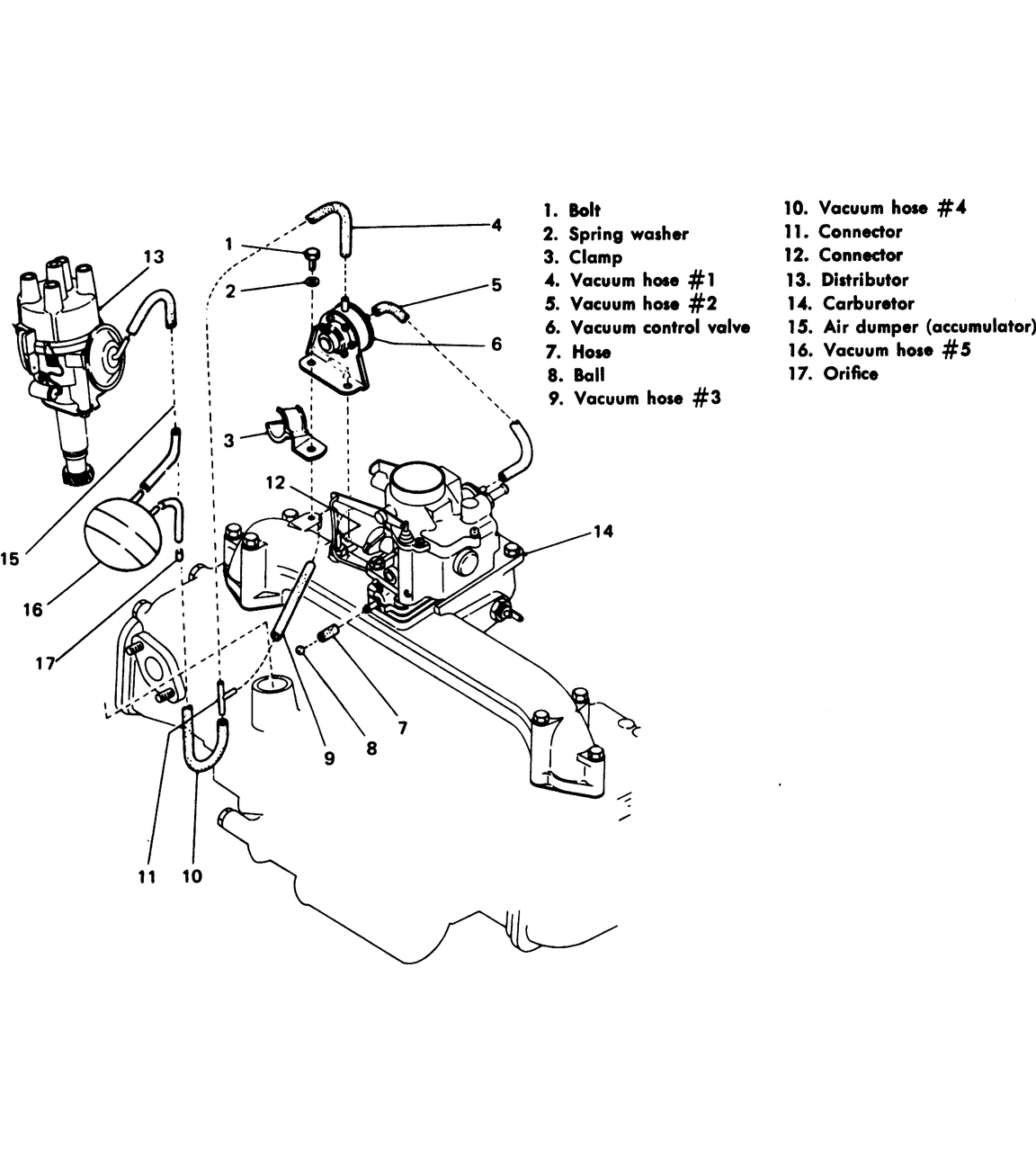
The operating principal of this system is not only to obtain correct air/fuel mixture while the vehicle is decelerating, but also to promote complete combustion by advancing or retarding the ignition timing, thus reducing the amount of emissions released into the atmosphere.
NOTE: This system is found, with variations, on almost all models from 1972.
While the vehicle is decelerating, the primary throttle valve is closed, causing a high vacuum condition to occur in the intake manifold. This vacuum is conducted through a vacuum control valve and on to the carburetor where a by–pass jet is opened and extra mixture is allowed to enter the venturi below the throttle plates. This enriches the mixture and promotes cleaner combustion.
The vacuum is also routed to the distributor vacuum control. After passing through an air damper (1972–73 only) which regulates the vacuum to a smooth application, the distributor vacuum control advances or retards the ignition spark in order to promote complete combustion in the cylinders.
While the primary throttle plate is opened during acceleration, cruising or idling, the by–pass air valve in the carburetor does not open because the vacuum does not reach the specified measure. However, the distributor vacuum control operates at a much lower vacuum condition. Thus it is operating more often than the by–pass valve in the carburetor.
There is an anti–dieseling solenoid switch mounted on the side opposite the float bowl on the carburetor. The purpose of this switch is to prevent the engine from dieseling when the ignition switch is turned OFF. When the ignition switch is turned off, the electrical current which supplies an electromagnet in the switch is also cut off. A spring inside of the housing forces a plunger into position, blocking the fuel passages leading to the opening below the throttle plates. When the ignition switch is turned ON, it energizes the electromagnet in the switch and pulls the plunger out of the fuel passage, thus allowing fuel to reach the opening below the throttle plates.
On some models there is a solenoid valve located on the line to the distributor vacuum control. It is an electrically operated switch which receives a signal from the coolant temperature switch. At coolant temperatures below 100°F (38°C), the solenoid valve prevents engine vacuum from actuating the distributor retard mechanism. This allows for improved engine starting in cold weather.
On 1982–84 models, this system operates the vacuum advance diaphragm of the distributor via a thermal vacuum valve. The valve opens the entire vacuum advance circuit to atmospheric pressure in a certain temperature range. This range (measured at the intake manifold cooling water circuit) is 59°F (15°C) to 95°F (35°C) on all but the turbocharged engine. On the 1800 Turbo, this range is 113°F (45°C) to 131°F (55°C).
The valve simultaneously activates the EGR valve so that when vacuum advance is turned off the EGR valve does not work either. If this system is operating improperly, the car would exhibit very poor operation when cold. Symptoms such as very poor fuel mileage and performance with the engine hot, or slow warm-up may also occur.
| Fig. 1: Engine modification system component locations
|
The system draws its vacuum supply from a port in the carburetor (or throttle body) above the throttle, so vacuum advance is not present at normal hot engine idle speed, but begins as the throttle is opened past idle. On certain models, advance is also desirable at idle. These incorporate a port located under the lower edge of the throttle plate which becomes ineffective above idle throttle opening. A check valve connects this port to the rest of the system. These models are: 1800 Turbo, 1982 1600 2–door Hatchback GL (5MT), 4–door GL (5MT) and Hardtop GLF (5MT), and all 1983–84 1600cc models. If the check valve fails, symptoms would include slow or erratic idle and, possibly, a slight hesitation.