Previous Next

TESTING

Thermal Vacuum Valve (TVV)

To check the function of the thermal vacuum valve:

  1. Drain a little coolant and remove the air cleaner.
  2. Disconnect the hoses and remove the valve from the intake manifold.
  3. Cap off the center (EGR) port and connect hoses to the upper and lower ports. These hoses must seal tightly so no water will get into the top part of the valve. The tops of the hoses must also stay dry.

    CAUTION
    When draining the coolant, keep in mind that cats and dogs are attracted by ethylene glycol antifreeze, and are quite likely to drink any that is left in an uncovered container or in puddles on the ground. This will prove fatal in sufficient quantity. Always drain the coolant into a sealable container. Coolant should be reused unless it is contaminated or several years old.

  4. Immerse the valve in a pan of water that also contains a 200°F (93°C) thermometer. If necessary, use ice to cool the water below 59°F (15°C) unless your car is an 1800 Turbo.
  5. Heat the water while blowing into the air cleaner hose connection.
  6. The valve should seal at first. As the temperature passes the 59°F (15°C) mark, or as it passes the 113°F (45°C) mark on the Turbo, the valve should open and you should be able to blow air through it freely.
  7. Again, at 104°F (40°C), 131°F (55°C) on the Turbo, the valve should seal tightly.
  8. If it fails any of these tests, replace the valve.
  9. Coat the valve with sealer before screwing it back into the intake manifold.
  10. To check for proper functioning of the check valve, install a timing light and idle the engine after it is fully warmed up.
  11. Accelerate the engine up to about 2000 rpm and then slowly return the throttle to normal idle position while watching the point at which the ignition fires.
  12. The timing should remain fully advanced right down to idle speed. If the check valve is stuck shut, timing will retard fairly suddenly at idle speed.
  13. If the check valve is stuck open, the timing will abruptly retard slightly above idle speed.
  14. If the valve fails these tests, note which end of the valve is connected to vacuum lines leading to the distributor, and then pull off the vacuum lines on either end of the valve.
  15. To confirm your test results, blow through the valve in the direction of flow from the carburetor lower port toward the distributor. Air should flow freely.
  16. Then, turn the valve around and blow through it in the other direction. The valve should seal tightly.
  17. Replace the valve if either test is failed.

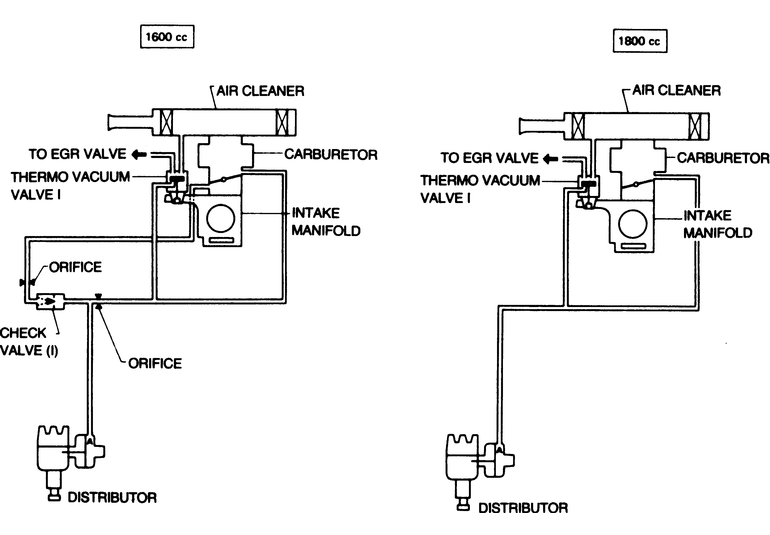
    Fig. 1: The ignition control system for the 1982–84 models have two versions, pictured here. See text for exact model delineation

Previous Next