The Subaru 1800 Turbo comes equipped with Multi–Port Electronic Fuel Injection system. The Electronic Fuel Injection System is particularly suited for use with the turbocharger because it requires no venturi restriction. That means that it has a greater capacity for total power than an equivalent carburetor since air flows through it more freely.
Also, carburetors are limited in their ability to accurately measure airflow because they do not compensate for changes in barometric pressure or temperature, and cannot accurately and quickly respond to throttle changes. This system overcomes those limitations.
Additionally, by injecting the fuel with nearly 40 psi (275 kPa) pressure right at the intake ports, the engine is fed a more consistently atomized mixture with the injection system. This improves performance and fuel economy, especially during cold engine operation.
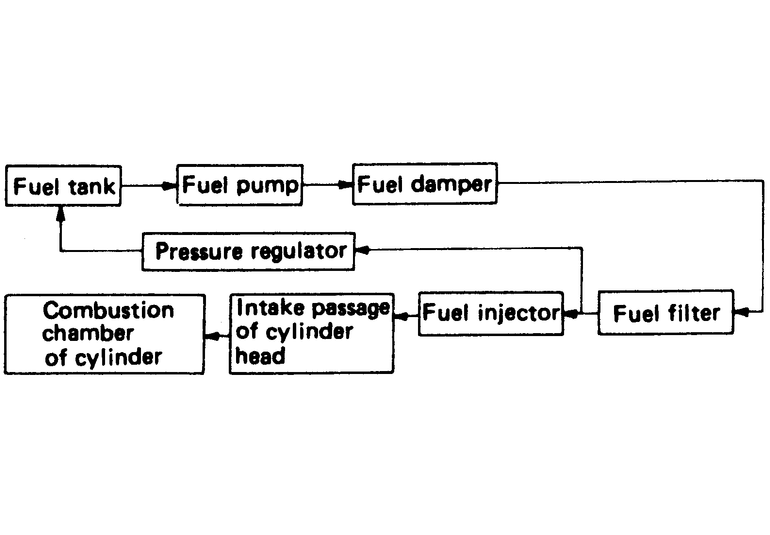
The heart of the system is a fuel supply loop which consists of a fuel pump and damper which supply fuel under a relatively smooth and constant pressure through a filter. Fuel is supplied to a loop which passes by each fuel injector (one for each cylinder). The loop returns to the fuel tank via a pressure regulator which measures the pressure or vacuum (depending upon throttle opening and turbocharger performance) that exists in the intake manifold. The pressure regulator, by precisely controlling the return of fuel to the tank, maintains exactly 36.3 psi (250 kPa) above the pressure in the intake manifold.
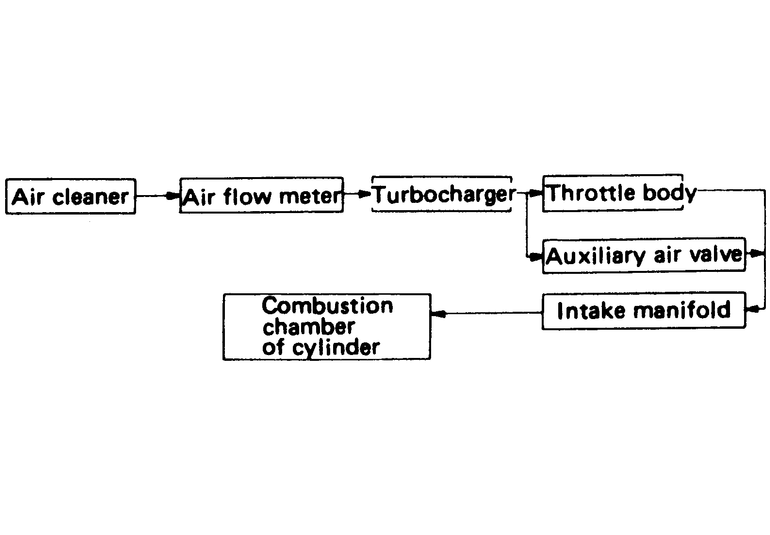
Each fuel injector consists of a nozzle and a tiny electric solenoid valve. The system employs electronics to determine how long the solenoid should be open each time it inputs fuel. By varying the electric pulse sent to the injector and, therefore, the time each injector stays open, the system can precisely supply the amount of fuel the engine requires. For example, if the driver should open the throttle and double the amount of airflow to the engine, the injectors would stay open just twice as long as before the driver decelerated. Air flowing into the system flows through the air cleaner, and then enters the air flow meter. This device measures the flow of air through a precisely designed flap, which opens or closes with airflow against the tension of a spring. A temperature measuring device compensates for the increased density of cold air.
From here, the air passes through the turbocharger into the throttle body. This part contains the throttle which controls airflow according to the driver's demands, much as in an ordinary carburetion system. It has switches which tell the electronic microprocessor which controls the system when the car is at full throttle or at idle, for appropriate changes in fuel/air mixture. When the driver releases the throttle, the throttle body closes off entirely, and air for engine idle is routed through the auxiliary air valve to the engine.
Whenever there is a change in airflow, it is reflected in a change in the air flow meter's signal to the microprocessor and a change in the width (or time) of the pulse the microprocessor sends to the injectors.
The system is extremely complex and requires specialized training and equipment to fully service and repair. You can, however, make a few simple checks and adjustments, provided you adhere to the safety precautions in this section.
| Fig. 1: The fuel passes from the tank, through a pump,
damper and filter to the fuel injectors. It returns through a fuel pressure
regulator.
|
| Fig. 2: Air entering the system passes through the air
cleaner to the air flow meter, where the system measures how much air
the engine is actually getting. From here, the air goes through the turbocharger
to the throttle body, which actually controls airflow.
|