Previous Next

Lower Ball Joint

INSPECTION

ff–1 and 1300G

Inspect the lower ball joint next, with the vehicle still raised and supported with jackstands, as follows:

  1. Grasp the wheel and move it up and down (vertically).
  2. Move the wheel back and forth.
  3. If play is excessive in either or both directions, replace the upper ball joint.

    NOTE: Excessive wheel play may also be caused by a worn wheel bearing or an improperly installed bearing nut.
1972–74 GL and DL

The lower control arm (transverse link) must be removed from the vehicle, in order to check the ball joint; see below.

  1. Use a pull scale to apply a force of 154 ft. lbs. (208 Nm) to the ball joint stud.
  2. The ball joint should have no more than 0.3mm play when this force is applied.
  3. Replace the entire control arm assembly if the ball joint is defective.
  4. Check the boot for wear, tears, or other signs of damage. Replace it, as necessary.
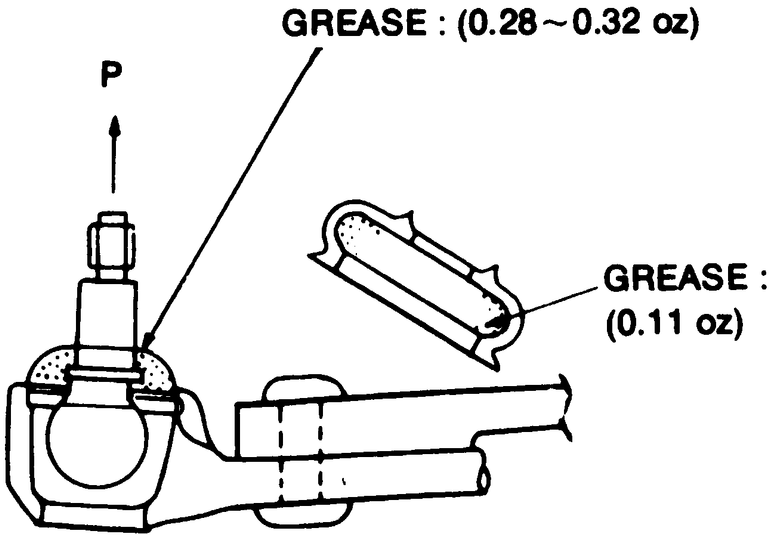
  5. Lubricate the ball stud with 0.28–0.35 oz. (8–10g) of long life chassis grease and apply 0.11 oz. (3g) of grease to the inside of the boot.

    Fig. 1: Lubricate the ball stud with 0.28–0.35 oz. (8–10g) of long life chassis grease and apply 0.11 oz. (3g) of grease to the inside of the boot. 1972–74 model shown

1975–84
INSPECTION

Inspect the lower ball joint, with the vehicle still raised and supported with jackstands, as follows:

  1. Grasp the wheel and move it up and down (vertically).
  2. Move the wheel back and forth.
  3. If play is excessive in either or both directions, replace the upper ball joint.

    NOTE: Excessive wheel play may also be caused by a worn wheel bearing or an improperly installed bearing nut.

Previous Next