Previous Next

Alternator

TESTING

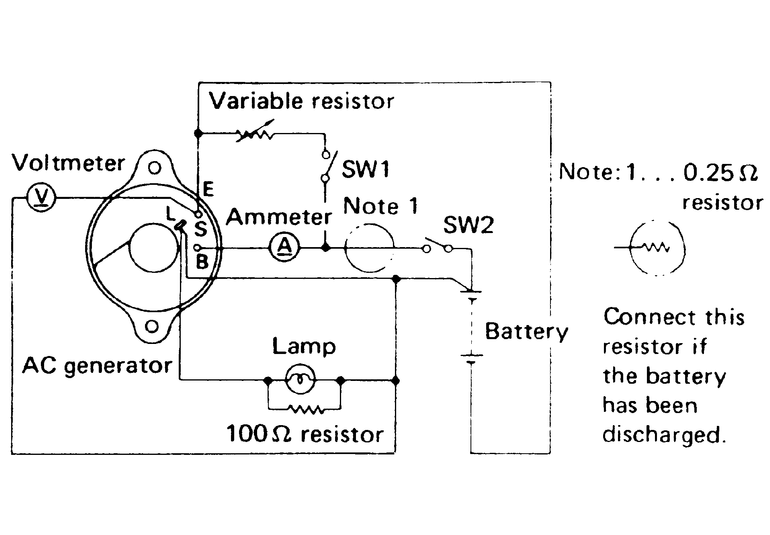
Fig. 1: Schematic for testing the alternator

Measuring Regulated Voltage
  1. Make sure the battery is firmly connected and fully charged.
  2. Refer to the diagram, and open switch SW1 while closing switch SW2.
  3. Turn the alternator at 5000 rpm and record the voltage.
  4. If the alternator is functioning correctly, the voltage should be between 14.3–14.8 volts.
Measuring Output Current
  1. Refer to the diagram, and set the variable resistor to its minimum resistance.
  2. Close switches SW1 and SW2.
  3. Turn the alternator while keeping the voltage constant by adjusting the variable resistor. Measure the current level at 1250, 2500 and 5000 rpm. If the alternator is functioning correctly, at 1250 rpm, the alternator should be producing at least 18 amps of current. At 2500 rpm, the unit should produce at least 49 amps, and at 5000 rpm, the alternator should produce at least 58 amps of current.
Alternator Speed at 13.5 Volts
  1. Refer to the diagram, and open switch SW1 while closing switch SW2.
  2. Slowly raise the alternator speed and record the voltage level.
  3. If the alternator is functioning correctly, at 900 rpm, the voltage should be 13.5 volts.

Previous Next