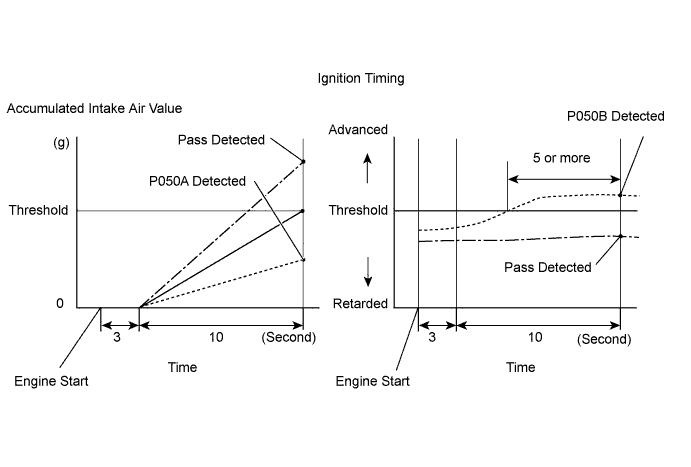
DTC P050A Cold Start Idle Air Control System Performance |
DTC P050B Cold Start Ignition Timing Performance |
| DTC No. | DTC Detection Conditions | Trouble Areas |
| P050A | Accumulated intake air amount during 10 seconds of idling after cold start, less than threshold (2 trip detection logic) |
|
| P050B | Ignition timing retard value insufficient for 5 seconds or more during 10 seconds of P050A monitoring duration at cold start (2 trip detection logic) |
|
| Related DTCs | P050A: Idle speed control problem at cold P050B: Idle ignition timing problem at cold |
| Required Sensors/Components (Main) | Mass air flow meter |
| Required Sensors/Components (Related) | Engine Coolant Temperature (ECT) sensor, Throttle position sensor, Vehicle speed sensor |
| Frequency of Operation | Once per driving cycle |
| Duration | 10 seconds |
| MIL Operation | 2 driving cycles |
| Sequence of Operation | None |
| Battery voltage | 8 V or more |
| Time after engine start | 3 seconds or more |
| Starter | OFF |
| ECT at engine start | -10°C (14°F) or more |
| ECT | -10°C to 50°C (14°F to 122°F) |
| Engine idling time | 3 seconds or more |
| Fuel-cut | OFF |
| Vehicle speed | Less than 1.875 mph (3 km/h) |
| Time after shift position changed (A/T) | 1 second or more |
| Battery voltage | 8 V or more |
| Time after engine start | 3 seconds or more |
| Starter | OFF |
| ECT at engine start | -10°C (14°F) or more |
| ECT | -10°C to 50°C (14°F to 122°F) |
| Engine idling time | 3 seconds or more |
| Fuel-cut | OFF |
| Vehicle speed | Less than 1.875 mph (3 km/h) |
| Accumulated air flow amount (A/T) | Varies with ECT (Example: Less than 42.5 g) |
| Accumulated time when ignition timing retard is cut off | 5 seconds or more |
| 1.CHECK ANY OTHER DTCS OUTPUT (IN ADDITION TO DTC P050A AND/OR P050B) |
Connect an intelligent tester to the DLC3.
Turn the ignition switch to ON.
Turn the tester ON.
Select the following the menu items: DIAGNOSIS / ENHANCED OBD II / DTC INFO / CURRENT CODES.
Read the DTCs.
| Display (DTC Output) | Proceed to |
| P050A and/or P050B | A |
| P050A and/or P050B and other DTCs | B |
|
| ||||
| A | |
 |
| 2.READ VALUE USING INTELLIGENT TESTER (FUEL TRIM) |
Connect the intelligent tester to the DLC3.
Turn the ignition switch on.
Turn the tester on.
Select the following menu items: DIAGNOSIS / ENHANCED OBD II / DATA LIST / PRIMARY / SHORT FT #1 and LONG FT #1.
Read the values displayed on the tester.
Add together the SHORT FT #1 and LONG FT #1 values to obtain the total FUEL TRIM.
|
| ||||
| NG | |
|
| 3.CHECK PCV HOSE CONNECTIONS |
|
| ||||
| OK | |
|
| 4.CHECK AIR INDUCTION SYSTEM |
Check the air induction system for vacuum leakage.
|
| ||||
| OK | |
|
| 5.REPLACE MASS AIR FLOW METER |
Replace the mass air flow meter.
| NEXT | |
|
| 6.CHECK WHETHER DTC OUTPUT RECURS (DTC P050A AND/OR P050B) |
Connect the intelligent tester to the DLC.
Turn the ignition switch on.
Turn the tester on.
Clear DTCs (Click here).
Switch the ECM from normal mode to check mode on the tester.
Start the engine to idle for a minute.
Select the following menu items: DIAGNOSIS / ENHANCED OBD II / DTC INFO / CURRENT CODES.
Read DTCs.
| NEXT | ||
 | ||
| ||
| 7.REPAIR OR REPLACE PCV HOSE |
| NEXT | |
|
| 8.CHECK WHETHER DTC OUTPUT RECURS (DTC P050A AND/OR P050B) |
Connect the intelligent tester to the DLC.
Turn the ignition switch on.
Turn the tester on.
Clear DTCs (Click here).
Switch the ECM from normal mode to check mode on the tester.
Start the engine to idle for a minute.
Select the following menu items: DIAGNOSIS / ENHANCED OBD II / DTC INFO / CURRENT CODES.
Read DTCs.
| NEXT | ||
| ||
| ||
| 9.REPAIR OR REPLACE AIR INDUCTION SYSTEM |
| NEXT | |
|
| 10.CHECK WHETHER DTC OUTPUT RECURS (DTC P050A AND/OR P050B) |
Connect the intelligent tester to the DLC.
Turn the ignition switch on.
Turn the tester on.
Clear DTCs (Click here).
Switch the ECM from normal mode to check mode on the tester.
Start the engine to idle for a minute.
Select the following menu items: DIAGNOSIS / ENHANCED OBD II / DTC INFO / CURRENT CODES.
Read DTCs.
| NEXT | ||
| ||
| ||
| 11.CHECK THROTTLE VALVE |
Check for deposits around the throttle valve and throttle valve condition.
|
| ||||
| OK | |
|
| 12.REPLACE ECM |
Replace the ECM (Click here).
| NEXT | |
|
| 13.CHECK WHETHER DTC OUTPUT RECURS (DTC P050A AND/OR P050B) |
Connect the intelligent tester to the DLC.
Turn the ignition switch on.
Turn the tester on.
Clear DTCs (Click here).
Switch the ECM from normal mode to check mode on the tester.
Start the engine to idle for a minute.
Select the following menu items: DIAGNOSIS / ENHANCED OBD II / DTC INFO / CURRENT CODES.
Read DTCs.
| NEXT | ||
| ||
| ||
| 14.REPLACE THROTTLE BODY ASSEMBLY |
Replace the throttle body assembly (Click here).
| NEXT | |
|
| 15.CHECK WHETHER DTC OUTPUT RECURS (P050A AND/OR P050B) |
Connect the intelligent tester to the DLC.
Turn the ignition switch on.
Turn the tester on.
Clear DTCs (Click here).
Switch the ECM from normal mode to check mode on the tester.
Start the engine to idle for a minute.
Select the following menu items: DIAGNOSIS / ENHANCED OBD II / DTC INFO / CURRENT CODES.
Read DTCs.
| NEXT | ||
| ||
| ||

