DTCs
| Monitoring Items
| Malfunction Detection Conditions
| Trouble Areas
| Detection Timings
| Detection Logic
|
P043E
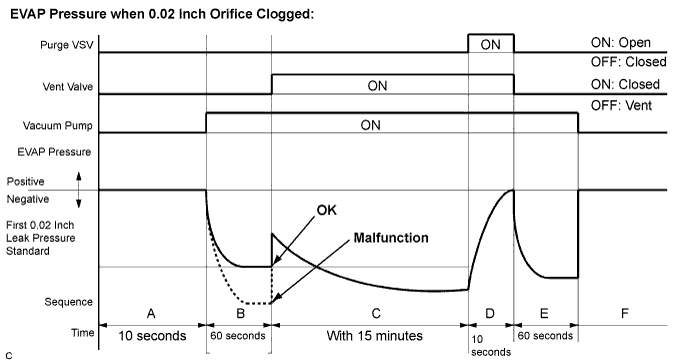
| 0.02 inch orifice clogged
| Vacuum pump creates negative pressure through 0.02 inch orifice, and EVAP system pressure is measured to determine leak pressure standard. The 0.02 inch leak pressure standard measured at the start and end of the leak check.
If system pressure is lower than -4.85 kPa (-36.38 mmHg)*, ECM determines that 0.02 inch orifice has clogging malfunction.
| - Pump module
- Connector/wire harness (Pump module - ECM)
- ECM
- Leakage from EVAP system
| While ignition switch OFF
| 2 trip
|
P043F
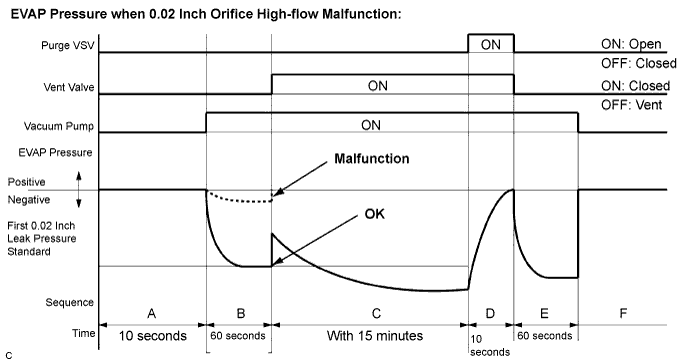
| 0.02 inch orifice high-flow
| Vacuum pump creates negative pressure through 0.02 inch orifice, and EVAP system pressure is measured to determine leak pressure standard. The 0.02 inch leak pressure standard generated at the start and at the end of leak check.
If system pressure is higher than -1.06 kPa (-7.95 mmHg)*, ECM determines that 0.02 inch orifice has high-flow malfunction.
| - Pump module
- Connector/wire harness (Pump module - ECM)
- ECM
- Leakage from EVAP system
| While ignition switch OFF
| 2 trip
|
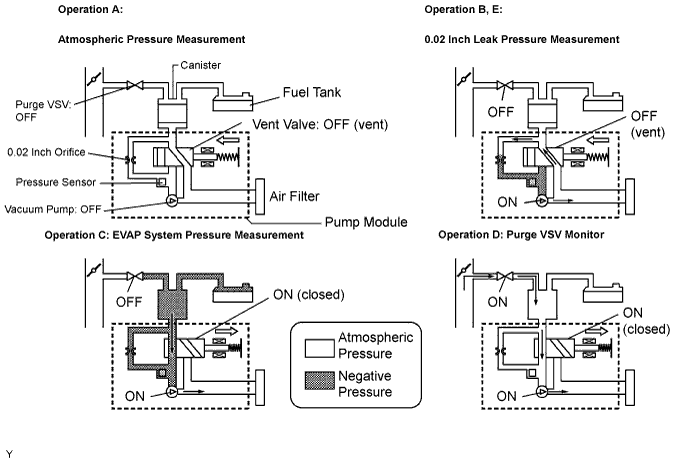
Sequence
| Operations
| Descriptions
| Duration
|
-
| ECM activation
| Activated by soak timer, 5 hours (7 or 9.5 hours) after ignition switch turned off.
| -
|
A
| Atmospheric pressure measurement
| Vent valve turned OFF (vent) and EVAP system pressure measured by ECM in order to register atmospheric pressure.
If pressure in EVAP system is not between 70 kPa and 110 kPa (525 mmHg and 825 mmHg), ECM cancels EVAP system monitor.
| 10 seconds
|
B
| First 0.02 inch leak pressure measurement
| In order to determine 0.02 inch leak pressure standard, vacuum pump creates negative pressure (vacuum) through 0.02 inch orifice and then ECM checks if vacuum pump and vent valve operate normally.
| 60 seconds
|
C
| EVAP system pressure measurement
| Vent valve turned ON (closed) to shut EVAP system.
Negative pressure (vacuum) is created in EVAP system, and EVAP system pressure then measured. Write down measured value as it will be used in leak check.
If EVAP pressure does not stabilize within 15 minutes, ECM cancels EVAP system monitor.
| 15 minutes*2
|
D
| Purge VSV monitor
| Purge VSV is opened and then EVAP system pressure is measured by ECM.
Large increase indicates normal.
| 10 seconds
|
E
| Second 0.02 inch leak pressure measurement
| After second 0.02 inch leak pressure measurement, leak check is performed by comparing first and second 0.02 inch leak pressure standards.
If stabilized system pressure is higher than second 0.02 inch leak pressure standard, ECM determines that EVAP system leaking.
| 60 seconds
|
F
| Final check
| Atmospheric pressure is measured and then monitoring result is recorded by ECM.
| -
|
The monitor will run whenever these DTCs are not present
| None
|
Atmospheric pressure
| 70 to 110 kPa (525 to 825 mmHg)
|
Battery voltage
| 10.5 V or more
|
Vehicle speed
| Less than 2.5 mph (4 km/h)
|
Ignition switch
| OFF
|
Time after key off
| 5 or 7 or 9.5 hours
|
EVAP pressure sensor malfunction (P0450, P0452, P0453)
| Not detected
|
EVAP canister purge valve
| Not operated by scan tool
|
EVAP canister vent valve
| Not operated by scan tool
|
EVAP leak detection pump
| Not operated by scan tool
|
Both of the following conditions are met before key off
| Condition 1 and 2
|
1. Duration that vehicle has been driven
| 5 minutes or more
|
2. EVAP purge operation
| Performed
|
ECT
| 4.4 to 35°C (40 to 95°F)
|
IAT
| 4.4 to 35°C (40 to 95°F)
|
One of following conditions met
| Condition 1, 2, 3, 4 or 5
|
1. EVAP pressure just after reference pressure measurement start
| More than -1 kPa (-7.5 mmHg)
|
2. Reference pressure
| Less than -4.85 kPa (-36.38 mmHg)
|
3. Reference pressure
| -1.057 kPa (-7.93 mmHg) or more
|
4. Reference pressure
| Not saturated
|
5. Difference between first reference pressure and second reference pressure
| 0.7 kPa (5.25 mmHg) or more
|