WINDOW / GLASS POWER WINDOW CONTROL SYSTEM GENERAL/CONTROL/DETAILS DETAILS
SYSTEM CONTROL
The power window control system has the following functions:
| Function | Outline |
|---|---|
| Power Up-and-down | Causes the window to open or close while the power window regulator master switch assembly or power window regulator switch assembly is being pulled halfway up or pushed halfway down. The window stops as soon as the switch is released. |
| One-touch Auto Up-and-down | Enables the window to be fully opened or closed at a touch of the power window regulator master switch assembly or power window regulator switch assembly. |
| Jam Protection | Automatically stops the power window and moves it downward if a foreign object gets jammed in the door window glass during one-touch auto-up operation or power up operation. |
| Catch Protection
(Front and Rear Doors) |
The catch protection function automatically stops the power window if an object gets caught by the door window glass during one-touch auto-down operation or power down. |
| Soft Stop
(Front and Rear Doors) |
During an up operation of the power window, the power window ECU stops the current to the power window motor right before the door window glass is fully closed. |
| Remote Control
(Front and Rear Doors) |
The multiplex network master switch assembly can control the up-and-down operation of the windows. |
| Window Lock | ·
Disables operation of the 3 passenger windows using each power window regulator switch assembly when the window lock switch is on. ·
Even when the window lock switch is on, the 3 passenger windows can be operated using the power window regulator master switch assembly. |
| Key Off Operation* | ·
Makes it possible to operate the power windows for approximately 43 seconds after the ignition switch is turned from ON to ACC or off, if either front door is not opened. ·
If the window lock switch is off, the windows can be operated using any of the power window regulator switch assemblies. If the window lock switch is on, only the power window regulator master switch assembly can be used to operate the windows. ·
If the driver door or front passenger door is opened during automatic window operation while the key-off operation function is on, the window will stop operating. |
| Key-linked Up-and-down*
(Front and Rear Doors) |
When the driver door is locked, and the driver door key cylinder is turned and held in the lock position for 1.5 seconds or more, the main body ECU (multiplex network body ECU) activates the power window motors to raise all door windows while the key cylinder is turned. Similarly, when the driver door is unlocked, turning and holding the driver door key cylinder in the unlock position for 1.5 seconds or more will cause all door windows to be lowered. |
| Transmitter-linked down*
(Front and Rear Doors) |
When the door control receiver receives a lock signal from the door control transmitter assembly for longer than 3.0 seconds, the main body ECU (multiplex network body ECU) controls the power window motors in accordance with the signal to close the windows. Similarly, when the door control receiver receives an unlock signal from the door control transmitter assembly for longer than 3.0 seconds, the main body ECU (multiplex network body ECU) controls the power window motors in accordance with the signal to open the windows. |
| Variable Speed Control
(Back Door) |
This control minimizes the occurrence of noise during the power window open/close operation by changing the operating speed of the power window motor. |
| Lock/Unlock Switch-linked Up-and-down*
(Back Door) |
Pressing and holding the lock switch of the luggage electrical key switch for 0.7 seconds or more will cause the back door ECU (multiplex network door ECU) to activate the power window motor, raising the back door window. Similarly, when the back door is unlocked, pressing and holding the unlock switch for 0.7 seconds or more will lower the back door window. |
*: Customizable parameters can be configured through customize settings. For details, refer to the Repair Manual.
- HINT:
-
The ECU built into each driver and front passenger door power window motor stores the initial position of its door window glass. The initial position is not cleared even if the cable is disconnected from the negative (-) battery terminal, or if fuses or the power window motor connector are disconnected. However, after removing or reinstalling window components, or replacing the power window regulator motor assembly, the stored initial position data must be cleared and/or initialization must be performed. For details, refer to the Repair Manual.
Jam Protection Function
A jam protection function automatically stops the power window and moves it downward if an object gets jammed in the door window glass during up operation.
The jam protection function operation differs according to the following situations:
| Situation | Operation |
|---|---|
| During auto up operation | Down operation until door window glass downward movement of 125 mm (4.92 in.) is reached, or 5 seconds elapse |
| During manual up function | Down operation until door window glass downward movement of 30 mm (1.18 in.) is reached, or 5 seconds elapse |
- HINT:
-
After the jam protection function has operated when an auto up or manual up operation was performed, the jam protection function will not operate if the manual up operation is performed again within approximately 4 seconds.
Catch Protection Function
A catch protection function automatically stops the power window if an object gets caught by the door window glass during one-touch auto down operation and power down operation.
- HINT:
-
After the catch protection function has operated when an auto down or power down operation was performed, the catch protection function will not operate if the manual down operation is performed again within approximately 4 seconds.
Soft Stop Function
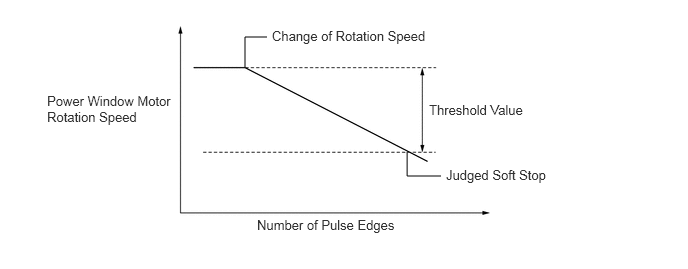
During an up operation of the power window, the soft stop function stops the current to the power window motor right before the door window glass is fully closed. This reduces the load on the door window glass outer weatherstrip.
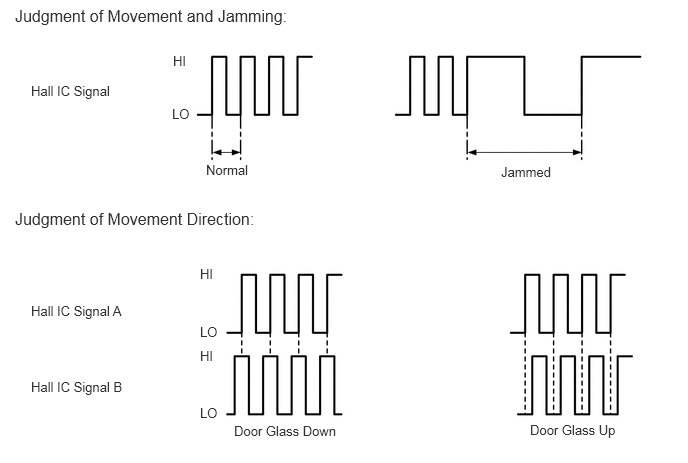
The power window ECU determines if the door window glass stop position is detected according to changes in the output signal from the pulse sensor (Hall IC). The judgment method is as follows:
Variable Speed Control
Opening Power Window
In order to minimize the noise when the power window open function starts operating, the power window ECU accelerates the window opening speed when the window is almost fully closed.
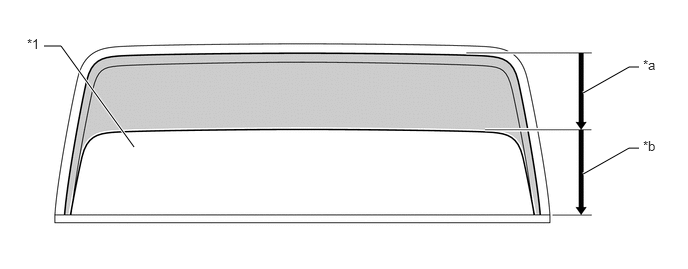
| *1 | Back Door Window Glass | - | - |
| *a | Acceleration | *b | Normal Speed |
Closing Power Window
In order to minimize the noise when the power window close function starts operating, the power window ECU accelerates the window closing speed when the window is almost fully opened.
In order to minimize the noise when the power window is closed fully, the power window ECU decelerates the window closing speed when the window is almost fully closed.
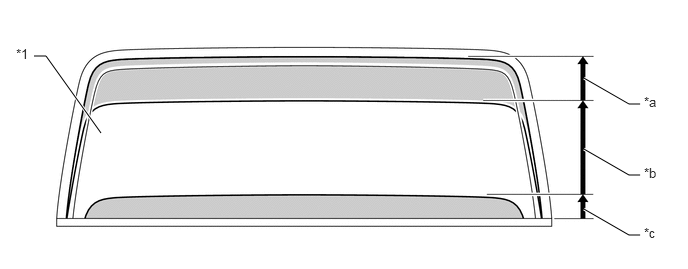
| *1 | Back Door Window Glass | - | - |
| *a | Deceleration | *b | Normal Speed |
| *c | Acceleration | - | - |
Power Window Regulator Motor Assembly
The magnet and Hall IC in the power window regulator motor assembly are used in the power window jam protection function and catch protection function.
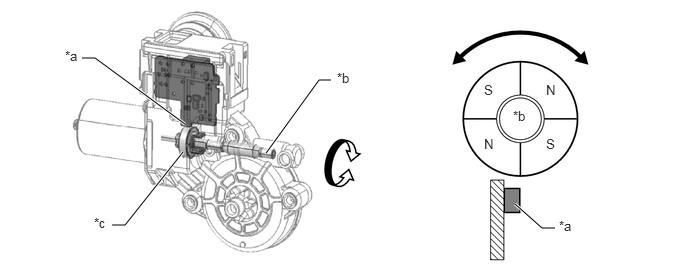
| *a | Hall IC | *b | Worm Gear |
| *c | Magnet | - | - |
The Hall ICs convert the changes in magnetic flux that occur through the rotation of the magnet into pulse signals and output them to the power window ECU built into the power window regulator motor assembly.
To control the jam protection function and catch protection function, the ECU determines the amount of movement and determines if the window glass is jamming based on the pulse signal A from the Hall IC; The direction of the window glass movement is determined based on the phase difference between the pulses of Hall IC signals A and B.
FAIL-SAFE
If the Hall IC in a power window motor malfunctions, the system will enter fail-safe mode and some power window functions will be prohibited.
Each power window only operates when the corresponding power window switch is fully pushed down or pulled up and held in that position.
DIAGNOSIS
If a power window ECU detects a malfunction in the power window control system, a Diagnostic Trouble Code (DTC) is stored in memory.
The DTCs can be read using the Global TechStream (GTS). For details, refer to the Repair Manual.