 |
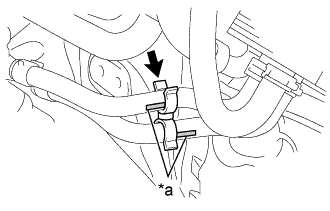
Install the clip as shown in the illustration.
| *a | Paint Mark |
OIL COOLER > INSTALLATION |
| 1. INSTALL TRANSMISSION OIL COOLER ASSEMBLY |
Install the transmission oil cooler to the transmission oil cooler bracket with the 2 bolts.
Connect the 2 new oil cooler hoses to the transmission oil cooler with the 2 hose clamps.
Install the transmission oil cooler with the 3 bolts.
| 2. CONNECT WATER BY-PASS HOSE |
Connect the 2 water by-pass hoses to the transmission oil cooler with the 2 hose clamps.
| 3. CONNECT TRANSMISSION OIL COOLER HOSE |
Connect the 2 oil cooler hoses with the 2 hose clamps.
|
Install the clip as shown in the illustration.
| *a | Paint Mark |
| 4. ADD ENGINE COOLANT |
Tighten the radiator drain cock plug.
Pour in coolant of the specified density until it reaches the base of the entrance to the water inlet.
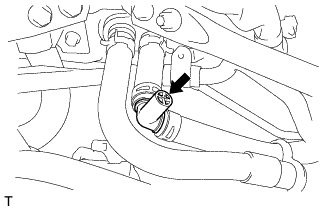 |
Open the air bleed plug on the heater hose side. (for LHD)
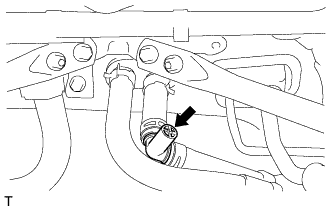 |
Open the air bleed plug on the heater hose side. (for RHD)
If the water level in the entrance to the water inlet drops, pour coolant in until it reaches the base of the entrance to the water inlet.
Close the air bleed plug when the coolant begins to come out of the air bleed valve on the heater hose side.
Pour in coolant of the specified concentration until it reaches the "FULL" level of the radiator reserve tank.
Close the radiator cap. [*1]
Start the engine, race it 5 to 6 times at under 3000 rpm or less, and then stop the engine. [*2]
1 minute after stopping the engine, remove the radiator cap and pour coolant in if the water level in the entrance to the water inlet has dropped. [*3]
Repeat operations [*1], [*2], and [*3] until the water level in the entrance to the water inlet does not drop.
Close the radiator cap and the radiator reserve tank cap.
Start the engine, set the heater on full warm, and then run it with the blower speed set to "LO".
Run the engine at 2000 rpm or less until the radiator fan starts and stops. [*4]
Stop the engine and wait until the coolant temperature drops to 30 °C (86 °F) or less. [*5]
Remove the radiator cap and, if the volume of coolant has dropped, pour coolant in until it reaches the base of the entrance to the water inlet and until it reaches the "FULL" level in the radiator reserve tank. [*6]
Close the radiator cap. [*7]
Set the heater to full warm, and, with the blower speed set to "LO", race the engine at 3000 rpm or less. [*8]
At this point, if the engine coolant can be heard flowing in the heater core, repeat operations [*4], [*5], [*6], [*7], and [*8].
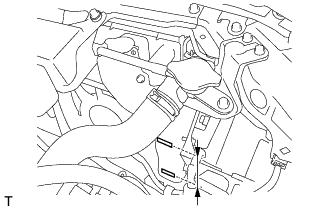 |
When the water level no longer drops, adjust the water level so that the water level in the radiator reserve tank reaches the "FULL" line.
| 5. ADD AUTOMATIC TRANSMISSION FLUID |
| 6. INSPECT FOR ENGINE COOLANT LEAK |
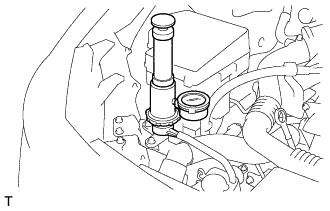 |
Fill the radiator with coolant and attach a radiator cap tester.
Warm up the engine.
Using a radiator cap tester, increase the pressure inside the radiator to 137 kPa (1.4 kgf/cm2, 20 psi), and check that the pressure does not drop.
If the pressure drops, check the hoses, radiator and water pump for leaks. If no external leaks are found, check the heater core, cylinder block and cylinder head.
| 7. INSPECT FOR AUTOMATIC TRANSMISSION FLUID LEAK |
| 8. INSTALL NO. 2 ENGINE UNDER COVER |
Install the 7 bolts and the No. 2 engine under cover.
| 9. INSTALL NO. 1 ENGINE UNDER COVER |
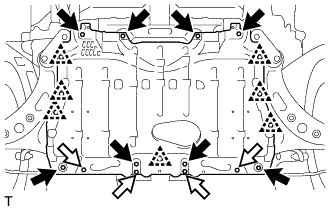 |
Install the No. 1 engine under cover with the 12 bolts and engage the 7 clips.
 | Bolt A |
 | Bolt B |