K3-VE ENGINE CONTROL SFI SYSTEM P0505 Idle Control System Malfunction
DESCRIPTION
The Idle Speed Control (ISC) valve is installed on the throttle body. During idling, it controls the engine speed by increasing or decreasing the air volume that bypasses the throttle valve, according to the signals received from the ECM.
The rotor built into the ISC valve rotates clockwise or counterclockwise by a fixed angle, in accordance with the signals from the ECM.
The rotor and valve are attached with a common screw, so the valve can only move forward or backward in proportion to the rotor revolutions. Thus, the intake air volume is controlled by changing the clearance between the valve and body.
| DTC No. | Detection Item | DTC Detection Condition | Trouble Area | MIL | Memory |
|---|---|---|---|---|---|
| P0505 | Idle Control System Malfunction | Abnormality (open or short) has occurred in idle speed control actuation signal
(1 trip detection logic) |
·
Open or short in idle speed control valve circuit ·
Idle speed control valve ·
ECM |
Comes on | DTC stored |
- HINT:
-
If the throttle body or ECM are changed, or a battery terminal is reconnected, be sure to initialize the ISC valve.
-
Follow the procedures below without depressing the accelerator pedal in order to perform the initialization:
- ·
Turn the ignition switch to ON (do not start the engine) and wait at least for 5 seconds.
·Turn the ignition switch to OFF and wait for approximately 15 seconds.
·Turn the ignition switch to ON again, and then start the engine.
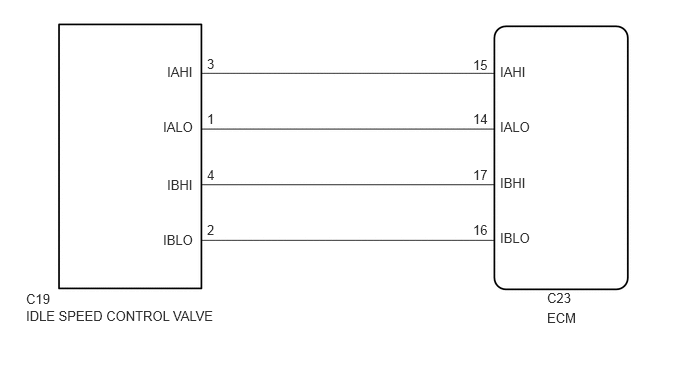
WIRING DIAGRAM
CAUTION / NOTICE / HINT
- HINT:
-
Read freeze frame data using an intelligent tester. Freeze frame data record the engine condition when malfunctions are detected. When troubleshooting, freeze frame data can help determine if the vehicle was moving or stationary, if the engine was warmed up or not, if the air-fuel ratio was lean or rich, and other data, from the time the malfunction occurred.
PROCEDURE
Connect the intelligent tester to the DLC3.
Start the engine.
Turn the tester on.
Enter the following menus: Powertrain / Engine / Data List / Engine Speed.
- Powertrain > Engine > Data List
-
Tester Display Engine Speed - 50003 206 32
Read the value displayed on the intelligent tester.
- Standard:
The engine speed is high with cold engine. Conversely, it falls with warm engine, and it is maintained at 750 rpm as an idle speed.
- Result:
Proceed to OK NG
OK
NG
Disconnect the idle speed control valve connector.
Disconnect the ECM connector.
Measure the resistance according to the value(s) in the table below.
- Standard Resistance (Check for Open):
Tester Connection Condition Specified Condition C19-3 (IAHI) - C23-15 (IAHI) Always Below 1 Ω C19-1 (IALO) - C23-14 (IALO) Always Below 1 Ω C19-4 (IBHI) - C23-17 (IBHI) Always Below 1 Ω C19-2 (IBLO) - C23-16 (IBLO) Always Below 1 Ω
- Standard Resistance (Check for Short):
Tester Connection Condition Specified Condition C19-3 (IAHI) or C23-15 (IAHI) - Body ground Always 10 kΩ or higher C19-1 (IALO) or C23-14 (IALO - Body ground Always 10 kΩ or higher C19-4 (IBHI) or C23-17 (IBHI) - Body ground Always 10 kΩ or higher C19-2 (IBLO) or C23-16 (IBLO) - Body ground Always 10 kΩ or higher
Reconnect the ECM connector.
Reconnect the idle speed control valve connector.
- Result:
Proceed to OK NG
OK
NG
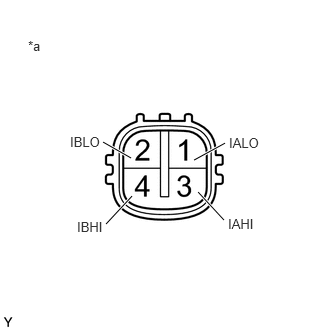
| *a | Component without harness connected
(Idle Speed Control Valve) |
Disconnect the idle speed control valve connector.
Measure the resistance according to the value(s) in the table below.
- Standard Resistance:
Tester Connection Condition Specified Condition 3 (IAHI) - 1 (IALO) 27°C (81°F) 45.6 to 50.4 Ω 4 (IBHI) - 2 (IBLO) 27°C (81°F) 45.6 to 50.4 Ω
Reconnect the idle speed control valve connector.
- Result:
Result Proceed to NG A OK (for LHD) B OK (for RHD) C
A
B
C