N04C-VL INTAKE INTAKE SYSTEM ON-VEHICLE INSPECTION
PROCEDURE

 1.CHECK TURBOCHARGER PRESSURE
Warm up the engine.
Using a 3-way connector, connect SST (turbocharger pressure gauge) to the hose between the turbo pressure sensor and the No. 2 air hose.
- SST
- 09992-00242
Depress the clutch pedal, and then fully depress the accelerator pedal. Measure the turbocharging pressure at maximum speed (approximately 3600 to 3700 rpm).
- Standard pressure:
40 to 70 kPa (0.41 to 0.71 kgf/cm2, 5.8 to 10.2 psi)
If the pressure is less than the minimum, check the intake air and exhaust system for leakage. If there is no leakage, replace the turbocharger.
If the pressure is above the specification, check if the actuator hose is disconnected or cracked. If not, check the turbocharger.
2.INSPECT TURBO PRESSURE SENSOR
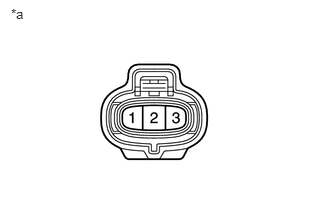
Inspect the power source voltage.
Disconnect the sensor connector.
Turn the ignition switch to ON.
Measure the voltage according to the value(s) in the table below.
- Standard voltage:
Tester Connection Switch Condition Specified Condition B18-3 (VC) - B18-1 (E) Ignition switch ON 4.5 to 5.5 V
|
If the result is not as specified, inspect the wire harness or ECM. (Click here( |
|
| *a | Component without harness connected (Turbo Pressure Sensor) |

Turn the ignition switch off.
Connect the sensor connector.
Check the power supply.
Turn the ignition switch to ON.
Disconnect the vacuum hose from the sensor.
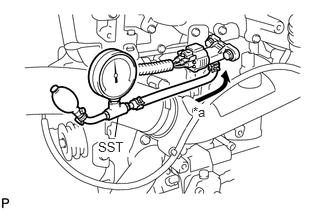
Using SST (a turbocharger pressure gauge), apply the following amount of pressure.
- SST
- 09992-00242
| *a | Pressure |
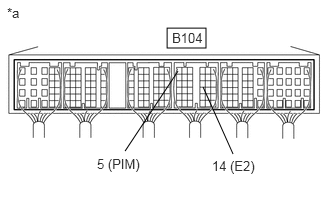
Measure the voltage according to the value(s) in the table below.
- Standard Voltage:
Tester Connection Applied Pressure kPa (kgf/cm2, psi) Specified condition B104-5 (PIM) - B104-14 (E2) 93.0 (0.95, 13.5) 0.25 to 0.40 V 150 (1.53, 21.8) 1.0 to 1.4 V
|
If the result is not as specified, replace the turbo pressure sensor. |
|
| *a | Component with harness connected (ECM) |
Turn the ignition switch off.
Connect the vacuum hose.