K112 CVT CVT SYSTEM GENERAL/CONTROL/DETAILS GENERAL
OUTLINE
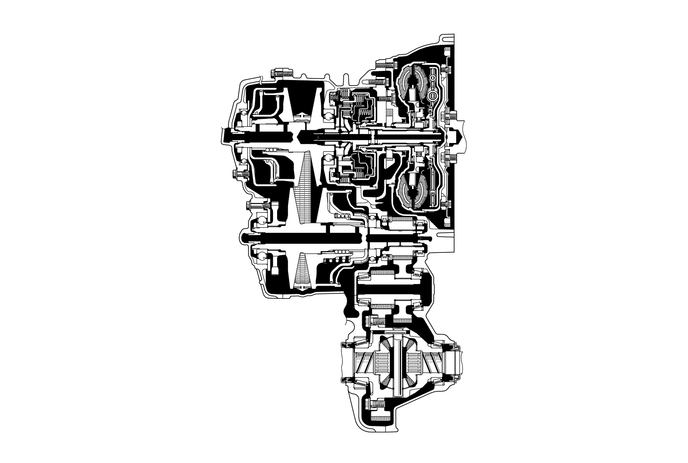
The K112 Continuously Variable Transaxle is used.
The K112 is a steel belt type Continuously Variable Transaxle (CVT) with a torque converter, controlled by fully electronic hydraulic pressure control. The CVT achieves class-leading fuel economy, plus a feeling of smooth driving and excellent drivability via the use of electronic control systems and a pulley-belt unit.
MAJOR DIFFERENCE
This manual has been modified from the previous manual as shown below:
The shift lock release button has been changed.
SPECIFICATION
|
*1: Reduction gear ratio is included. *2: Differential included *3: The weight shown is with the fluid fully filled. |
||
| Engine Type | 2AZ-FE | |
| Transaxle Type | K112 | |
| Pulley Ratio | Forward | 2.396 to 0.428 (Pulley Ratio Width 5.598) |
| Reverse | 1.668 | |
| Final Gear Ratio*1 | 5.470 | |
| Fluid Capacity*2 | Liters (US qts, Imp. qts) | 8.7 (9.2, 7.7) |
| Fluid Type | Toyota Genuine CVT Fluid TC | |
| Weight (Reference)*3 | kg (lb) | 95 (209.4) |
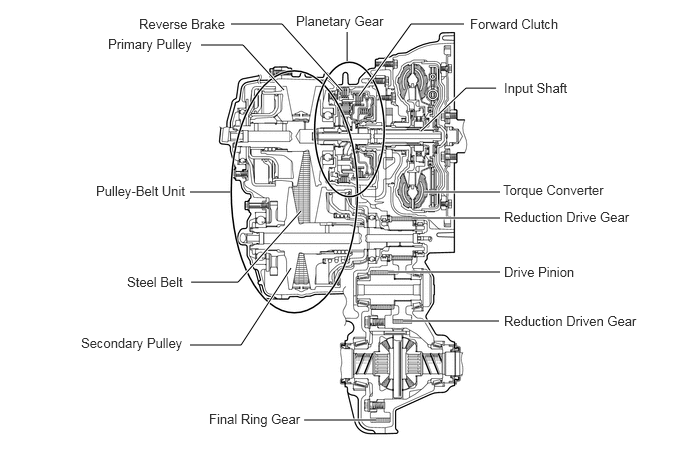
| Forward Clutch | The number of Forward Clutch Discs | 3 |
| Reverse Brake | The number of Reverse Brake Discs | 3 |
| Planetary Gear | The number of Sun Gear Teeth | 71 |
| The number of Pinion Gear Teeth | 16 | |
| The number of Ring Gear Teeth | 102 | |
| Reduction Gear | The number of Drive Gear Teeth | 26 |
| The number of Driven Gear Teeth | 40 | |
| Final Gear | The number of Drive Gear Teeth | 18 |
| The number of Driven Gear Teeth | 64 |
MAIN FEATURE
Fuel Economy Characteristics
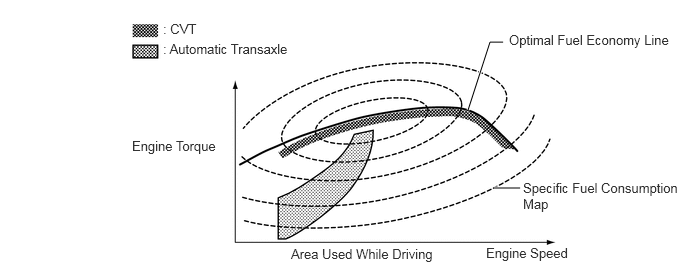
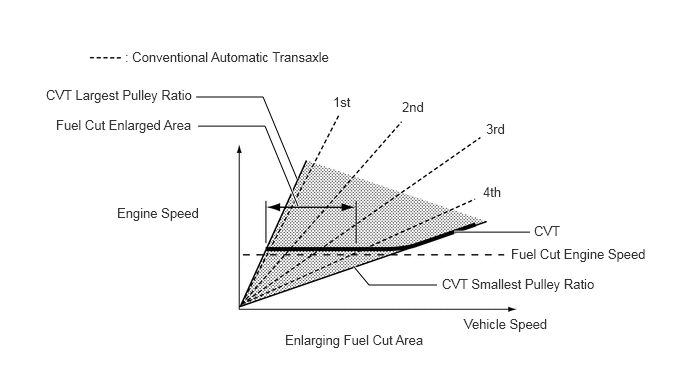
Unlike a conventional automatic transaxle that requires gear changes, a CVT allows driving at close to the optimal fuel economy line (a preset high torque range that has low-fuel consumption). Therefore, maximum engine performance can be obtained. In addition, by enlarging the lock-up area at lower speeds, transmission loss can be minimized during acceleration, ensuring that engine output is used effectively. During deceleration of the vehicle, an enlarged fuel cut area improves fuel economy. While the vehicle is being driven at high speeds, the wide pulley ratio range allows the engine speed to be lowered, significantly improving fuel economy.
CVT Power Performance
One characteristic of a CVT is the ability to keep the engine speed at the optimum power output range during all operating conditions.
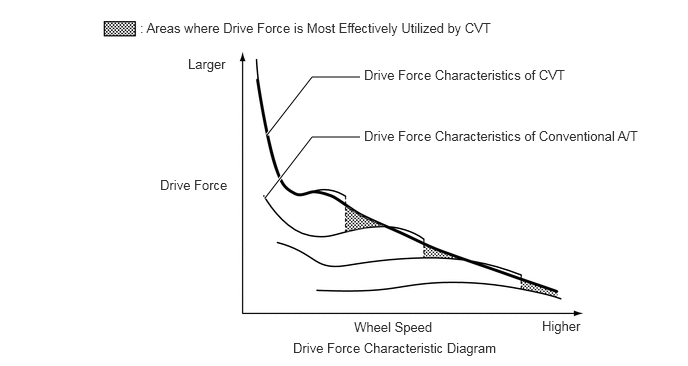
Unlike a conventional automatic transaxle that requires gear changes, a CVT allows vehicle acceleration while maintaining the same engine speed. Therefore, the optimal output range of the engine can be effectively used to obtain the maximum drive force.
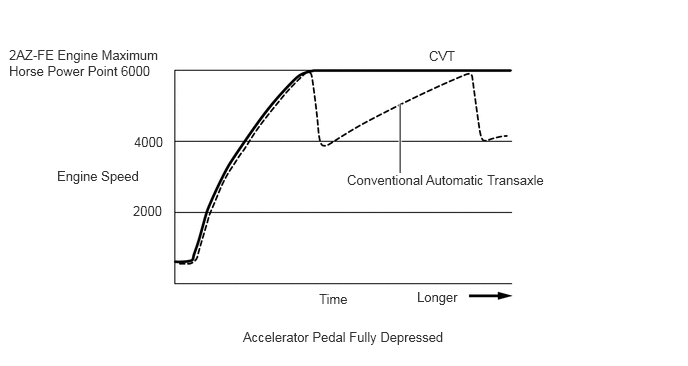
A conventional automatic transaxle that requires gear changes has drive force characteristics (engine speed, relationship between torque and vehicle speed) that are unique for each gear that is selected. Therefore, the characteristic line of the drive force for an automatic transaxle is a curved line separated at each gear change. Unlike a conventional automatic transaxle, the characteristic line of the drive force of a CVT is a continuous line that delivers drive force seamlessly under almost all driving conditions. This allows smooth shifting and maximizes engine efficiency.
In addition, reducing the initial time lag that occurs during acceleration and optimizing drive force (engine speed X output torque) maximizes engine performance.