BRAKE BRAKE MASTER CYLINDER(for RHD) REMOVAL
CAUTION / NOTICE / HINT
- NOTICE:
- ·
The master cylinder and piston are designed so that the piston can easily fall out. Prevent this by making sure that the tip of the master cylinder points downward when handling the master cylinder.
·Make sure foreign matter does not attach to the master cylinder's piston. If foreign matter attaches, clean it off with a cloth. Then apply lithium soap base glycol grease to the entire outer circumference contact surface area of the piston.
PROCEDURE

 1.DRAIN BRAKE FLUID
- NOTICE:
-
Wash off brake fluid immediately if it comes in contact with any painted surface.
47202
2.REMOVE BRAKE MASTER CYLINDER RESERVOIR SUB-ASSEMBLY
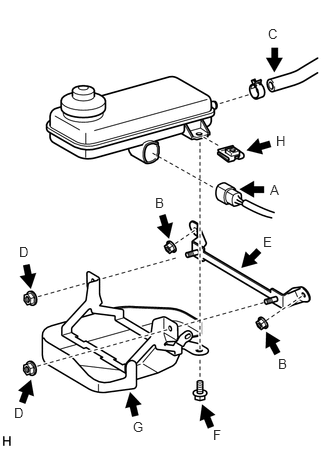
Disconnect the brake fluid level warning switch connector (labeled A).
Remove the 2 nuts (labeled B) and reservoir with brackets.
Disconnect the No. 1 reservoir tube (labeled C) from the reservoir.
Remove the 2 nuts (labeled D) and reservoir bracket (labeled E).
Remove the bolt (labeled F), reservoir bracket (labeled G), nut (labeled H) and reservoir.
44781D
3.REMOVE RESERVOIR HOSE BRACKET
Remove the No. 1 reservoir tube from the clamps of the bracket.
Remove the nut and bracket.
47201
4.REMOVE BRAKE MASTER CYLINDER SUB-ASSEMBLY
Release the vacuum pressure in the brake booster as follows.
Stop the engine.
Depress the brake pedal several times.
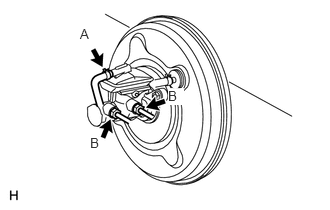
Disconnect the No. 1 reservoir tube (labeled A) from the master cylinder.
Using SST, disconnect the 2 brake lines (labeled B) from the master cylinder.
- SST
- 09023-00101
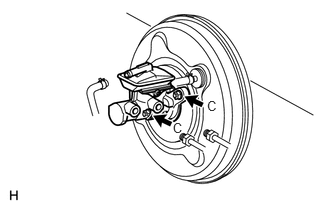
Remove the 2 nuts (labeled C).
Pull out the master cylinder from the brake booster.
- NOTICE:
- ·
The master cylinder and piston are designed so that the piston can easily fall out. Prevent this by making sure that the tip of the master cylinder points downward when handling the master cylinder.
·Make sure foreign matter does not attach to the master cylinder's piston. If foreign matter attaches, clean it off with a cloth. Then apply lithium soap base glycol grease to the entire outer circumference contact surface area of the piston.
Remove the O-ring from the master cylinder.