U660E AUTOMATIC TRANSMISSION / TRANSAXLE AUTOMATIC TRANSAXLE SYSTEM HYDRAULIC TEST
PERFORM HYDRAULIC TEST
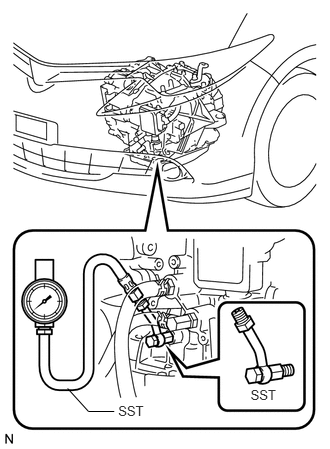
Measure the line pressure.
- NOTICE:
- ·
Perform the test at the normal operating ATF (Automatic Transmission Fluid) temperature: 50 to 80°C (122 to 176°F).
·The line pressure test should always be carried out in pairs. One technician should observe the conditions of wheels or wheel stoppers outside the vehicle while the other is performing the test.
·Be sure to prevent the SST hose from interfering with the exhaust pipe.
·This check must be conducted after checking and adjusting the engine.
·Perform the test when the A/C is OFF.
·When conducting the stall test, do not continue for more than 5 seconds.
·When performing the stall speed test repeatedly, wait for 15 seconds or more between tests.
Warm up the ATF (Automatic Transmission Fluid).
Lift the vehicle up.
Remove the engine under cover.
Connect the intelligent tester to the DLC3.
Remove the test plug on the transaxle case front left side and install SST.
- SST
- 09992-00095 (09992-00231, 09992-00271)
Start the engine.
Shift to the D position, and then use the intelligent tester to hold 3rd gear using the active test. Measure the line pressure while the engine is idling.
| Condition | D position kPa (kgf/cm2, psi) |
|---|---|
| Idling | 50 to 400 kPa
(0.5 to 4.1 kgf/cm2, 7 to 58 psi) |
Turn the ignition switch off.
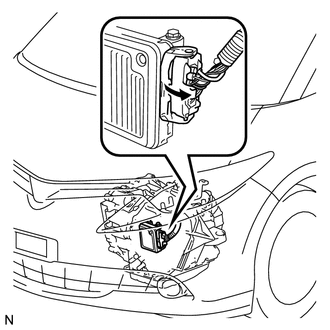
Disconnect the TCM connector.
- HINT:
-
Disconnect the connector only when performing the D position stall test.
Start the engine.
Firmly depress the brake pedal, shift to the D position, depress the accelerator pedal all the way down, and check the line pressure while the stall test is performed.
| Condition | D position kPa (kgf/cm2, psi) |
|---|---|
| Stall test | 800 to 1400 kPa
(8.2 to 14.3 kgf/cm2, 116 to 203 psi) |
Turn the ignition switch off.
Connect the TCM connector, depress the brake pedal firmly, shift to the R position, and check the line pressure while the engine is idling and during the stall test.
| Condition | R position kPa (kgf/cm2, psi) |
|---|---|
| Idling | 590 to 880 kPa
(6.0 to 9.0 kgf/cm2, 86 to 128 psi) |
| Stall test | 1800 to 2100 kPa
(18.4 to 21.4 kgf/cm2, 261 to 305 psi) |
Remove the SST, and install the test plug.
Clear the DTC.
| Problem | Possible cause |
|---|---|
| Measured values are higher than the specified value in all positions | ·
Shift solenoid valve (SLT) defective ·
Regulator valve defective |
| Measured values are lower than the specified value in all positions | ·
Shift solenoid valve (SLT) defective ·
Regulator valve defective ·
Oil pump defective |
| Pressure is low in the D position only | ·
D position circuit fluid leak ·
Clutch No. 1 (C1) defective |
| Pressure is low in the R position only | ·
R position circuit fluid leak ·
Brake No. 2 (B2) defective ·
Brake No. 3 (B3) defective |