PARK ASSIST / MONITORING TOYOTA PARKING ASSIST-SENSOR SYSTEM OPERATION CHECK
CHECK INITIAL CHECK FUNCTION
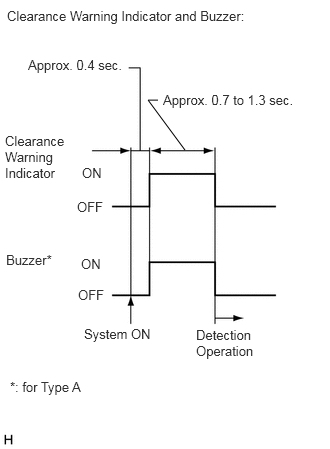
Check the initial check function for the clearance warning indicator and buzzer. (for Type A)
Turn the engine switch on (IG).
Adjust the shift lever to the R position (when the back sonar and rear clearance sonar is checked).
Adjust the shift lever to the N position (when the front clearance sonar is checked).
- NOTICE:
-
Apply the parking brake securely so that the vehicle does not move.
Check the initial check function for the clearance warning indicator. (for Type B)
Turn the engine switch on (IG).
Adjust the shift lever to the R position (when the back sonar and rear clearance sonar is checked).
Adjust the shift lever to the N position (when the front clearance sonar is checked).
- NOTICE:
-
Apply the parking brake securely so that the vehicle does not move.
When the clearance sonar main switch is turned on, check that the following occurs: 1) after 0.4 seconds, the buzzer sounds and the indicator illuminates for approximately 0.7 to 1.3 seconds, and 2) the system starts the obstacle detection operation. (for Type A)
When the clearance sonar main switch is turned on, check that the following occurs: 1) after 0.4 seconds, the indicator illuminates for approximately 0.7 to 1.3 seconds, and 2) the system starts the obstacle detection operation. (for Type B)
If the sensor is found to have an anomaly due to an open circuit or freezing for approximately 5 seconds or more, indications as shown in the following illustration appear.
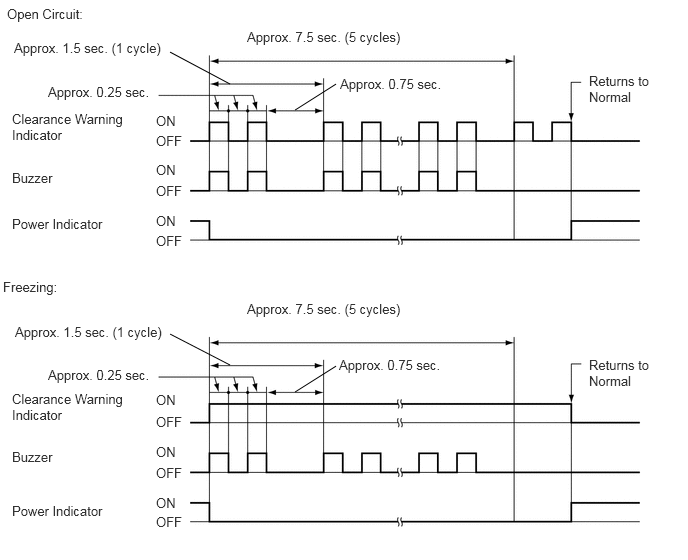
- HINT:
- ·
If a sensor has an open circuit or a sensor's detection operation malfunctions because it is wet or frozen, the buzzer sounds.
·When the sensor condition returns to normal, the system ends normal clearance sonar mode and returns to steering sensing mode.
·If the clearance sonar main switch is on and the engine switch is turned on (IG), the buzzer does not sound.
DETECTION RANGE MEASUREMENT AND INDICATOR CHECK
Turn the engine switch on (IG).
Adjust the shift lever to the R position (when the back sonar and rear clearance sonar is checked).
Adjust the shift lever to the N position (when the front clearance sonar is checked).
- NOTICE:
-
Apply the parking brake securely so that the vehicle does not move.
Turn the clearance sonar main switch on.
Move a φ 60 mm (2.36 in.) pole around the sensor to measure the detection range of the sensor.
- NOTICE:
- ·
The measured detection range is for the φ 60 mm (2.36 in.) pole. The detection range for walls and other obstacle is different.
·The No. 1 ultrasonic sensor side view detection range's hatched area represents the cross section of the top view detection range's A lines. The hatched area does not represent the entire side view detection range.
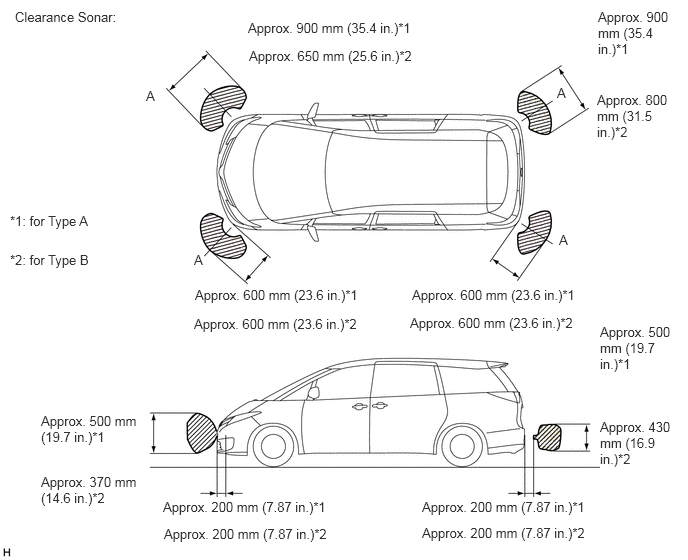
Check the clearance warning indicator and the buzzer sounding condition when the clearance sonar sensor detects an obstacle.
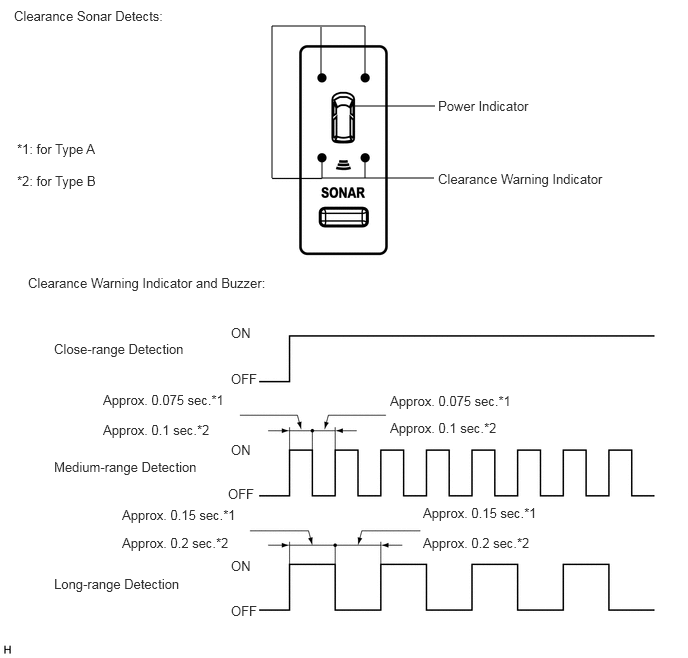
- Operation condition:
Clearance sonar Engine switch Clearance sonar main switch Shift position Vehicle speed Front On (IG) On Position other than P 10 km/h (6 mph) or less R position - Rear On (IG) On R position -
- Standard:
Clearance Warning Indicator and Buzzer Detection Range Obstacle Close-range detection
Within approx. 300 +/- 30 mm (11.8 +/- 1.2 in.)60 mm (2.36 in.) diameter pole Medium-range detection
From approx. 300 +/- 30 to 450 +/- 50 mm (11.8 +/- 1.2 to 17.7 +/- 2.0 in.)60 mm (2.36 in.) diameter pole Long-range detection
From approx. 450 +/- 50 to 600 +/- 60 mm (17.7 +/- 2.0 to 23.6 +/- 2.4 in.)60 mm (2.36 in.) diameter pole
- HINT:
- ·
Ultrasonic waves are used to measure the detection range. However, the detection range may vary depending on the ambient temperature.
·If one of the back sonar sensors is faulty, the other sensors will not be able to detect obstacles.
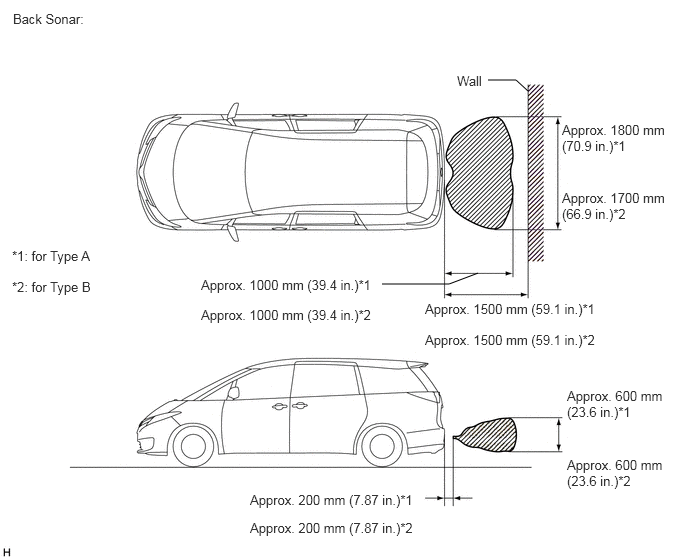
Check the clearance warning indicator and the buzzer sounding condition when the back sonar sensor detects an obstacle.
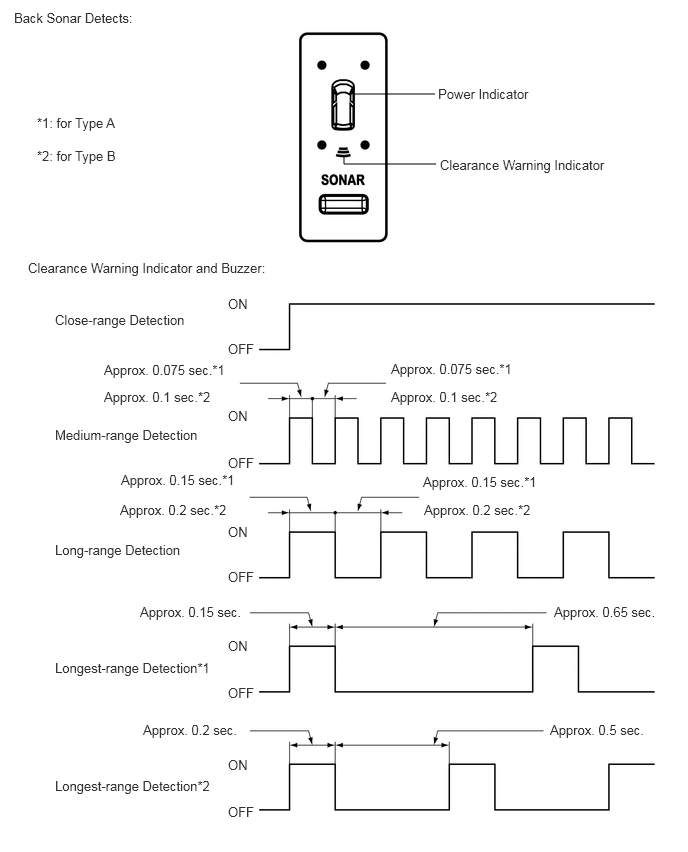
- Operation condition:
Engine switch Clearance sonar main switch Shift position Vehicle speed On (IG) On R position -
- Standard:
Clearance Warning Indicator and Buzzer Detection Range Obstacle Close-range detection
Within approx. 350 +/- 40 mm (13.8 +/- 1.6 in.)60 mm (2.36 in.) diameter pole Medium-range detection
From approx. 350 +/- 40 to 450 +/- 50 mm (13.8 +/- 1.6 to 17.7 +/- 2.0 in.)60 mm (2.36 in.) diameter pole Long-range detection
From approx. 450 +/- 50 to 600 +/- 60 mm (17.7 +/- 2.0 to 23.6 +/- 2.4 in.)60 mm (2.36 in.) diameter pole Longest-range detection
From approx. 600 +/- 60 to 1500 +/- 150 mm (23.6 +/- 2.4 to 59.1 +/- 5.9 in.)Wall
- HINT:
- ·
Ultrasonic waves are used to measure the detection range. However, the detection range may vary depending on the ambient temperature.
·If one of the back sonar sensors is faulty, the other sensors will not be able to detect obstacles.