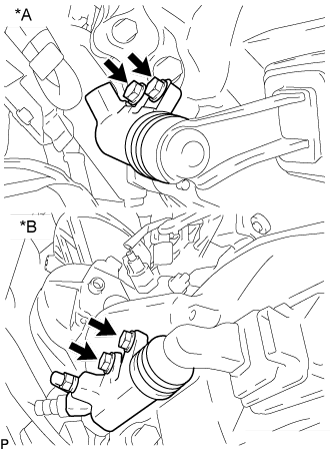
Install the clutch release cylinder with the 2 bolts.
Torque:
12 N*m{
120 kgf*cm
, 9 ft.*lbf
}
Text in Illustration
*A
for 5L-E, 2TR-FE
*B
for 2KD-FTV
2.
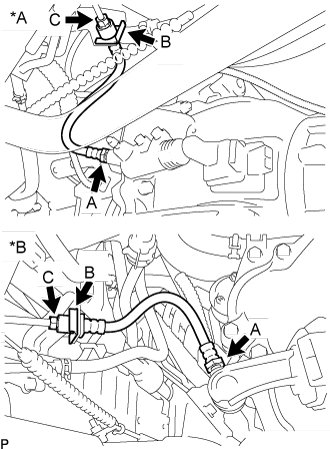
INSTALL CLUTCH HOSE NO.1
Using a union nut wrench, install the clutch hose No.1 to the clutch release cylinder (Procedure A).
Torque:
23 N*m{
235 kgf*cm
, 17 ft.*lbf
}
Text in Illustration
*A
for 2TR-FE
*B
for 5L-E, 2KD-FTV
NOTICE:
Use the formula to calculate special torque value for situations where a union nut wrench is combined with a torque wrench (Click here).
Connect the clutch hose No.1 to the bracket with a new clip (Procedure B).
Using a union nut wrench, connect the clutch tube to the clutch hose No.1 (Procedure C).
Torque:
25 N*m{
255 kgf*cm
, 18 ft.*lbf
}
NOTICE:
Use the formula to calculate special torque value for situations where a union nut wrench is combined with a torque wrench (Click here).
3.
ADD BRAKE FLUID
Fluid:
SAE J1703 or FMVSS No. 116 DOT3 or equivalent
NOTICE:
Do not remove the filter from the brake master cylinder reservoir and be sure to fill with new brake fluid to avoid any potential contamination of the brake system. Contamination, for example by dirt particles or mineral oil, could lead to functional brake problems.
4.
BLEED CLUTCH LINE
Fill the brake reservoir tank with brake fluid and bleed the clutch system.
Torque:
11 N*m{
110 kgf*cm
, 8 ft.*lbf
}
5.
CHECK FOR BRAKE FLUID LEAKAGE
HINT:
Check for leakage in the clutch system.
6.
INSPECT BRAKE FLUID LEVEL IN RESERVOIR
Check the fluid level and add fluid if necessary.
Fluid:
SAE J1703 or FMVSS No.116 DOT3 or equivalent
NOTICE:
Do not remove the filter from the brake master cylinder reservoir and be sure to fill with new brake fluid to avoid any potential contamination of the brake system. Contamination, for example by dirt particles or mineral oil, could lead to functional brake problems.