ON-VEHICLE INSPECTION
Inspection · Vehicles built from Oct 2014
| INSPECT OIL QUALITY |

Check the engine oil for deterioration, water contamination, discoloration or thinning.
If the quality is visibly poor, replace the engine oil and oil filter element (Click here).
| INSPECT ENGINE OIL LEVEL |
Warm up the engine, stop the engine and wait for 5 minutes.
Check that the oil level is between the upper level and lower level of the engine oil level dipstick. If the oil level is low, check for leakage and add oil up to the upper level of the engine oil level dipstick.
- NOTICE:
- Do not fill engine oil above the full level mark.
| INSPECT OIL PRESSURE |
Check the condition of the oil pressure warning light and oil level warning light.
- NOTICE:
- If the ignition switch is turned off, the warning lights do not illuminate the next time the engine is started. Therefore, checking the vehicle after it has been brought in for service will not be of any use for troubleshooting. It is essential to ask the customer whether the warning lights were illuminated or not when the malfunction occurred.
-
Condition 1
Condition 2
Condition 3
Condition 4
Oil Pressure Warning Light
Illuminated
Illuminated
Illuminated
Illuminated
Oil Level Warning Light
Illuminated
Illuminated
Not illuminated
Not illuminated
DTC Output (MIL does not illuminate)
P0524
None
P0524
None
Possible Cause
- Intake of air into an oil line due to a decrease in the amount of engine oil, or oil pressure stuck at a low value (a DTC is stored as the oil pressure does not increase when the system switches to high oil pressure control mode)
- Clogging in an oil line (the oil strainer, etc.), or a problem with the oil pump
- Intake of air into an oil line due to a decrease in the amount of engine oil
- Clogging in an oil line (the oil strainer, etc.), or a problem with the oil pump
- Oil pressure stuck at a low value (a DTC is stored as the oil pressure does not increase when the system switches to high oil pressure control mode)
- Clogging in an oil line (the oil strainer, etc.), or a problem with the oil pump
Clogging in an oil line (the oil strainer, etc.), or a problem with the oil pump
Solution to Problem
- Add engine oil so that the oil level is within the specified range and perform an oil pressure control system check. If the results of the check are normal, it is likely that the illumination of the warning light was caused by oil consumption (if the amount of oil consumption is large, check the oil consumption and perform repairs). If the results of the check are abnormal, it is likely that the problem was caused by the oil pressure control system being stuck in low pressure oil control mode (Click here).
- Perform an oil pressure inspection. If the results are abnormal, repair the engine.
- Perform the inspection procedure for DTC P0524 (Click here).
- Perform an oil pressure inspection. If the results are abnormal, repair the engine.
Perform an oil pressure inspection. If the results are abnormal, repair the engine.
- HINT:
- Under normal conditions, the oil pressure warning light and oil level warning light are not illuminated.
- When performing a check of the oil pressure control system, if the system does not switch from high oil pressure control mode, one of the following may be the cause of the problem.
- The sleeve valve is locked in the position for high oil pressure.
- The oil pressure switching valve relay is malfunctioning.
- The oil pressure switching valve is stuck off.
- If a DTC is stored but the cause of the problem cannot be found, either of the following may be the cause of the problem.
- Engine oil was added by the customer due to a lack of engine oil.
- The system was temporarily stuck in low oil pressure control mode (foreign matter was stuck in the system, etc.)
- Check the oil pressure control system using the following procedure.
- Under normal conditions, the oil pressure warning light and oil level warning light are not illuminated.
Check the oil pressure control system (when using the GTS).
Reference Purpose of Check
When to Perform Check
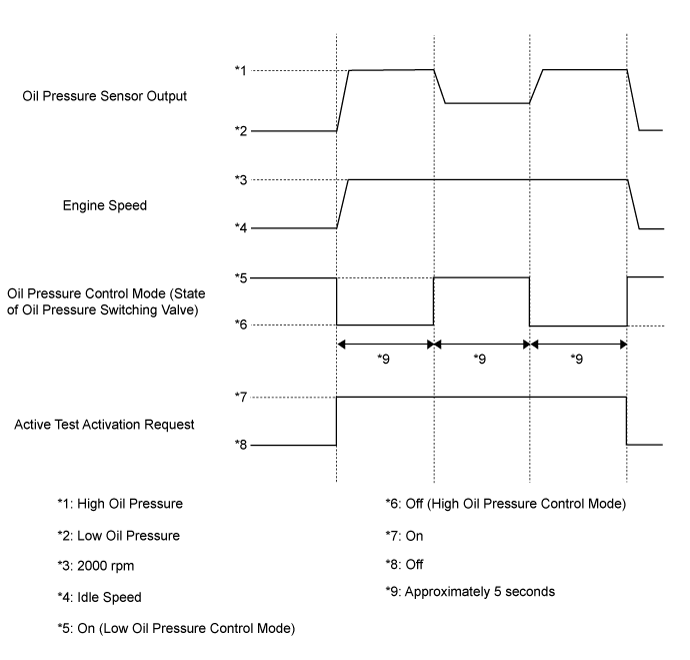
This check is used to check whether the oil pressure control system is operating properly when the oil pressure switching valve is forcibly operated.
Perform this check when DTC P0524 is output.
Connect the GTS to the DLC3.
Start the engine and warm it up.
- HINT:
- Confirm that the engine coolant temperature is 70°C (158°F) or higher, as the oil pressure changes according to the engine coolant temperature.
Enter the following menus: Powertrain / Engine and ECT / Utility / Engine Oil Pressure Control Check.
Check the following table and perform the oil pressure control system check.
- HINT:
- Even when the engine is warmed up, there are some instances where the oil pressure control system check cannot be performed.
- The engine speed will increase during the oil pressure control system check.
- Even when the engine is warmed up, there are some instances where the oil pressure control system check cannot be performed.
Item
Condition
Content of Check
System Operation
Oil Pressure Control System Check
- Engine is idling
- Vehicle is stopped
- Shift lever is in P (for Automatic Transmission)
- Shift lever is in neutral (for Manual Transmission)
- Engine coolant temperature is in specified range
- Valve turns off (high oil pressure control mode)
- Valve turns on (low oil pressure control mode)
- Valve turns off (high oil pressure control mode)
The average oil pressure over 1 second when the valve is operated is displayed.
Details:
The oil pressure is measured for 1 second when the valve is operated, and the value measured every 0.1 seconds is displayed for each valve state [(1) to (3)].
- Engine is idling
Read the "valve off" (high pressure control mode) and "valve on" (low pressure control mode) oil pressure values.
- Reference Oil Pressure:
Item
Specified Condition
Valve Off (High Pressure Control Mode)
170 to 450 kPa (1.7 to 4.6 kgf/cm2, 25 to 65 psi)
Valve On (Low Pressure Control Mode)
100 to 200 kPa (1.0 to 2.0 kgf/cm2, 15 to 29 psi)
Compare the "valve off" (high pressure control mode) and "valve on" (low pressure control mode) oil pressure values and check the difference.
- Standard:
- 50 kPa (0.5 kgf/cm2, 7.3 psi) or more

Check the oil pressure control system (when not using the GTS).
- HINT:
- When not using the GTS, it is not possible to determine whether the system is stuck in high oil pressure control mode.
Inspect the oil pressure according to the procedure listed below under "Inspect Engine Oil Pressure".
- Standard Oil Pressure:
Condition
Specified Condition
Idling
50 kPa (0.5 kgf/cm2, 7.3 psi) or higher
Engine running at 2500 rpm
200 kPa (2.0 kgf/cm2, 29 psi) or higher
Engine running at 3500 rpm
250 kPa (2.5 kgf/cm2, 36 psi) or higher
- HINT:
- The possible cause can be determined based on the results of the oil pressure inspection (refer to the following table).
Measurement Results -
Condition 1
Condition 2
Idling
Normal
Abnormal
2500 rpm
Abnormal
Abnormal
3500 rpm
Abnormal
Abnormal
Possible Cause
Oil pressure control stuck in low oil pressure control mode
Clogging in an oil line (the oil strainer, etc.), or a problem with the oil pump
| INSPECT ENGINE OIL PRESSURE |
Remove the engine oil pressure sender gauge (Click here).
Install an oil pressure gauge with an adapter.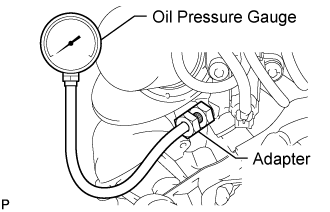
Warm up the engine.
- HINT:
- Confirm that the engine coolant temperature is 70°C (158°F) or higher after the engine is warmed up, as the oil pressure changes according to the engine coolant temperature.
Measure the engine oil pressure.
- Standard Oil Pressure:
Condition
Specified Condition
Idling
50 kPa (0.5 kgf/cm2, 7.3 psi) or higher
2500 rpm
200 kPa (2.0 kgf/cm2, 29 psi) or higher
3000 rpm
250 kPa (2.5 kgf/cm2, 36 psi) or higher
- HINT:
- When the oil pressure sender gauge assembly is removed, the oil pressure control system operates in high oil pressure control mode.
Remove the oil pressure gauge and adapter.
Install the engine oil pressure sender gauge (Click here).
Inspect for engine oil leaks (Click here).