2007-2013 Highlander Kluger · Service Manual ENGINE

Active Control Engine Mount System

Circuit diagnosis · Vehicles built May 2007 – Jun 2010

Versions by build date: May 2007 – Jun 2010 from Jul 2010

DESCRIPTION

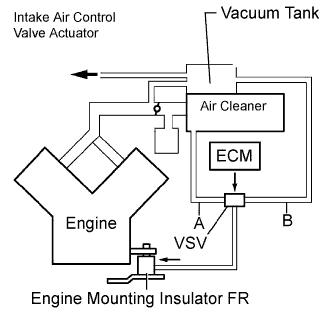
A168227E01
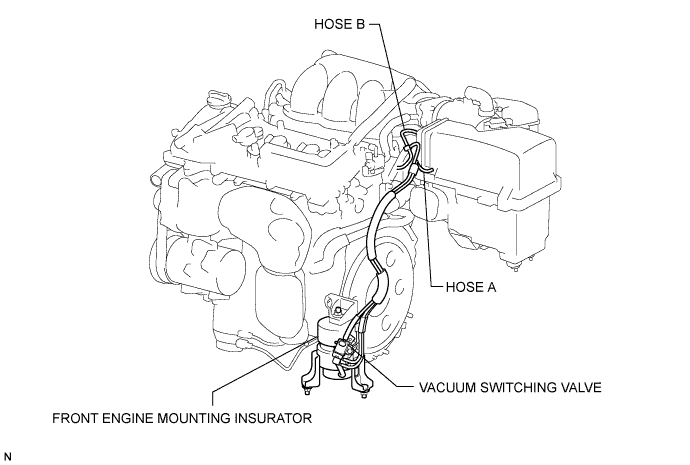
The active control engine mount system decreases engine vibration at an engine idling using the active control engine mount VSV. The VSV is controlled by a pulse signal transmitted to the VSV from the ECM. The frequency of this pulse signal is matched to the engine speed to decrease engine vibration.

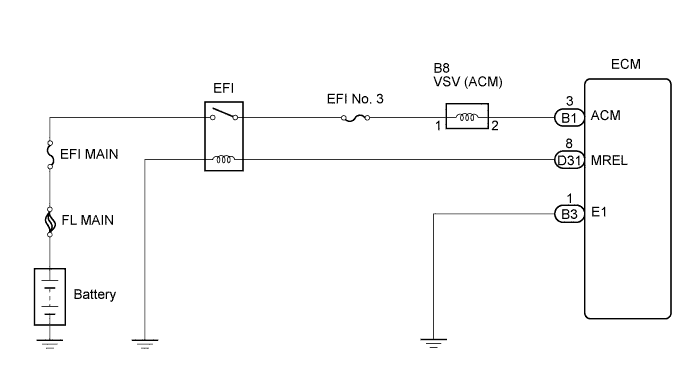
WIRING DIAGRAM

A136867E27

INSPECTION PROCEDURE


1. CHECK VACUUM HOSES

  1. G042514E05
    Check the air and vacuum hoses for looseness, disconnection and blockage. If the hose is damaged, replace the vacuum hose assembly.


NG
REPAIR OR REPLACE VACUUM HOSES
OK


2. CHECK VACUUM

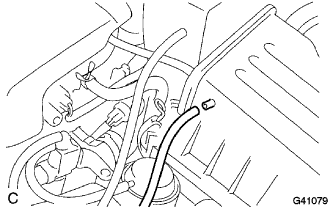
  1. G041079
    Start the engine.

  1. Disconnect the vacuum hose from the air cleaner cap.

  1. Check that the disconnected port located on the vacuum tank applies suction to your finger.

    OK:
    Vacuum pressure exists.

  1. Reconnect the vacuum hose.


NG
CHECK AND REPLACE VACUUM SOURCE AND HOSES
OK


3. INSPECT ECM

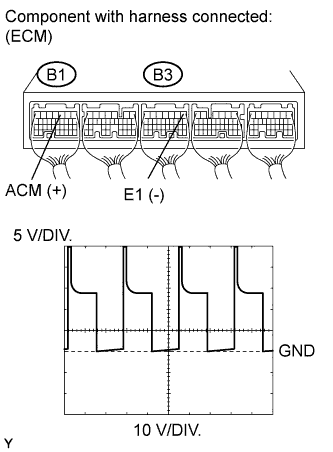
  1. A114640E08
    Connect the oscilloscope between terminals ACM and E1 of the ECM connectors.

  1. Warm up the engine to normal operating temperature.

  1. Turn the A/C switch on.

  1. Measure the voltage according to the value(s) in the table below.

    Standard voltage:
    Tester Connection
    Condition
    Voltage
    B1-3 (ACM) - B3-1 (E1)
    Shift position is D, and engine speed is 850 rpm or less
    Pulse generation
    Shift position is D, and engine speed is 950 rpm or more
    9 to 14 V
    Shift position is P
    9 to 14 V


NG
Go to step 6
OK


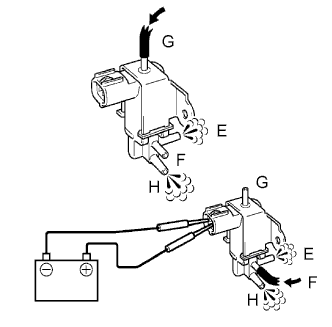
4. INSPECT DUTY VACUUM SWITCHING VALVE (OPERATION)

  1. A052014E04
    Remove the VSV for ACM.

  1. Check operation of the VSV for ACM when positive battery voltage is applied to the terminals of the VSV for ACM connector.

    Positive battery voltage is not applied:
    The air from pipe G is flowing out through pipes E and H.

    Positive battery voltage is applied:
    The air from pipe F is flowing out through pipes E and H.

  1. Reinstall the VSV for ACM.


NG
REPLACE DUTY VACUUM SWITCHING VALVE
OK


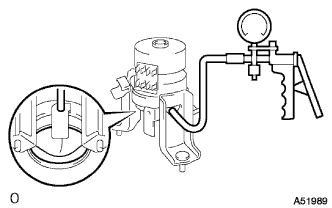
5. INSPECT ENGINE MOUNTING INSULATOR ASSEMBLY FRONT

  1. A051989
    Disconnect the vacuum hose from the front engine mount insulator.

  1. Using vacuum pump, apply vacuum of 80 kPa (600 mmHg, 25 in.Hg) and wait for 1 minute.

  1. Check that there is no change in the needle movement of the vacuum pump gauge.

  1. Check that there is no fluid leakage caused by a break in the diaphragm.

    OK:
    Vacuum pressure exists.

  1. Reconnect the vacuum hose.


NG
REPLACE ENGINE MOUNTING INSULATOR ASSEMBLY FRONT
OK

SYSTEM OK

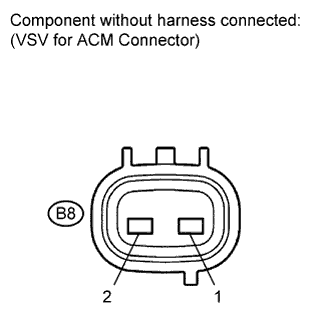
6. INSPECT DUTY VACUUM SWITCHING VALVE (RESISTANCE)

  1. A172714E01
    Disconnect the VSV for ACM connector.

  1. Measure the resistance according to the value(s) in the table below.

    Standard resistance:
    Tester Connection
    Condition
    Specified Condition
    1 - 2
    20°C (68°F)
    19 to 21 Ω

  1. Reconnect the VSV for ACM connector.


NG
REPLACE DUTY VACUUM SWITCHING VALVE (Click here)
OK


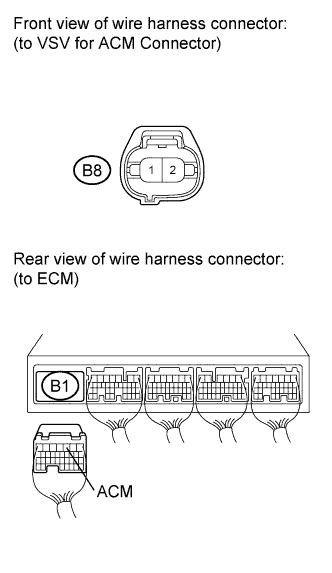
7. CHECK HARNESS AND CONNECTOR (VSV FOR ACM - ECM, VSV FOR ACM - EFI RELAY)

  1. A168244E02
    Disconnect the VSV for ACM connector.

  1. Disconnect the ECM connector.

  1. Measure the resistance according to the value(s) in the table below.

    Standard resistance (Check for open):
    Tester Connection
    Condition
    Specified Condition
    B8-2 - B1-3 (ACM)
    Always
    Below 1 Ω

    Standard resistance (Check for open):
    Tester Connection
    Condition
    Specified Condition
    B8-2 or B1-3 (ACM) - Body ground
    Always
    10 kΩ or higher

  1. Reconnect the ECM connector.

  1. Reconnect the VSV connector.


NG
REPAIR OR REPLACE HARNESS OR CONNECTOR (VSV FOR ACM - ECM)
OK

REPAIR OR REPLACE HARNESS OR CONNECTOR (VSV FOR ACM - EFI NO. 3 FUSE)


← P2A00 A/F Sensor Circuit Slow Response (Bank 1 Sensor 1) (+ P2A03) (from Jul 2010)Active Control Engine Mount System (from Jul 2010) →