The hybrid vehicle control ECU has a self-diagnosis system. If the computer, hybrid vehicle control system, or a component is not working properly, the ECU records the conditions that relate to the fault. The ECU also illuminates the master warning light in the combination meter and provides other appropriate messages on the multi-information display, such as the HV system warning message, the HV battery warning message, or the discharge warning message.
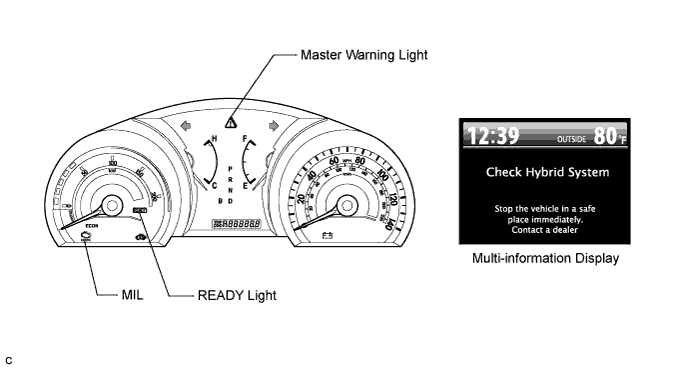
- HINT:
- The master warning light will illuminate when the THS II malfunctions and the light will blink when in inspection mode.
- When troubleshooting OBD II (On-Board Diagnostics) vehicles, the Techstream (complying with SAE J1987) must be connected to the DLC3 (Data Link Connector 3) of the vehicle.
OBD II regulations require that the vehicle's on-board computer illuminate the MIL (Malfunction Indicator Lamp) on the instrument panel when the computer detects a malfunction in:
- The emission control system components.
- The powertrain control components (which affect vehicle emissions).
- The computer itself.
In addition, the applicable DTCs prescribed by SAE J2012 are recorded in the hybrid vehicle control ECU memory. If the malfunction does not recur in 3 consecutive trips, the MIL turns off automatically but the DTCs remain recorded in the hybrid vehicle control ECU memory. - To check for DTCs, connect the Techstream to the DLC3. The Techstream displays DTCs, freeze frame data, and a variety of THS II data. The DTCs and freeze frame data can be erased with the Techstream. In order to enhance the OBD function on vehicles and develop the Off-Board diagnosis system, Controller Area Network (CAN) communication is used in this system. CAN is a network which uses a pair of data transmission lines spanning multiple computers and sensors. It allows for high speed communications between the systems and simplification of the wire harness connections.