Fuel System
Fuel
PRECAUTION
CAUTION:
• Do not smoke or be near an open flame when working on the fuel system.
• Keep gasoline away from rubber or leather parts.
1. DISCHARGE FUEL SYSTEM PRESSURE
CAUTION:
• Do not disconnect any part of the fuel system until you have discharged the fuel system pressure.
• Even after discharging the fuel pressure, place a cloth or equivalent over fittings as you separate them to reduce risk of fuel spray on yourself or in the engine compartment.
(a) Disconnect the fuel pump connector.
-
(b) Start the engine. Once the engine stops, turn the ignition switch OFF.
HINT:
DTC P0171/25 (system too lean) may be set.
-
(c) Crank the engine again and check the engine does not start.
-
(d) Disconnect the cable from the negative (-) battery terminal.
CAUTION:
Wait for 90 seconds after disconnecting the cable from the negative (-) battery terminal to prevent airbag and seatbelt pretensioner activation.
HINT:
Obtain the audio system PIN from the vehicle owner, if applicable. Otherwise the audio system will be inoperable when the battery cable is reconnected.
-
(e) Loosen the fuel tank cap and discharge the pressure in the fuel tank completely.
-
(f) Connect the fuel pump connector.
-
2. FUEL SYSTEM
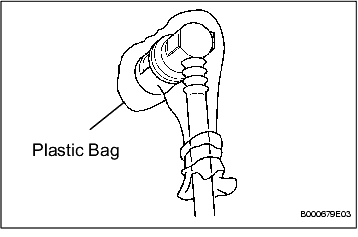
(a) When disconnecting the high fuel pressure line, a large amount of gasoline will spill out. Follow these procedures.
(1) Discharge the fuel system pressure (see above procedure).
(2) Put a container under the connection.
(3) Disconnect the fuel pump tube.
(4) Drain the fuel remaining inside the fuel pump tube.
(5) To protect the disconnected fuel pump tube from damage and contamination, cover it with a plastic bag.
-
(b) Observe these precautions when removing and installing the injector.
(1) Never reuse the O-rings.
(2) When placing a new O-ring on an injector, take care not to damage it in any way.
(3) Coat new O-rings with grease or gasoline before installing. Never use engine, gear or brake oil.
-
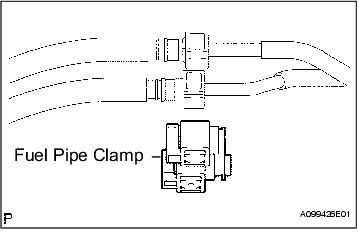
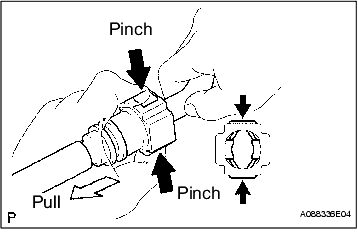
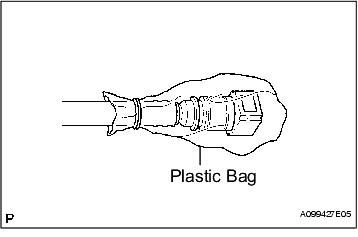
(c) Install the injector to the delivery pipe and cylinder head, as shown in the illustration. Before installing the injector, apply grease or gasoline on the area where the delivery pipe touches the injector O-ring.
(1) Quick type: Remove the fuel pipe clamp from the fuel tube connector.
(2) Check for foreign matter on the pipe and around the connector before disconnecting it. Clean them if necessary.
(3) Check for dirt or mud on the pipe and around the connector before disconnection. Clean if necessary.
(4) If the connector and the pipe are stuck, pinch the connector, push and pull the pipe to disconnect the pipe and pull it out.
NOTICE:
Do not use any tools.
(5) Check for dirt or mud on the seal surface of the disconnected pipe. Clean if necessary.
(6) To protect the disconnected pipe and connector from damage and contamination, cover it with a plastic bag.
-
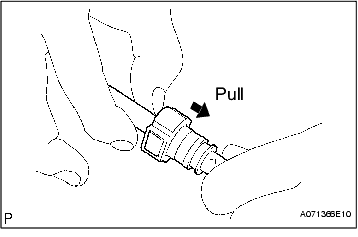
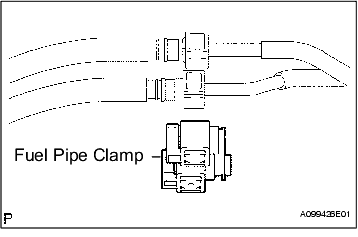
(d) Observe these precautions when connecting the fuel tube connector (quick type).
(1) Check there is no damage or contamination in the connected part of the pipe.
(2) Align the axis of the connector with the axis of the pipe. Push the pipe into the connector until the connector makes a 'click' sound. If the connection is tight, apply a small amount of fresh engine oil on the tip of the pipe.
(3) After having finished the connection, try to pull apart the pipe and the connector and confirm they are securely connected.
(4) w/ fuel pipe clamp type: Install the fuel pipe clamp to the connector.
(5) w/ fuel hose connector cover type: Engage the lock claws to the connector by pushing down on the cover, as shown in the illustration.
(6) Check there is no fuel leakage.
-
3. CHECK FOR FUEL LEAKS
(a) Check there are no fuel leaks after performing maintenance anywhere on the fuel system.
-
ON-VEHICLE INSPECTION
1. CHECK FOR FUEL PUMP OPERATION AND FUEL LEAKS
(a) Connect the intelligent tester to the DLC3.
(1) Turn the ignition switch ON.
NOTICE:
Do not start the engine.
(2) Push the intelligent tester main switch ON.
(3) Select Active Test and enter the following menus: Powertrain / Engine and ECT / Active Test / Control the Fuel Pump / Speed.
-
(b) Check fuel pump operation.
(1) Check for pressure in the fuel inlet tube from the fuel line. Check if the sound of fuel flowing in the fuel tank can be heard.
If there is no sound, check the integration relay, fuel pump, ECM and wiring connector.
-
(c) Check for fuel leaks.
(1) Check there are no fuel leaks after performing maintenance anywhere on the system.
If there are fuel leaks, repair or replace the leaking part.
-
2. CHECK FUEL PRESSURE
(a) Check the battery voltage is above 12 V.
-
(b) Discharge the fuel system pressure (
Click Here
)
-
(c) Disconnect the cable from negative (-) battery terminal.
HINT:
Obtain the audio system PIN from the vehicle owner, if applicable. Otherwise the audio system will be inoperable when the battery cable is reconnected.
-
(d) Pinch and pull the No. 1 fuel hose (fuel tube connector) to disconnect it from the fuel filter.
CAUTION:
• Do not smoke or be near an open flame when working on the fuel system.
• Keep gasoline away from rubber or leather parts.
• Fuel may spray from the tube as a result of retained pressure. Do not allow fuel to be sprayed in the engine compartment.
-
(e) Install SST (pressure gauge) as shown in the illustration.
SST
09268-31011
(90467-13001
95336-08070
09268-41500
09268-41120)
09268-45014
(09268-41200
09268-41220)
-
(f) Wipe off any fuel.
-
(g) Reconnect the negative (-) battery cable.
-
(h) Operate the fuel pump.
(1) Connect the intelligent tester to the DLC3.
(2) Turn the ignition switch ON.
NOTICE:
Do not start the engine.
(3) Push the intelligent tester main switch ON.
(4) Select Active Test and enter the following menus: Powertrain / Engine and ECT / Active Test / Control the Fuel Pump / Speed.
-
(i) Measure the fuel pressure.
Fuel pressure:
281 to 287 kPa (2.87 to 2.93 kgf/cm2, 40.8 to 41.7 psi)
If the pressure is higher than the specification, replace the fuel pressure regulator.
If the pressure is lower than the specification, check the fuel hoses and connections, fuel pump, fuel filter and fuel pressure regulator.
-
(j) Start the engine.
-
(k) Measure the fuel pressure.
Fuel pressure:
281 to 287 kPa (2.87 to 2.93 kgf/cm2, 40.8 to 41.7 psi)
If the pressure is not as specified, check the fuel pump, pressure regulator and/or injectors.
-
(l) Stop the engine.
-
(m) Check the fuel pressure remains as specified for 5 minutes after the engine has stopped.
Fuel pressure:
147 kPa (1.5 kgf/cm2, 21psi) or more.
If the pressure is not as specified, check the fuel pump, pressure regulator and/or injectors.
-
(n) After checking the fuel pressure, disconnect the negative (-) battery cable and carefully remove SST and the fuel tube connector to prevent fuel from spraying.
-
(o) Reconnect the No. 1 fuel hose (fuel tube connector).
-
(p) Check for fuel leaks (
Click Here
)
-