CONDENSER (for 1KD-FTV, 2KD-FTV) > INSTALLATION |
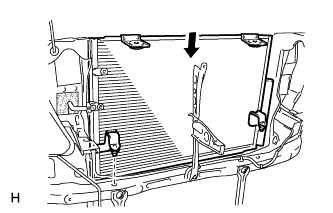
| 1. INSTALL COOLER CONDENSER ASSEMBLY |
|
Install the cooler condenser assembly.
| 2. INSTALL UPPER RADIATOR SUPPORT SUB-ASSEMBLY |
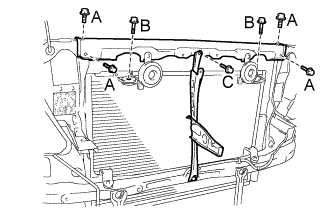 |
Install the upper radiator support sub-assembly with the 7 bolts.
| 3. INSTALL HOOD LOCK ASSEMBLY |
for LHD:
for RHD:
| 4. INSTALL AIR CONDITIONING TUBE AND ACCESSORY ASSEMBLY |
Remove the vinyl tape attached to the air conditioning tube and accessory assembly and connecting part of the cooler condenser.
Sufficiently apply compressor oil to a new O-ring and the fitting surface of the air conditioning tube and accessory assembly joint.
Install the O-ring to the air conditioning tube and accessory assembly.
Install the air conditioning tube and accessory assembly to the cooler condenser with the bolt.
| 5. INSTALL NO. 1 COOLER REFRIGERANT DISCHARGE HOSE |
Remove the vinyl tape attached to the No. 1 cooler refrigerant discharge hose and connecting part of the cooler condenser.
Sufficiently apply compressor oil to a new O-ring and the fitting surface of the No. 1 cooler refrigerant discharge hose joint.
Install the O-ring to the No. 1 cooler refrigerant discharge hose.
Install the No. 1 cooler refrigerant discharge hose to the cooler condenser with the bolt.
| 6. INSTALL FRONT BUMPER COVER |
| 7. CHARGE REFRIGERANT |
Perform vacuum purging using a vacuum pump.
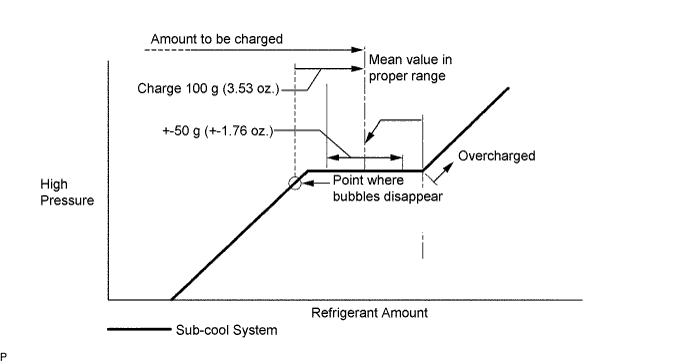
Charge refrigerant HFC-134a (R134a).
| 8. WARM UP ENGINE |
Warm up the engine at less than 1,850 rpm for 2 minutes or more after charging refrigerant.
| 9. CHECK FOR REFRIGERANT GAS LEAK |
After recharging the refrigerant gas, check for refrigerant gas leakage using a halogen leak detector.
After recharging the refrigerant gas, prepare the vehicle for a refrigerant gas leakage check by making sure the following conditions are met.
The ignition switch is OFF.
The vehicle is in a place with good air ventilation and without any volatile gases, such as evaporated gasoline or exhaust gas. The detector is very sensitive gases, If volatile gases are unavoidable, the vehicle must be lifted up.
Some refrigerant is remaining in the refrigerant system.
The compressor is OFF and its pressure is approximately 392 to 588 kPa (4 to 6 kgf/cm2).
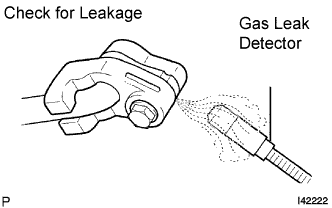 |
Using a gas leak detector, check the refrigerant line for leakage.
If a gas leak is not detected on the drain hose, remove the blower motor control (blower resistor) from the cooling unit. Insert the gas leak detector sensor into the unit and perform the test.
Disconnect the connector and leave the pressure switch on for approximately 20 minutes. Bring the gas leak detector close to the pressure switch and perform the test.