5L-E ENGINE CONTROL ECD SYSTEM P0180 Fuel Temperature Sensor "A" Circuit
DESCRIPTION
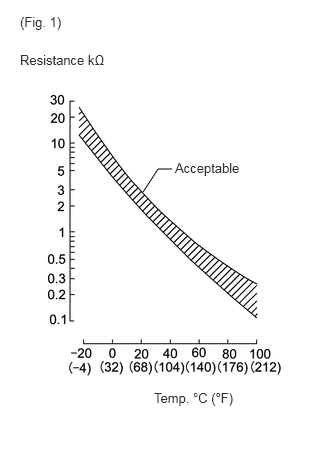
The fuel temperature sensor senses the fuel temperature. A thermistor built into the sensor changes the resistance value according to the fuel temperature. The lower the fuel temperature, the greater the thermistor resistance value, and the higher the fuel temperature, the lower the thermistor resistance value (See Fig. 1).
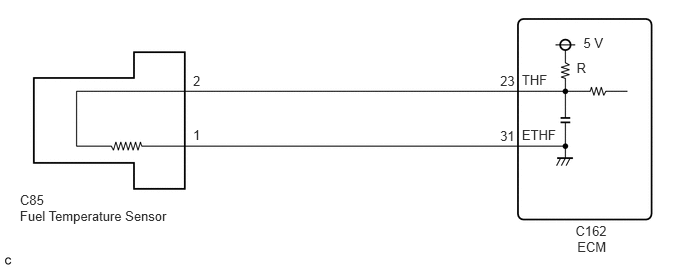
The fuel temperature sensor is connected to the ECM. The 5 V power source voltage in the ECM is applied to the fuel temperature sensor from terminal THF via a resistor R. That is, resistor R and the fuel temperature sensor are connected in series. When the resistance value of the fuel temperature sensor changes in accordance with changes in the fuel temperature, the potential at the terminal THF also changes. Based on this signal, the ECM increases the fuel injection volume to improve driveability during low engine revolution and high fuel temperature.
| DTC No. | DTC Detection Condition | Trouble Area |
|---|---|---|
| P0180 | Open or short in fuel temperature sensor circuit for 0.5 seconds or more. | ·
Open or short in fuel temperature sensor circuit ·
Fuel temperature sensor ·
ECM |
WIRING DIAGRAM
CAUTION / NOTICE / HINT
- HINT:
-
Read freeze frame data using the GTS. Freeze frame data records the engine condition when malfunctions are detected. When troubleshooting, freeze frame data can help determine if the vehicle was moving or stationary, if the engine was warmed up or not, and other data from the time the malfunction occurred.
PROCEDURE
Connect the GTS to the DLC3.
Turn the ignition switch to ON and turn the GTS on.
Enter the following menus: Powertrain / Engine and ECT / Data List / Fuel Temperature.
Read the value.
- Result:
Display Proceed -40°C (-40°F) A 140°C (284°F) or more B The same as actual fuel temperature C
- HINT:
- ·
If there is an open circuit, the GTS indicates -40°C (- 40°F).
·If there is a short circuit, the GTS indicates 140°C (284°F) or higher.
A
B
C
Disconnect the fuel temperature sensor connector.
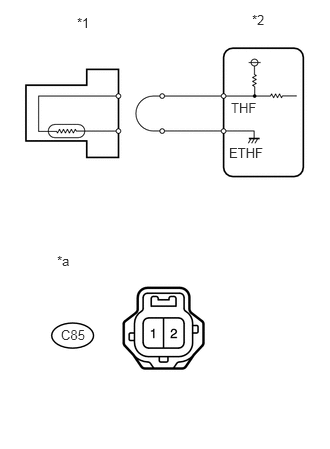
Connect terminals 2 and 1 of the fuel temperature sensor connector.
Connect the GTS to the DLC3.
Turn the ignition switch to ON and turn the GTS on.
Enter the following menus: Powertrain / Engine and ECT / Data List / Fuel Temperature.
Read the value.
- OK:
140°C (284°F) or higher
| *1 | Fuel Temperature Sensor |
| *2 | ECM |
| *a | Front view of wire harness connector
(to Fuel Temperature Sensor) |
OK
NG
Disconnect the fuel temperature sensor connector.
Disconnect the ECM connector.
Measure the resistance according to the value(s) in the table below.
- Standard Resistance:
Tester Connection Condition Specified Condition C85-2 - C162-23 (THF) Always Below 1 Ω C85-1 - C162-31 (ETHF) Always Below 1 Ω
OK
NG
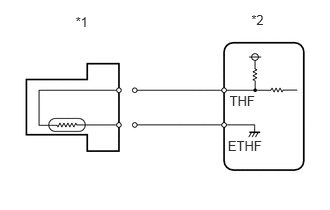
Disconnect the fuel temperature sensor connector.
Connect the GTS to the DLC3.
Turn the ignition switch to ON and turn the GTS on.
Enter the following menus: Powertrain / Engine and ECT / Data List / Fuel Temperature.
Read the value.
- OK:
-40°C (-40°F)
| *1 | Fuel Temperature Sensor |
| *2 | ECM |
Reconnect the fuel temperature sensor connector.
OK
NG
Disconnect the fuel temperature sensor connector.
Disconnect the ECM connector.
Measure the resistance according to the value(s) in the table below.
- Standard Resistance:
Tester Connection Condition Specified Condition C85-2 or C162-23 (THF) - Body ground Always 10 kΩ or higher
OK
NG