1KD-FTV ENGINE CONTROL ECD SYSTEM P0340 Camshaft Position Sensor "A" Circuit (Bank 1 or Single Sensor)
DESCRIPTION
The camshaft position sensor (G signal) consists of a magnet, iron core and pickup coil.
The G signal plate (timing pulley) has five teeth on its outer circumference and is installed on the camshaft. When the camshaft rotates, the protrusion on the signal plate and the air gap on the pickup coil change, causing fluctuations in the magnetic field that generate a voltage in the pickup coil.
The NE signal plate has 34 teeth and is mounted on the crankshaft angle sensor plate. The NE signal sensor generates 34 signals for every revolution. The ECM detects the camshaft angle based on the G signal, and detects the crankshaft angle based on the NE signal.
| DTC Detection Drive Pattern | DTC Detection Condition | Trouble Area |
|---|---|---|
| Crank engine for 4 seconds (STA on) | STA on:
No camshaft position sensor signal is sent to the ECM while cranking for 4 seconds or more (2 trip detection logic)*1 (1 trip detection logic)*2. |
·
Open or short in camshaft position sensor circuit ·
Camshaft position sensor ·
Camshaft timing pulley ·
ECM |
| Idle engine for 1 second (STA off) | STA off:
Either condition is met for 1 second (1 trip detection logic): ·
G signal is not input with an engine speed of 650 rpm or more. ·
No camshaft position sensor signal is sent to the ECM with an engine speed of 650 to 3000 rpm 20 times or more. |
*1: Only for vehicle Euro-OBD.
*2: Only for vehicle except Euro-OBD.
- HINT:
If DTC P0340 is stored, the following symptoms may appear:
-Difficulty starting
-Misfire
-Combustion noise
-Black smoke
-White smoke
-Lack of power
WIRING DIAGRAM
Refer to DTC P0335 (See page Engine / Hybrid System>1KD-FTV (ENGINE CONTROL)>ECD SYSTEM>P0335).
CAUTION / NOTICE / HINT
- NOTICE:
-
After replacing the ECM, the new ECM needs registration (See page Engine / Hybrid System>1KD-FTV (ENGINE CONTROL)>ECD SYSTEM>REGISTRATION) and initialization (See page Engine / Hybrid System>1KD-FTV (ENGINE CONTROL)>ECD SYSTEM>INITIALIZATION).
- HINT:
-
Read freeze frame data using the intelligent tester. Freeze frame data records the engine condition when malfunctions are detected. When troubleshooting, freeze frame data can help determine if the vehicle was moving or stationary, if the engine was warmed up or not, and other data from the time the malfunction occurred.
PROCEDURE
Inspect the camshaft position sensor (See page Engine / Hybrid System>1KD-FTV (ENGINE CONTROL)>CAMSHAFT POSITION SENSOR>INSPECTION).
OK
NG
Disconnect the camshaft position sensor connector.
Disconnect the ECM connector.
Measure the resistance according to the value(s) in the table below.
- Standard Resistance (Check for Open):
Tester Connection Condition Specified Condition C52-1 - C92-13 (G+) Always Below 1 Ω C52-2 - C92-14 (G-) Always Below 1 Ω
- Standard Resistance (Check for Short):
Tester Connection Condition Specified Condition C52-1 or C92-13 (G+) - Body ground Always 10 kΩ or higher C52-2 or C92-14 (G-) - Body ground Always 10 kΩ or higher
Reconnect the camshaft position sensor connector.
Reconnect the ECM connector.
OK
NG
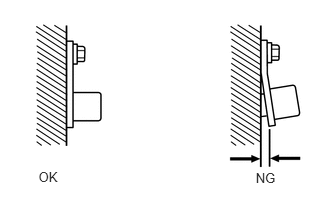
Check the sensor installation.
- OK:
Sensor is installed correctly.
OK
NG
Check the condition of the camshaft timing pulley.
- OK:
Timing pulley does not have any cracks or deformation.
OK
NG
Replace the ECM (See page Engine / Hybrid System>1KD-FTV (ENGINE CONTROL)>ECM>REMOVAL).
NEXT
Replace the camshaft position sensor (See page Engine / Hybrid System>1KD-FTV (ENGINE CONTROL)>CAMSHAFT POSITION SENSOR>REMOVAL).
NEXT
Repair or replace the harness or connector.
NEXT
Securely reinstall the sensor (See page Engine / Hybrid System>1KD-FTV (ENGINE CONTROL)>CAMSHAFT POSITION SENSOR>INSTALLATION).
NEXT
Replace the camshaft timing pulley (See page Engine / Hybrid System>1KD-FTV (FUEL)>FUEL SUPPLY PUMP>REMOVAL).
NEXT
Connect the intelligent tester to the DLC3.
Clear the DTCs (See page Engine / Hybrid System>1KD-FTV (ENGINE CONTROL)>ECD SYSTEM>DTC CHECK / CLEAR).
Turn the ignition switch off for 30 seconds or more.
Start the engine and idle it for 4 seconds or more.
Enter the following menus: Powertrain / Engine and ECT / DTC.
Confirm that the DTC is not output again.
NEXT