1HZ EMISSION CONTROL EMISSION CONTROL SYSTEM ON-VEHICLE INSPECTION
CAUTION / NOTICE / HINT
- NOTICE:
-
Always stop the engine when installing or removing vacuum gauges, or when removing the vacuum hoses.
- HINT:
-
In a malfunction where the EGR system is always on, black or white smoke may be emitted from the exhaust pipe assembly. If this occurs, inspect the EGR system also.
PROCEDURE

 1.VISUALLY INSPECT HOSES, CONNECTIONS AND GASKETS
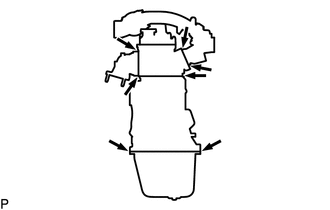
Visually check that the hoses, connections and gaskets have no cracks, leaks or damage.
- NOTICE:
-
Detachment or other problems with the engine oil level dipstick, oil filler cap, ventilation hose and other components may cause the engine to run improperly.
If the result is not as specified, replace parts as necessary.
25620 2.INSPECT EGR VALVE ASSEMBLY
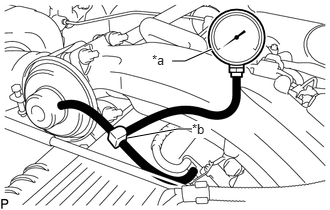
| *a | Vacuum Gauge |
| *b | 3-Way Connector |
Using a 3-way connector, connect a vacuum gauge to the hose between the EGR valve assembly and vacuum switching valve assembly (for EGR Cut).
Check the seating of the valve.
Start the engine and check that the engine starts and then idles.
Check "cold" engine condition.
The engine coolant temperature should be below 20°C (68°F).
Check the vacuum gauge indicates zero at idle.
Check "hot" engine condition.
Warm up the engine.
- HINT:
-
The coolant temperature should be between 70°C (158°F) and 96°C (205°F).
Check that the vacuum gauge indicates about 44 kPa (330 mmHg, 12.9 in.Hg) at idle.
Check that the vacuum gauge indicator increases about 44 kPa (330 mmHg, 12.9 in.Hg) at 1500 rpm.
When the accelerator pedal is quickly depress to the full open, check that the vacuum gauge indicator drops momentarily.
Keep the engine speed at more than 4000 rpm.
Check that the vacuum gauge indicates zero.
When the accelerator pedal is released, check that the vacuum gauge indicator reading drops momentarily while the engine speed decreases from more than 4000 rpm to idle.
89421D 3.CHECK MANIFOLD ABSOLUTE PRESSURE SENSOR
4.INSPECT FOR VACUUM PUMP
Disconnect the vacuum hose from the vacuum pump.
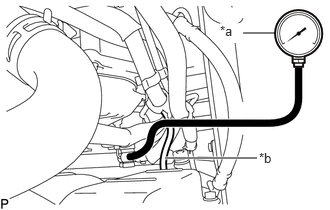
| *a | Vacuum Gauge |
| *b | Disconnect |
Connect the hose of a vacuum gauge to the vacuum pump.
With the engine idling, check the negative pressure of the vacuum pump.
- Standard negative pressure:
-
More than 87 kPa (650 mmHg, 25.6 in.Hg)
If the result is not as specified, replace the vacuum pump.
Remove the vacuum gauge from the vacuum pump.
Connect the vacuum hose to the vacuum pump.
5.INSPECT BOOST ALTITUDE COMPENSATIONAL STOPPER SYSTEM
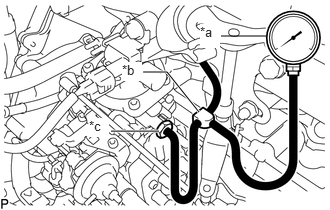
| *a | Vacuum Gauge |
| *b | 3-Way Connector |
| *c | BACS Union |
Using a 3-way connector, connect a vacuum gauge to the hose between the BACS union and vacuum switching valve assembly (for BACS).
Warm up the engine.
- HINT:
-
Confirm that the engine coolant temperature is 70°C (104°F).
When the adjusting lever of the injection pump is quickly pushed to full open, check that the vacuum gauge indicator slowly increases from 0 to 44 kPa (330 mmHg, 12.9 in.Hg).
If no problem is found with this inspection, system is normal; Otherwise inspection each part.
Remove the vacuum gauge from the BACS union and vacuum switching valve assembly (for BACS).