 |
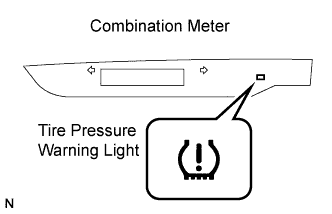
If the tire pressure warning light comes on, immediately check the tire pressure and adjust them to the specified value.
- Cold tire inflation pressure:
Tire size Front kPa (kgf/cm2, psi) Rear kPa (kgf/cm2, psi) P185/65R15
P195/55R15240 (2.4, 35) 230 (2.3, 33)
If the tire pressure warning light comes on after blinking for 1 minute, there is a malfunction in the system. Check for DTCs.
It is necessary to register the transmitter ID in the tire pressure warning ECU after replacing the tire pressure warning valve and transmitter and/or tire pressure warning ECU (Click here).
When replacing the tire pressure warning ECU;
Using the Data List, read the transmitter IDs registered in the ECU and make a note of them before removing the tire pressure warning ECU.
Register the transmitter IDs after installing a new tire pressure warning ECU.
When replacing the tire pressure warning valve and transmitter;
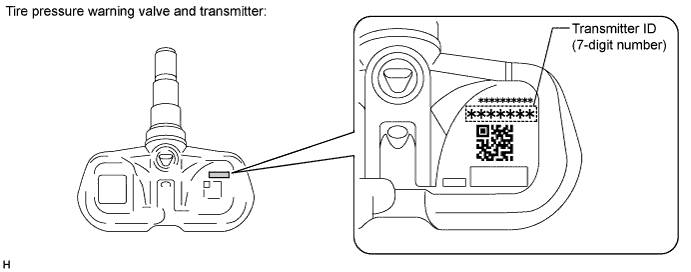
Take a note of the 7-digit number (transmitter ID) written on the tire pressure warning valve and transmitter when replacing the old one. Register the transmitter IDs in the tire pressure warning ECU after replacing the tire pressure warning valve and transmitter and installing the tires and wheels on the vehicle.
- NOTICE:
- The transmitter ID is written on the tire pressure warning valve and transmitter. It will be unable to be read after installing the tire pressure warning valve and transmitter on the tire and wheel. Therefore, take a note of the transmitter ID before installing the tire pressure warning valve and transmitter.
When replacing the tire pressure warning ECU and the tire pressure warning valve and transmitters:
It is necessary to perform the initialization (Click here) after the registration (Click here).
Precautions about the tire pressure;
- The tire pressures decrease naturally.
- In winter, tire pressure may decrease due to low ambient temperatures (tire pressure decreases by approximately 10 kPa (0.1 kgf/cm2, 1.45 psi) for every 10°C (50°F) drop in the ambient temperature). Therefore, the tire pressure warning system is more likely to operate if the tire pressures are not adjusted appropriately. If the daily temperature variation is large, pressurize the tires high so that the tire pressures are suitable under cold conditions. As a result, incorrect tire pressure warning system operation should decrease.