ON-VEHICLE INSPECTION
Inspection · Vehicles built from Aug 2007
| CHECK IGNITION COIL ASSEMBLY AND PERFORM SPARK TEST |

- NOTICE:
- In this section, the terms "Cold" and "Hot" refer to the temperature of the sensor. "Cold" means approximately -10 to 50°C (14 to 122°F). "Hot" means approximately 50 to 100°C (122 to 212°F).
Check the DTCs.
- NOTICE:
- If a DTC is present, perform troubleshooting in accordance with the procedure for that DTC.
Check that sparks occur.
Remove the V-bank cover.
Disconnect the throttle body connector.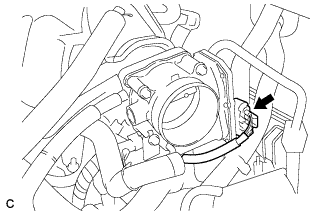

Remove the 4 bolts then separate the throttle body.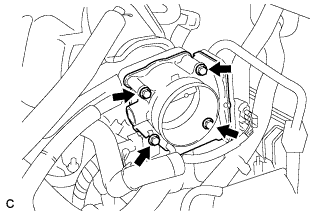
Remove the intake air surge tank (Click here).
Remove the bolt and ignition coil.
Using a 16 mm spark plug wrench, remove the spark plugs.
Disconnect the 6 fuel injector connectors.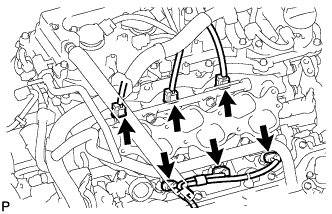
Install the spark plug into the ignition coil, and then connect the ignition coil connectors.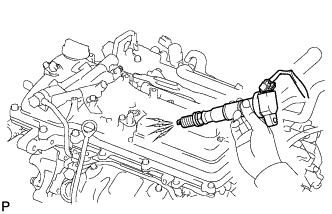
Ground the spark plug.
Check that spark occurs at the spark plug while the engine is being cranked.
- NOTICE:
- Be sure to ground the spark plugs when checking them.
- If an ignition coil has been struck or dropped, replace it.
- Do not crank the engine for more than 2 seconds.
- Be sure to ground the spark plugs when checking them.
Using a 16 mm plug wrench, install the spark plug.
- Torque:
- 18 N*m{ 184 kgf*cm , 13 ft.*lbf }
Install the ignition coil with the bolt.
- Torque:
- 9.0 N*m{ 92 kgf*cm , 80 in.*lbf }
Connect the 6 fuel injector connectors.
Install the intake air surge tank (Click here).
Install the V-bank cover.
Perform troubleshooting using the following steps.
Check that the ignition coil connectors are securely connected.
- Result:
Result
Action
NG
Connect securely
OK
Go to next step
Perform a spark test on each ignition coil.
- Replace the ignition coil with a known good one as necessary.
- Perform the spark test again.
- Result:
Result
Action
OK
Replace ignition coil
NG
Go to next step
- Replace the ignition coil with a known good one as necessary.
Check the power supply to the ignition coil.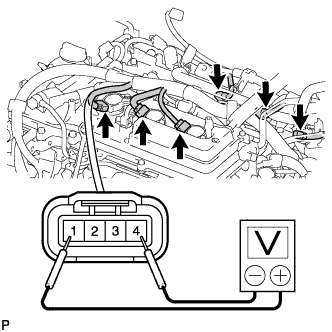
- Disconnect the ignition coil connector.
- Turn the ignition switch on (IG).
- Measure the voltage of the wire harness side connector.
- Standard voltage:
Tester Connection
Specified Condition
1 (+B) - 4 (GND)
9 to 14 V
- Result:
Result
Action
NG
Check wire harness and connector
OK
Go to next step
- Disconnect the ignition coil connector.
Check the resistance of the crankshaft position sensor.
- Standard resistance:
Temperature Condition
Specified Condition
Cold
1630 to 2740 Ω
Hot
2065 to 3225 Ω
- Result:
Result
Action
NG
Replace crankshaft position sensor
OK
Go to next step
Check the IGT signal from the ECM.
- Result:
Result
Action
NG
Check ECM (Click here)
OK
Repair wiring between ignition coil and ECM
| CHECK SPARK PLUG |
Check the electrode using a megohmmeter: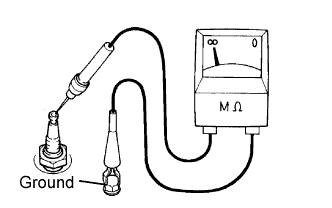
Using a megohmmeter, measure the insulation resistance.
- Standard insulation resistance:
- 10 MΩ or more
Check the electrode without using a megohmmeter:
Quickly accelerate the engine to 4,000 rpm 5 times.
Remove the spark plug.
Visually check the spark plug.
If the electrode is dry, the spark plug is functioning properly. If the electrode is damp, proceed to the next step.
Check the spark plug for any damage on its threads and insulator.
If there is damage, replace the spark plug.- Recommended spark plug:
Manufacturer
Spark plug type
DENSO
FK20HR11
Check the spark plug electrode gap.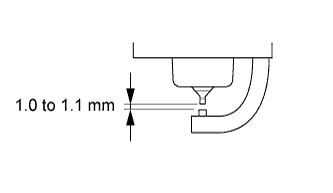
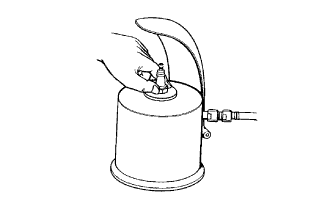
- Maximum electrode gap for used spark plug:
- 1.4 mm (0.055 in.)
- Electrode gap for new spark plug:
- 1.0 to 1.1 mm (0.039 to 0.043 in.)
- Standard air pressure:
- 588 kPa (6 kgf/cm2, 85 psi)
- Standard duration:
- 20 seconds or less
- HINT:
- Only use the spark plug cleaner when the electrode is free of oil. If the electrode has traces of oil, use gasoline to clean off the oil before using the spark plug cleaner.