BRAKE (REAR) REAR BRAKE INSPECTION
PROCEDURE

 1.CHECK BRAKE CYLINDER AND PISTON
Check the cylinder bore and piston for rust or scoring.
If necessary, replace the disc brake cylinder and piston.
2.CHECK PAD LINING THICKNESS
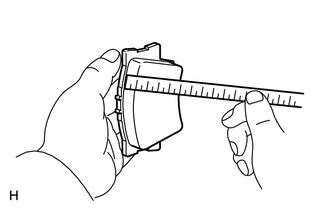
Using a ruler, measure the pad lining thickness.
- Standard thickness:
10.5 mm (0.413 in.)
- Minimum thickness:
1.0 mm (0.0394 in.)
If the pad lining thickness is less than the minimum, replace the pad.
3.CHECK REAR DISC BRAKE PAD SUPPORT PLATE
Check the 2 plates as follows. If necessary, replace the plates.
Use brake cleaner to clean the pad of the pad support plate and cylinder mounting contact surface. Inspect for deformation, cracks, rust and foreign matter that is difficult to remove.
Use brake cleaner to clean the pad support plate contact surface of the cylinder mounting. After installing the pad support plate to the cylinder mounting, inspect for looseness and deformation.
After installing the pad, check that the pad does not fall off easily (due to the spring force of the pad support plate being insufficient).
4.CHECK DISC THICKNESS
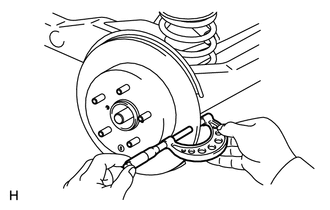
Using a micrometer, measure the disc thickness.
- Standard thickness:
12.0 mm (0.472 in.)
- Minimum thickness:
10.5 mm (0.413 in.)
If the disc thickness is less than the minimum, replace the disc.
5.CHECK DISC RUNOUT
Check the rear axle hub bearing looseness (Click hereDrivetrain>AXLE AND DIFFERENTIAL>REAR AXLE HUB>ON-VEHICLE INSPECTION) and rear axle hub runout (click hereDrivetrain>AXLE AND DIFFERENTIAL>REAR AXLE HUB>ON-VEHICLE INSPECTION).
Install the disc with the 5 hub nuts.
- Torque:
- 103 N*m (1050 kgf*cm, 76 ft.*lbf)
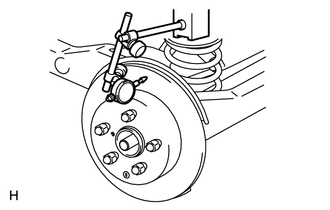
Using a dial indicator, measure the disc runout 10 mm (0.394 in.) from the outer edge of the disc.
- Maximum disc runout:
0.15 mm (0.00591 in.)
If the runout is more than the maximum, change the installation positions of the disc and axle so that the runout is the smallest possible.
If the runout is more than the maximum even when the installation positions are changed, grind the disc.
If the disc thickness is less than the minimum, replace the disc.
Remove the 5 hub nuts and disc.