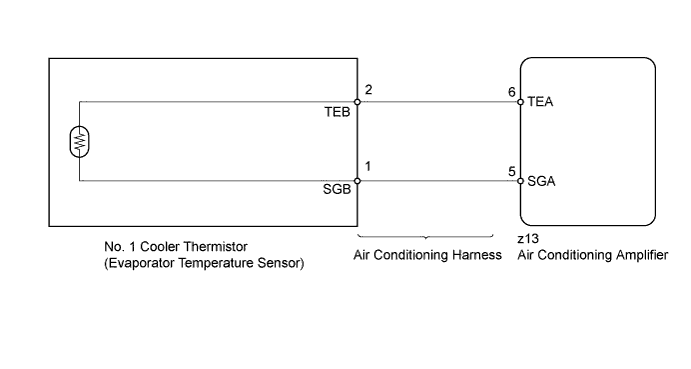
DTC B1413/13 Evaporator Temperature Sensor Circuit |
| DTC Code | DTC Detection Condition | Trouble Area |
| B1413/13 | Open or short in evaporator temperature sensor circuit |
|
| 1.READ VALUE USING TECHSTREAM (EVAPORATOR FIN THERMISTOR) |
Connect the Techstream to the DLC3.
Turn the ignition switch to ON.
Turn the Techstream on.
Enter the following menus: Body Electrical / Air Conditioner / Data List / Evaporator Fin Thermistor.
According to the display on the Techstream, read the Data List.
| Tester Display | Measurement Item/Range | Normal Condition | Diagnostic Note |
| Evaporator Fin Thermistor | Evaporator fin thermistor / Min.: -29.7°C (-21.46°F) Max.: 59.55°C (139.19°F) | Actual evaporator temperature is displayed | Open in circuit: -29.7°C (-21.46°F) Short in circuit: 59.55°C (139.19°F) |
| Result | Proceed to |
| NG | A |
| OK (When troubleshooting according to Problem Symptoms Table) | B |
| OK (When troubleshooting according to the DTC output) | C |
|
| ||||
|
| ||||
| A | |
 |
| 2.INSPECT NO. 1 COOLER THERMISTOR (EVAPORATOR TEMPERATURE SENSOR) |
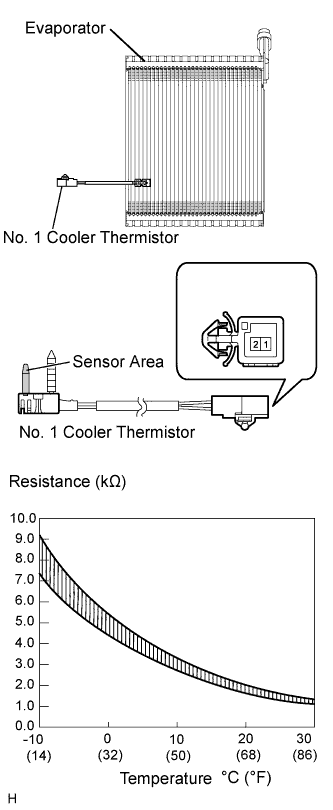 |
Remove the No. 1 cooler thermistor (evaporator temperature sensor) connector (Click here).
Measure the resistance according to the value(s) in the table below.
| Tester Connection | Condition | Specified Condition |
| 1 - 2 | -10°C (14°F) | 7.30 to 9.10 kΩ |
| -5°C (23°F) | 5.65 to 6.95 kΩ | |
| 0°C (32°F) | 4.40 to 5.35 kΩ | |
| 5°C (41°F) | 3.40 to 4.15 kΩ | |
| 10°C (50°F) | 2.70 to 3.25 kΩ | |
| 15°C (59°F) | 2.14 to 2.58 kΩ | |
| 20°C (68°F) | 1.71 to 2.05 kΩ | |
| 25°C (77°F) | 1.38 to 1.64 kΩ | |
| 30°C (86°F) | 1.11 to 1.32 kΩ |
Reinstall the No. 1 cooler thermistor (evaporator temperature sensor) connector.
|
| ||||
| OK | |
|
| 3.INSPECT AIR CONDITIONING HARNESS |
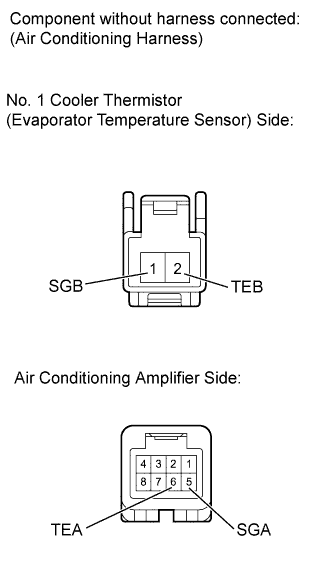 |
Remove the air conditioning harness.
Measure the resistance according to the value(s) in the table below.
| Tester Connection | Condition | Specified Condition |
| 1 (SGB) - 5 (SGA) | Always | Below 1 Ω |
| 2 (TEB) - 6 (TEA) | Always | Below 1 Ω |
| 1 (SGB) - 6 (TEA) | Always | 10 kΩ or higher |
| 2 (TEB) - 5 (SGA) | Always | 10 kΩ or higher |
Reinstall the air conditioning harness.
|
| ||||
| OK | ||
 | ||
| ||
