Home › Suspension › TIRE PRESSURE MONITORING › TIRE PRESSURE WARNING VALVE

TIRE PRESSURE WARNING VALVE > INSTALLATION

for Preparation Click here


1. INSTALL TIRE PRESSURE WARNING VALVE AND TRANSMITTER
  1. When reusing the tire pressure warning valve and transmitter, install a new grommet to it.

    NOTICE:
    Install a new grommet even if the removed one is not damaged.

    HINT:
    A new tire pressure warning valve and transmitter comes with a grommet. Therefore, it is not necessary to install a new grommet.


    C153797E01
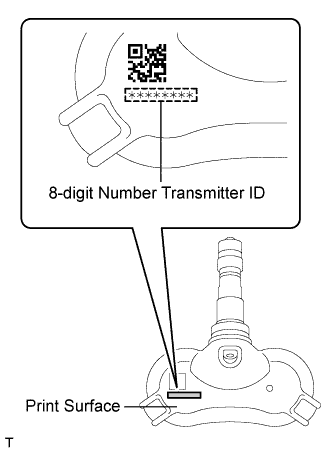
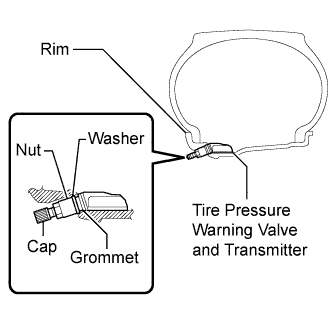
  1. Insert the tire pressure warning valve and transmitter from the inside of the rim into the valve installation hole so that the print surface can be seen.

    NOTICE:
    1. Check that there is no oil, water or lubricant around the rim hole, tire pressure warning valve and transmitter, washer and nut. Failing to do so may result in improper installation.
    2. Check that there is no visible deformation, damage or other abnormalities on the tire pressure warning valve and transmitter.
    3. Check that there is no foreign matter on the inner grommet and around the rim hole.
    4. If the tire pressure warning valve and transmitter is installed upside down, it may be damaged or fail to transmit signals when running at high speeds.
    5. If installing a new tire pressure warning valve and transmitter, write down the ID number before installation.
    6. It is necessary to perform initialization (Click here) after registration of the transmitter IDs into the tire pressure warning ECU (Click here).
    C139137E04
  1. Install a new washer and new nut on the tire pressure warning valve and transmitter from the rim side.

    Torque:
    4.0 N*m{ 41 kgf*cm , 35 in.*lbf }

    NOTICE:
    1. No further tightening is required once the nut is tightened to the specified torque.
    2. Check that there is no foreign matter on the washer and nut.


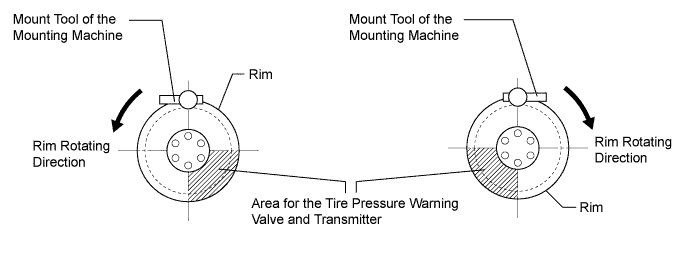
  1. Set the wheel disc to a mounting machine and install the lower tire bead. At this time, position the main body of the tire pressure warning valve and transmitter in the shaded area shown in the illustration.


    C172710E01

    NOTICE:
    1. If the tire pressure warning valve and transmitter is positioned outside this area, it interferes with the tire bead, possibly causing damage to the tire pressure warning valve and transmitter.
    2. If the use of lubricant is required when installing the bead, do not apply the lubricant directly to the tire pressure warning valve and transmitter.

  1. Install the upper bead.

    NOTICE:
    Make sure that the tire bead and tool do not interfere with the main body of the tire pressure warning valve and transmitter and that the tire pressure warning valve and transmitter is not clamped by the bead.

  1. Install the valve core to the tire pressure warning valve and transmitter.

  1. Inflate the tire. If the valve nut is loose after inflating the tire, retighten the nut to the specified torque and then check for air leaks with soapy water.

    Torque:
    4.0 N*m{ 41 kgf*cm , 35 in.*lbf }

    NOTICE:
    Do not tighten the nut further after tightening it to the specified torque.

  1. Adjust the air pressure of the tires to the specified value.

  1. Install the cap to the tire pressure warning valve and transmitter.


2. INSTALL FRONT WHEEL

Torque:
for Aluminum Wheel:
131 N*m{ 1336 kgf*cm , 97 ft.*lbf }
for Steel Wheel:
209 N*m{ 2131 kgf*cm , 154 ft.*lbf }


3. INSTALL REAR WHEEL

Torque:
for Aluminum Wheel:
131 N*m{ 1336 kgf*cm , 97 ft.*lbf }
for Steel Wheel:
209 N*m{ 2131 kgf*cm , 154 ft.*lbf }


4. INSPECT TIRE
  1. Check the tires for wear and proper inflation pressure.

    Standard Cold Tire Inflation Pressure:
    Tire Size
    Front
    kPa (kgf/cm2, psi)
    Rear
    kPa (kgf/cm2, psi)
    P275/65R18
    230 (2.3, 33)
    230 (2.3, 33)
    P275/55R20
    210 (2.1, 30)
    230 (2.3, 33)


    R003031
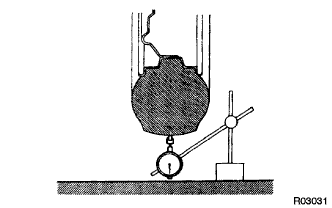
  1. Using a dial indicator, check the tire runout.

    Tire runout:
    3.0 mm (0.118 in.) or less


5. REGISTRATION TRANSMITTER ID
(Click here)


6. INITIALIZE SYSTEM
(Click here)


7. INSPECT TIRE PRESSURE WARNING SYSTEM
(Click here)