CHASSIS STEERING GENERAL/CONTROL/DETAILS VARIABLE FLOW CONTROL (VFC) POWER STEERING
General
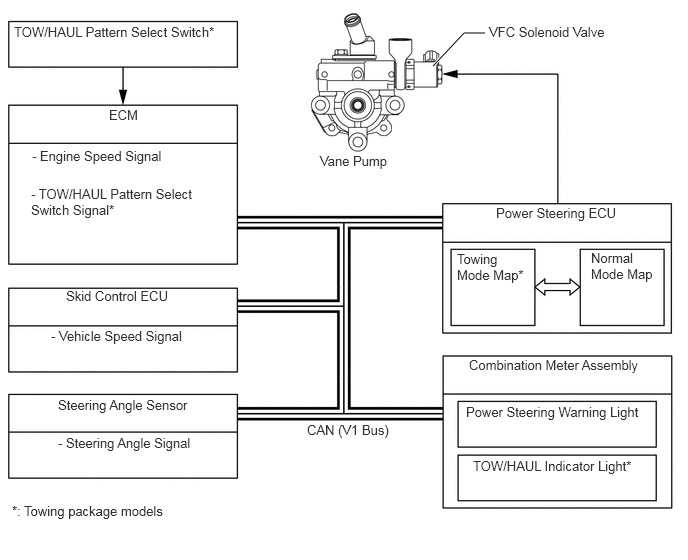
The VFC power steering is provided with a solenoid valve, which is controlled by the power steering ECU, in the vane pump. The solenoid valve controls the discharge flow rate of the power steering fluid in accordance with the operating conditions of the steering wheel, vehicle speed, and engine speed. Thus, it reduces the load on the engine applied by the actuation of the vane pump, and improves fuel economy.
A towing mode has been added to towing package models to achieve better steering feel when towing.
Through use of the TOW/HAUL pattern select switch provided on the instrument panel, mode can be switched between normal and towing, offering a good steering feeling optimal to the selected mode.
When the mode is switched to normal or towing, the control map of flow rate control will be changed inside the power steering ECU.
System Diagram
Layout of Main Components
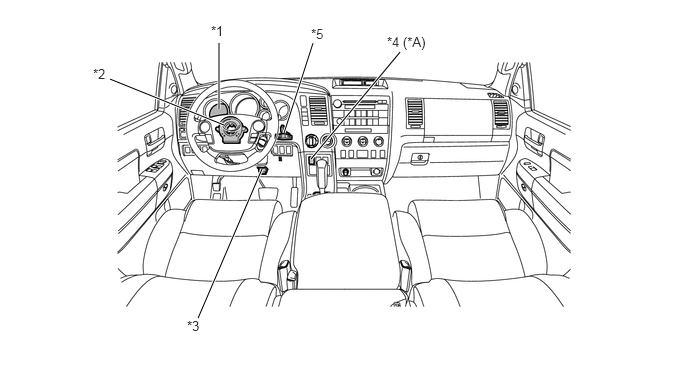
| *A | Towing Package Models | - | - |
| *1 | Combination Meter Assembly | *2 | Steering Angle Sensor |
| *3 | DLC3 | *4 | TOW/HAUL Pattern Select Switch |
| *5 | Power Steering ECU | - | - |
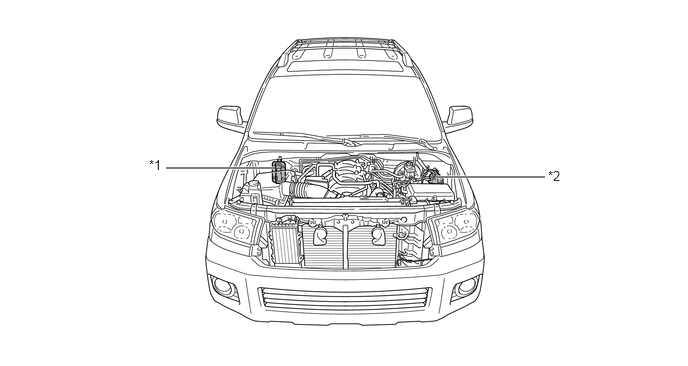
| *1 | ECM | *2 | Skid Control ECU |
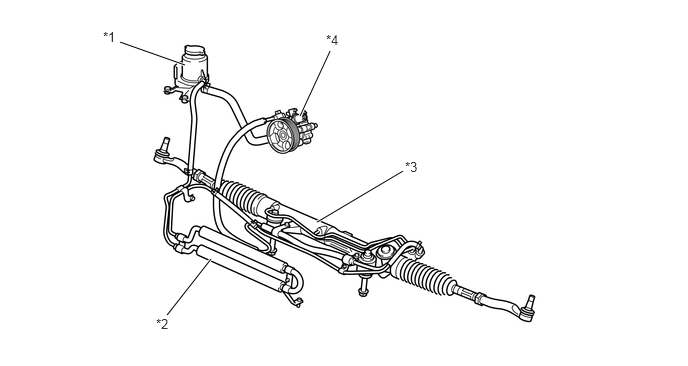
| *1 | Reservoir Tank | *2 | Oil Cooler |
| *3 | Steering Gear | *4 | Vane Pump
·
VFC Solenoid Valve |
Vane Pump
A compact and lightweight vane pump is used.
A VFC solenoid valve is provided to control the discharge flow rate.
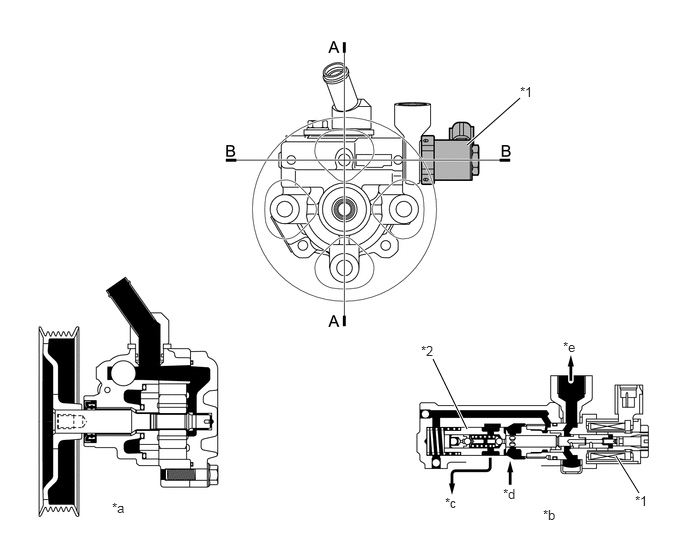
| *1 | VFC Solenoid Valve | *2 | Flow Control Valve |
| *a | A-A Cross Section | *b | B-B Cross Section |
| *c | To Reservoir Tank | *d | From Pump |
| *e | To Steering Gear | - | - |
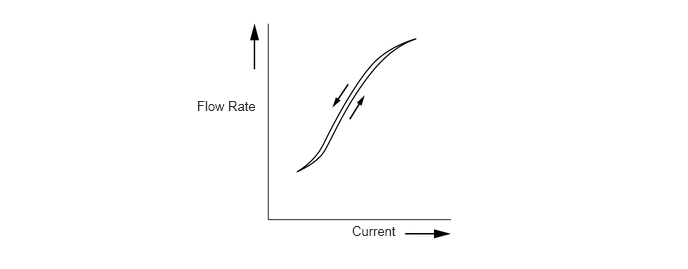
System Operation
The towing mode, which has been added to towing package models, performs flow rate control in order to prevent the steering from becoming too light when front wheel axle loads are reduced due to vehicle towing.
The power steering ECU effects the following controls:
| Flow Rate Control | Function |
|---|---|
| Standby Control or Assist Control (Basic Control) | It effects control in accordance with the vehicle speed, steering angle, and steering speed conditions. It effects assist control when the steering wheel is being operated and standby control when the steering wheel is not being operated. Thus, it prevents the vane pump from discharging excessive flow, which lightens the load on the engine and achieves better fuel economy. Also, the following corrections are made to determine an optimal discharge flow rate. |
| Steering Angle Correction | Determines the discharge flow rate in accordance with driving conditions, such as steering at standstill, cornering, or straightline driving. |
| Steering Return Correction | Determines the discharge flow rate for returning the steering wheel to its neutral position after the steering wheel is operated. |
| Engine Speed Correction | Determines the discharge flow rate in accordance with the engine speed. |
Flow Rate Control
Standby Control or Assist Control (Basic Control)
The standby control or assist control is performed in accordance with vehicle condition such as a vehicle speed, a steering angle, and a steering speed.
| Vehicle Condition | Standby Control | Assist Control |
|---|---|---|
| Vehicle speed 0 km/h (0 mph) | Steering Speed 0 deg/s (For 10 seconds or more) | Steering Speed more than 0 deg/s |
| Vehicle speed more than 0 km/h (0 mph) | Steering Angle less than 4.5° (For 10 seconds or more) | Steering Angle 4.5° or more |
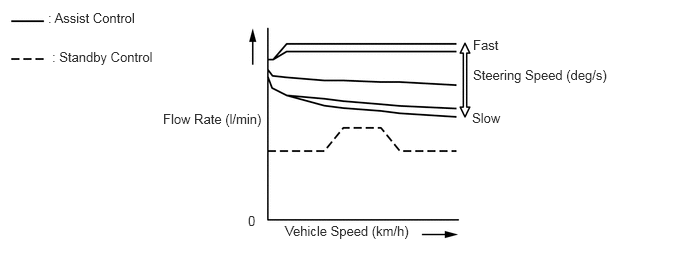
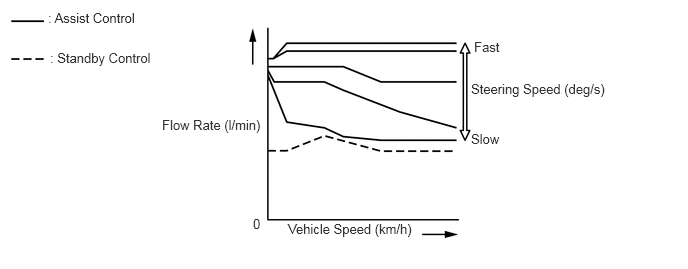
The assist flow rate is determined in accordance with the vehicle speed and steering speed.
For 3 seconds after the ignition switch is turned on, the flow rate is controlled at 10.5 l/min. After that, the flow rate is controlled as shown in the graph below.
Steering Angle Correction
Based on the steering angle and vehicle speed signals, this function corrects the flow rate in accordance with the driving conditions. Thus, it ensures an optimal steering feeling for every steering condition, such as steering at standstill, cornering, or straightline driving.
The correction flow rate decreases when the vehicle speed and steering angle increase.
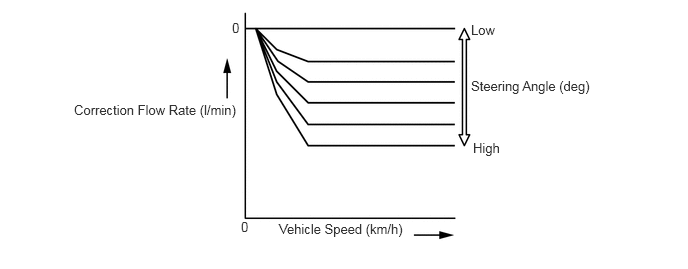
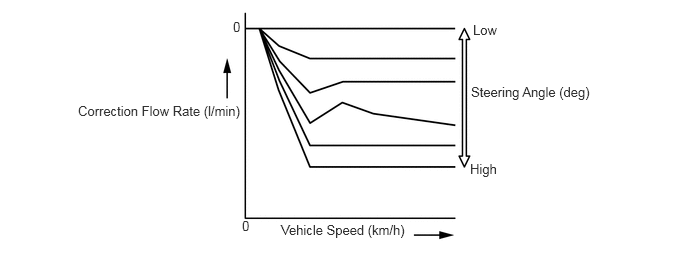
Steering Return Correction
To return the steering wheel to the neutral position quickly after a sudden lane change, the ordinary flow rate is insufficient, as it makes the steering feel heavy. The steering return correction increases the correction flow rate in accordance with the steering speed and vehicle speed, in order to ensure an optimal steering force and vehicle stability.
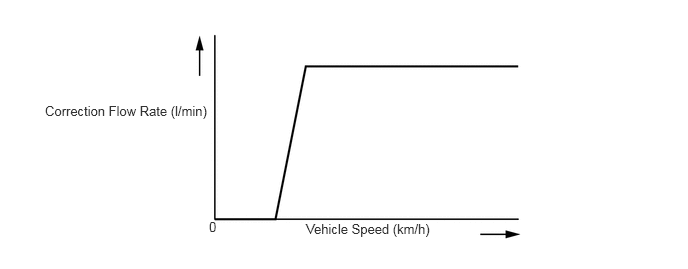
Engine Speed Correction
With the conventional vane pump, the flow rate increases when engine speed increases. The engine speed correction reduces the correction flow rate in accordance with the engine speed. This ensures optimal steering force, reduces engine load, and improves fuel economy.
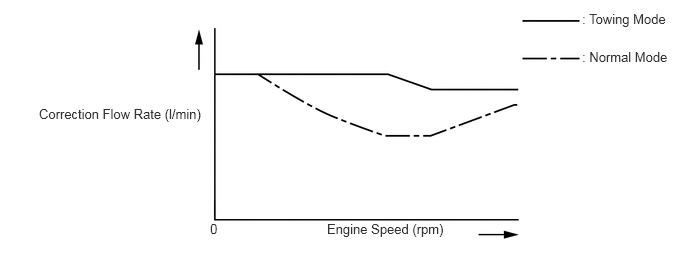
Fail-safe
If the power steering ECU detects a malfunction in this system, it illuminates the power steering warning light to alert the driver of the malfunction.
If a malfunction occurs in any of the sensors, the power steering control ECU effects the following fail-safecontrol.
| Malfunction | Flow Rate Control* | Correction | ||
|---|---|---|---|---|
| Steering Angle | Steering Return | Engine Speed | ||
| Steering Angle Signal | ·
Fixes steering angle at 0° ·
Fixes steering speed at 360 deg/s ·
Effects control when steering speed is 360deg/s |
X | X | ○ |
| Neutral Position Signal | ·
Fixes steering angle at 0° ·
Effects normal control |
X | X | ○ |
| Vehicle Speed Signal | ·
Fixes vehicle speed at 2 km/h (1.2 mph) ·
Effects control when vehicle speed is 2 km/h (1.2 mph) |
○ | ○ | ○ |
| Engine Speed Signal | ·
Fixes engine speed at 0 rpm ·
Effects normal control |
○ | ○ | X |
| Steering Angle and Neutral Position Signals | ·
Fixes steering angle at 0° ·
Fixes steering speed at 360 deg/s ·
Effects control when steering speed is 360 deg/s |
X | X | ○ |
| Steering Angle and Vehicle Speed Signals | ·
Fixes steering angle at 0° ·
Fixes steering speed at 360 deg/s ·
Fixes vehicle speed at 2 km/h (1.2 mph) ·
Controls flow rate at 8.5 l/min constantly |
X | X | X |
| Steering Angle and Engine Speed Signals | ·
Fixes steering angle at 0° ·
Fixes steering speed at 360 deg/s ·
Fixes engine speed at 0 rpm ·
Effects control when steering speed is 360 deg/s |
X | X | X |
| Neutral Position and Vehicle Speed Signals | ·
Fixes steering angle at 0° ·
Fixes vehicle speed at 2 km/h (1.2 mph) ·
Effects control when vehicle speed is 2 km/h (1.2 mph) |
X | X | ○ |
| Neutral Position and Engine Speed Signals | ·
Fixes steering angle at 0° ·
Fixes engine speed at 0 rpm ·
Effects normal control |
X | X | X |
| Vehicle Speed and Engine Speed Signals | ·
Fixes vehicle speed at 2 km/h (1.2 mph) ·
Fixes engine speed at 0 rpm ·
Effects control when vehicle speed is 2 km/h (1.2 mph) |
○ | ○ | X |
| Neutral Position, Vehicle Speed and Engine Speed Signals | ·
Fixes steering angle at 0° ·
Fixes vehicle speed at 2 km/h (1.2 mph) ·
Fixes engine speed at 0 rpm ·
Effects control when vehicle speed is 2 km/h (1.2 mph) |
X | X | X |
| Steering Angle, Vehicle Speed and Engine Speed Signals | ·
Fixes steering angle at 0° ·
Fixes steering speed at 360 deg/s ·
Fixes vehicle speed at 2 km/h (1.2 mph) ·
Fixes engine speed at 0 rpm ·
Controls flow rate at 8.5 l/min constantly |
X | X | X |
| Steering Angle, Neutral Position and Engine Speed Signals | ·
Fixes steering angle at 0° ·
Fixes steering speed at 360 deg/s ·
Fixes engine speed at 0 rpm ·
Effects control when steering speed is 360 deg/s |
X | X | X |
| Steering Angle, Neutral Position and Vehicle Speed Signals | ·
Fixes steering angle at 0° ·
Fixes steering speed at 360 deg/s ·
Fixes vehicle speed at 2 km/h (1.2 mph) ·
Controls flow rate at 8.5 l/min constantly |
X | X | X |
| Steering Angle, Neutral Position, Vehicle Speed and Engine Speed Signals | ·
Fixes steering angle at 0° ·
Fixes steering speed at 360 deg/s ·
Fixes vehicle speed at 2 km/h (1.2 mph) ·
Fixes engine speed at 0 rpm ·
Controls flow rate at 8.5 l/min constantly |
X | X | X |
- HINT:
-
*: Fixes at assist control during fail-safe.