Home › ENGINE · 2TR-FE › ENGINE CONTROL SYSTEM › SFI SYSTEM

DTC    P0011    Camshaft Position "A" - Timing Over-Advanced or System Performance (Bank 1)

DTC    P0012    Camshaft Position "A" - Timing Over-Retarded (Bank 1)

for Preparation Click here

HINT:
If DTC P0011 or P0012 is present, check the VVT (Variable Valve Timing) system.


DESCRIPTION

Refer to DTC P0010 .

DTC No.
DTC Detection Conditions
Trouble Areas
P0011
  1. Advanced cam timing:
    With warm engine and engine speed of between 550 rpm and 4,000 rpm, all conditions (a), (b) and (c) met
    (1 trip detection logic):
    1. (a) Difference between target and actual intake valve timings more than 5°CA (Crankshaft Angle)
    2. (b) Current intake valve timing fixed (timing changes less than 1°CA in 1 second)
    3. (c) Variations in VVT controller timing more than 19°CA of maximum delayed timing (advanced)
  1. Valve timing
  2. Oil control valve (OCV)
  3. OCV filter
  4. Camshaft timing gear assembly
  5. ECM
P0012
  1. Retarded cam timing:
    With warm engine and engine speed of between 550 rpm and 4,000 rpm, all conditions (a), (b) and (c) met (2 trip detection logic):
    1. (a) Difference between target and actual intake valve timings more than 5°CA (Crankshaft Angle)
    2. (b) Current intake valve timing fixed (timing changes less than 1°CA in 1 second)
    3. (c) Variations in VVT controller timing 19°CA or less of maximum delayed timing (retarded)
  1. Valve timing
  2. Oil control valve (OCV)
  3. OCV filter
  4. Camshaft timing gear assembly
  5. ECM

MONITOR DESCRIPTION

The ECM optimizes the intake valve timing using the VVT (Variable Valve Timing) system to control the intake camshaft. The VVT system includes the ECM, the Oil Control Valve (OCV) and the VVT controller. The ECM sends a target duty-cycle control signal to the OCV. This control signal regulates the oil pressure supplied to the VVT controller. The VVT controller can advance or retard the intake camshaft. If the difference between the target and actual intake valve timings is large, and changes in actual intake valve timing are small, the ECM interprets this as the VVT controller stuck malfunction and sets a DTC.
Example:
A DTC is set when the following conditions 1), 2) and 3) are met:
1) The difference between the target and actual intake valve timings is more than 5°CA (Crankshaft Angle).
2) It takes 1 second or more to change the valve timing by 1°CA.
3) After above conditions 1) and 2) are met, the OCV is forcibly activated certain times (63 times for P0011, 12 times for P0012) or more.
DTC P0011 (Advanced Cam Timing) is subject to 1 trip detection logic.
DTC P0012 (Retarded Cam Timing) is subject to 2 trip detection logic.
These DTCs indicate that the VVT controller cannot operate properly due to OCV malfunctions or the presence of foreign objects in the OCV.
The monitor will not run unless the following conditions are met:
  1. The engine is warm (the engine coolant temperature is 70°C [158°F] or more).
  2. The vehicle has been driven at more than 40 mph (64 km/h) for 3 minutes.
  3. The engine has idled for 3 minutes.

MONITOR STRATEGY


Related DTCs
P0011: Advance camshaft timing
P0012: Retard camshaft timing
Required Sensors/Components (Main)
VVT OCV and VVT actuator
Required Sensors/Components (Related)
Crankshaft position sensor, Camshaft position sensor and Engine coolant temperature sensor
Frequency of Operation
Once per driving cycle
Duration
Within 10 seconds
MIL Operation
P0011: Immediate
P0012: 2 driving cycles
Sequence of Operation
None

TYPICAL ENABLING CONDITIONS


Monitor runs whenever following DTCs not present
P0100 - P0103 (MAF meter)
P0115 - P0118 (ECT sensor)
P0125 (Insufficient ECT for closed loop)
P0335 (CKP sensor)
P0340 (CMP sensor)
P0351 - P0354 (Igniter)
Battery voltage
11 V or more
Throttle position learning
Completed
Engine RPM
550 to 4,000 rpm
Engine coolant temperature
70 to 100°C (167 to 212°F)

TYPICAL MALFUNCTION THRESHOLDS


Advance: 
Both of the following conditions are met
-
(a) Deviation of valve timing
More than 5° CA (crankshaft angle)
(b) Valve timing
No change at advanced valve timing

Retarded: 
Both of the following conditions are met
-
(a) Deviation of valve timing
More than 5° CA (crankshaft angle)
(b) Valve timing
No change at retarded valve timing
If the difference between the target and actual camshaft timings is greater than the specified value, the ECM operates the VVT (Variable Valve Timing) actuator.
Then, the ECM monitors the camshaft timing change for 5 seconds.

WIRING DIAGRAM

Refer to DTC P0010 .

INSPECTION PROCEDURE

NOTICE:
DTC P0011 or P0012 may be set when foreign objects in the engine oil are caught in some parts of the system. The DTC will remain set even if the system returns to normal after a short time. Foreign objects are filtered out by the oil filter.

HINT:
Read freeze frame data using an intelligent tester. Freeze frame data record the engine condition when malfunctions are detected. When troubleshooting, freeze frame data can help determine if the vehicle was moving or stationary, if the engine was warmed up or not, if the air-fuel ratio was lean or rich, and other data, from the time the malfunction occurred.

1.CHECK ANY OTHER DTCS OUTPUT (IN ADDITION TO DTC P0011 OR P0012)
  1. Connect an intelligent tester to the DLC3.

  1. Turn the ignition switch to ON and turn the tester ON.

  1. Select the following menu items: DIAGNOSIS / ENHANCED OBD II / DTC INFO / CURRENT CODES.

  1. Read DTCs.

    Result:
    Display (DTC output)
    Proceed To
    P0011 or P0012
    A
    P0011 or P0012 and other DTCs
    B

    HINT:
    If any DTCs other than P0011 or P0012 are output, troubleshoot those DTCs first.


B
GO TO DTC CHART
A


2.PERFORM ACTIVE TEST USING INTELLIGENT TESTER (OPERATE OCV)
  1. Connect the intelligent tester to the DLC3.

  1. Start the engine and turn the tester ON.

  1. Warm up the engine.

  1. On the tester, select the following menu items: DIAGNOSIS / ENHANCED OBD II / ACTIVE TEST / VVT CTRL B1.

  1. Check the engine speed while operating the Oil Control Valve (OCV) using the tester.

    Result:
    Tester Operations
    Specified Conditions
    OCV OFF
    Normal engine speed
    OCV ON
    Engine idles roughly or stalls
    (soon after OCV switched from OFF to ON)


NG
Go to step 4
OK


3.CHECK WHETHER DTC OUTPUT RECURS (DTC P0011 OR P0012)
  1. Connect the intelligent tester to the DLC3.

  1. Turn the ignition switch to ON and turn the tester ON.

  1. Clear DTCs (Click here).

  1. Start the engine and warm it up.

  1. Switch the ECM from normal mode to check mode using the tester (Click here).

  1. Drive the vehicle for more than 10 minutes.

  1. Read DTCs using the tester.

    OK:
    No DTC output.


OK
END
NG


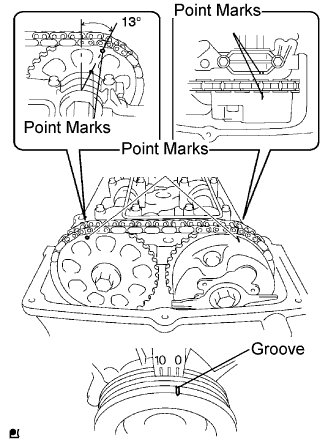
4.CHECK VALVE TIMING (CHECK FOR LOOSE AND JUMPED TEETH ON TIMING CHAIN)


    G038285E01
  1. Remove the cylinder head cover .

  1. Turn the crankshaft pulley, and align its groove with the timing mark "0" on the timing chain cover.

  1. Check that the point marks on the camshaft timing gears are as shown in the illustration.
    If not, turn the crankshaft 1 revolution (360°) and align the marks as above.

    OK:
    Point marks on the camshaft timing gears are aligned as shown in illustration.

  1. Reinstall the cylinder head cover .


NG
ADJUST VALVE TIMING
OK


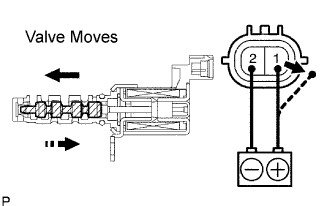
5.INSPECT CAMSHAFT TIMING OIL CONTROL VALVE ASSEMBLY (OCV)


    A097066E04
  1. Remove the OCV.

  1. Measure the resistance between the terminals of the OCV.

    Standard Resistance:
    6.9 to 7.9 Ωat 20°C (68°F)

  1. Apply the positive battery voltage to terminal 1 and negative battery voltage to terminal 2. Check the valve operation.

    OK:
    Valve moves quickly.

  1. Reinstall the OCV.


NG
REPLACE CAMSHAFT TIMING OIL CONTROL VALVE ASSEMBLY
OK


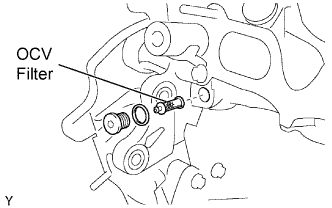
6.INSPECT OIL CONTROL VALVE FILTER


    G034998E02
  1. Remove the OCV filter.

  1. Check that the filter is not clogged.

    OK:
    Filter is not clogged.

  1. Reinstall the OCV filter.


NG
CLEAN OIL CONTROL VALVE FILTER
OK

REPLACE CAMSHAFT TIMING GEAR ASSEMBLY