Home › TRANSMISSION · A340E AUTOMATIC TRANSMISSION › AUTOMATIC TRANSMISSION SYSTEM

DTC    P0712    Transmission Fluid Temperature Sensor "A" Circuit Low Input

DTC    P0713    Transmission Fluid Temperature Sensor "A" Circuit High Input

for Preparation Click here


DESCRIPTION

The ATF (Automatic Transmission Fluid) temperature sensor converts the fluid temperature into a resistance value which is input into the ECM. The No. 2 ATF temperature sensor is on the transmission, just before the oil cooler inlet pipeline.

HINT:
The ATF temperature is liable to increase under conditions such as towing, climbing hills and in traffic.


The table below shows the symptoms and recovery conditions for when the sensor is normal and when the sensor has a short circuit. 
No. 2 ATF Temperature Sensor Status
Detection Condition
Symptom
Recovery Condition
Sensor is normal
  1. ATF temperature more than 130°C (266°F)
  1. Shift point too low
  1. ATF temperature less than 125°C (257°F)
Sensor is normal
When conditions (a) and (b) are satisfied continuously.
(a) ATF temperature more than 130°C (266°F)
(b) Engine coolant temperature more than 98°C (208.4°F)
  1. Lock-up in 4th or 3rd gear *1
  1. ATF temperature less than 110°C (230°F) and engine coolant temperature less than 98°C (208.4°F)
Sensor circuit is short circuited
  1. Any conditions
  1. Shift point too low
  1. Symptoms still occur
Sensor circuit is short circuited
  1. Engine coolant temperature more than 95°C (203°F)
  1. Lock-up in 4th or 3rd gear *1
  1. Symptoms still occur

HINT:
*1: When the ATF temperature is normal, the transmission locks up in 4th gear with the shift lever in the D position and in 3rd gear with the shift lever in the 3rd position.


DTC No.
DTC Detection Condition
Trouble Area
P0712
No. 2 ATF temperature sensor resistance is less than 79 Ω for 0.5 seconds or more. (1-trip detection logic)
  1. Short in No. 2 ATF temperature sensor circuit
  2. No. 2 ATF temperature sensor
  3. ECM
P0713
No. 2 ATF temperature sensor resistance is more than 156 kΩ for 0.5 seconds or more, or either of the following conditions is met (1-trip detection logic):
  1. Open in No. 2 ATF temperature sensor circuit
  2. No. 2 ATF temperature sensor
  3. ECM
Condition (A):
15 minutes or more have elapsed after the engine start when engine coolant temperature or intake air temperature is -0.625°C (30.875°F) or less. (1-trip detection logic)
Condition (B):
10 seconds or more have elapsed after the engine start when engine coolant temperature and intake air temperature are more than -0.625°C (30.875°F). (1-trip detection logic)

MONITOR DESCRIPTION

The Automatic Transmission Fluid (ATF) temperature sensor converts the ATF temperature to an electrical resistance value. Based on the resistance, the ECM determines the ATF temperature, and detects any open or short malfunctions in the ATF temperature circuit. If the resistance of the ATF temperature is less than 79 Ω or more than 156 kΩ, the ECM interprets this as a fault in the ATF temperature sensor or its wiring. The ECM stores a DTC.

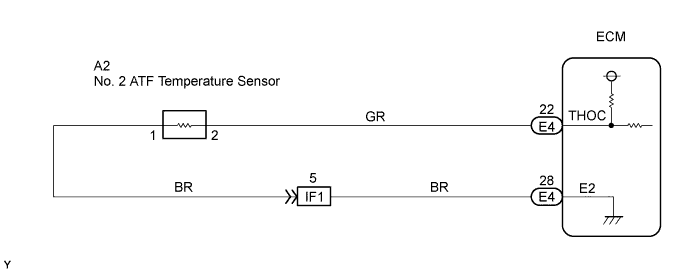
WIRING DIAGRAM


C121784E01


INSPECTION PROCEDURE

NOTICE:
Perform the universal trip to clear permanent DTCs (Click here).

HINT:
According to the Data List displayed by Techstream, you can read the values of switches, sensors, actuators and so on without removing parts. Reading the Data List as the first step of troubleshooting is one method to save time.

NOTICE:
In the table below, the values listed under "Normal Condition" are reference values. Do not depend solely on these reference values when deciding whether a part is faulty or not.

  1. Warm up the engine.
  2. Turn the ignition switch off.
  3. Connect Techstream to the DLC3.
  4. Turn the ignition switch to ON.
  5. Turn the Techstream on.
  6. Enter the following menus: Powertrain / Engine and ECT / Data List / All Data.
  7. According to the display on the Techstream, read the Data List.

    Engine and ECT 
    Tester Display
    Measurement Item/Range
    Normal Condition
    Diagnostic Note
    A/T Oil Temperature 3
    No. 2 ATF temperature sensor value/
    Min.: -40°C (-40°F)
    Max.: 215°C (419°F)
    1. Approximately 80°C (176°F): After stall test
    2. Equal to ambient temperature when engine cold
    If value is -40°C (-40°F) or 215°C (419°F), No. 2 ATF temperature sensor circuit is open or short circuited

    HINT:
    When DTC P0712 is output and Techstream reading is 150°C (302°F) or more, there is a short circuit.
    When DTC P0713 is output and Techstream reading is -40°C (-40°F), there is an open circuit.
    Check the temperature displayed on the tester in order to check if a malfunction exists.


    Temperature Displayed
    Malfunction
    -40°C (-40°F)
    Open circuit
    160°C (320°F) or more
    Short circuit

    HINT:
    If a circuit related to the ATF temperature sensor becomes open, P0713 is immediately set (in 0.5 seconds).

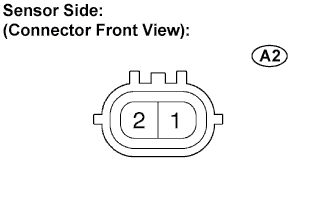
1.INSPECT TEMPERATURE SENSOR
A085194E02
  1. Disconnect the ATF temperature sensor connector from the transmission.

  1. Measure the resistance between the sensor connector terminals.

    Standard resistance:
    Tester Connection
    Specified Condition
    1 - 2
    79 Ω to 156 kΩ
    1 - Body ground
    10 kΩ or higher
    2 - Body ground
    10 kΩ or higher

    HINT:
    If the resistance is outside the specified range at either of the ATF temperatures shown in the table below, the driveability of the vehicle may decrease.

    ATF Temperature:
    Resistance:
    20°C (68°F)
    10.3 to 13.9 kΩ
    110°C (230°F)
    0.68 to 0.88 kΩ


NG
REPAIR OR REPLACE TRANSMISSION WIRE (Click here)
OK


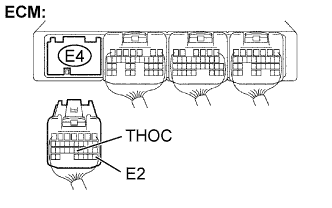
2.CHECK HARNESS AND CONNECTOR (ATF TEMPERATURE - ECM)
C095813E06
  1. Connect the transmission wire connector.

  1. Disconnect the ECM connector.

  1. Measure the resistance according to the value(s) in the table below.

    Standard resistance:
    Tester Connection
    Specified Condition
    E4-22 (THOC) - E4-28 (E2)
    79 Ω to 156 kΩ
    E4-22 (THOC) - Body ground
    10 kΩ or higher
    E4-28 (E2) - Body ground
    10 kΩ or higher


NG
REPAIR OR REPLACE HARNESS OR CONNECTOR
OK

REPLACE ECM (Click here)